logo
Already a member? Login here

Movie Rental´s archives ↓

One Final Trailer for ‘Morbius’ Vampire Movie Starring Jared Leto

One Final Trailer for ‘Morbius’ Vampire Movie Starring Jared Leto

by
February 28, 2022
Source: YouTube

Morbius Trailer

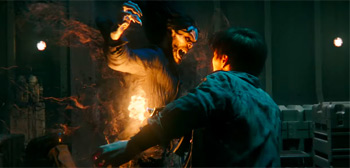
“We all have monsters within us… it’s up to us to control it.” Sony Pictures has revealed the third final official trailer for Morbius, co-produced by Marvel Studios starring Jared Leto as the “superhero” known as Morbius the Living Vampire. The story follows a brilliant biochemist named Michael Morbius who tries to cure himself of a rare blood disease, but inadvertently infects himself with a form of vampirism instead. And thus he becomes “the living vampire” – though is he a villain or a hero? The cast includes Matt Smith, Adria Arjona, Jared Harris, Al Madrigal, Charlie Shotwell, and Tyrese Gibson. We posted the first trailer for this way back in 2020, and after numerous delays it’s finally set to open in April this year. Sony really wants this to be another epic Marvel hit but this just doesn’t seem to have the chops to pull that off. They even put in that “a new Marvel legend arrives” voice at the end. Does anyone think this looks good?

Here’s the third final trailer (+ psoter) for Daniel Espinosa’s Morbius, direct from Sony’s YouTube:

Morbius Movie

You can rewatch the first 2020 teaser for Daniel Espinosa’s Morbius here, or last year’s new trailer here.

One of Marvel’s most compelling and conflicted characters comes to the big screen as Oscar winner Jared Leto transforms into the enigmatic antihero, Michael Morbius. Dangerously ill with a rare blood disorder, and determined to save others suffering his same fate, Dr. Morbius attempts a desperate gamble. What at first appears to be a radical success soon reveals itself to be a remedy potentially worse than the disease. Morbius is directed by Swedish filmmaker Daniel Espinosa, director of the films Babylonsjukan, Outside Love, Snabba Cash, Safe House, Child 44, and Life previously. The screenplay is written by Matt Sazama and Burk Sharpless, based on the comic book character created by Roy Thomas and Gil Kane. Produced by Avi Arad, Lucas Foster, Matt Tolmach; and it’s co-produced by Marvel Studios. Sony will release Espinosa’s Morbius in theaters everywhere starting on April 1st, 2022 this spring. Anyone want to watch this or not?

Find more posts: Marvel, To Watch, Trailer

Jane Campion & Maggie Gyllenhaal Win 2022 Directors Guild Awards

Jane Campion Maggie Gyllenhaal Win 2022 Directors Guild Awards

by
March 13, 2022
Source: DGA

This weekend, the winners of the 74th Annual DGA Awards were announced in Los Angeles. We’re in the last few weeks of the awards season this year, with only a few big ones left to go. This year, the New Zealand filmmaker Jane Campion won the top prize for Best Film for The Power of the Dog, along with Maggie Gyllenhaal winning Best First Film for The Lost Daughter. Loved both of these films and I’m very happy for both of them to win. This is the first time ever in DGA history that two women have won both of these awards together. In addition, Stanley Nelson won the Documentary prize for his superb film Attica (watch the trailer); and filmmaker Barry Jenkins won the Series prize for his show The Underground Railroad. The Directors Guild Awards are one of the premiere prizes in Hollywood, honoring “Outstanding Directorial Achievement” in many different categories. Congrats to all of the winners and all of the nominees this year.

The winners of the Directors Guild of America Outstanding Directorial Achievement Awards for 2021 were announced on Saturday, March 12th, during the 74th Annual DGA Awards Dinner at the Beverly Hilton in Los Angeles, California. You can check out the full list of this year big’s winners, which also includes other honors for directing for TV series and commercials, via the official DGA website. Congrats to Campion!

For the 74th annual DGA Awards honoring films from 2021, The Power of the Dog’s director Jane Campion won over fellow filmmaker nominees: Paul Thomas Anderson for Licorice Pizza, Kenneth Branagh for Belfast, Steven Spielberg for West Side Story, and Denis Villeneuve for Dune. An outstanding set of nominees, though I’d remove Branagh (I did not care for Belfast much) and put in Ryûsuke Hamaguchi for Drive My Car or Sian Heder for CODA instead. As for the Best First-Time Feature, The Lost Daughter’s Maggie Gyllenhaal won over fellow nominees: Rebecca Hall for Passing, Tatiana Huezo for Prayers for the Stolen, Lin-Manuel Miranda for tick, tick… Boom!, and also Michael Sarnoski for Pig. All of ten of these films are worth seeing if you haven’t watched them yet. Congrats to all of the nominees and honorees from 2021. Coming up next, the Academy Awards are on March 27th wrapping up the 2021 awards season.

Also from this year’s awards: Spike Lee was given the Lifetime Achievement Award, and Joseph P. Reidy was given the Frank Capra Achievement Award for an Assistant Director or Unit Production Manager in recognition of career achievement in the industry. The previous winners of the Directors Guild Award prize include: Guillermo del Toro for The Shape of Water (2017), Alfonso Cuarón for Roma (2018), Sam Mendes for 1917 (2019), and Chloe Zhao for Nomadland (2020). The DGA Awards have been given out since 1948.

Find more posts: Awards, Movie News

Displaced Kashmiri Pandits Will Be Able to Return to Valley Soon: RSS Chief

He also praised The Kashmir Files’ movie, saying it has created public awareness across the country and outside about the reality behind the exodus of Kashmiri pandits from the valley in 1990.(Twitter/RSS File photo)

110 years after it sank, Titanic continues to capture the public’s imagination

Although it sank 110 years ago during its maiden voyage, the RMS Titanic looms as large in the public’s imagination today as it ever did.

The stories associated with the great White Star Line ocean liner have moved seamlessly from traditional media — books and films — to social media where they continue to captivate.

Titanic struck an iceberg while speeding toward New York. It sank 700 nautical miles (1,296 kilometres) east of Halifax on April 15, 1912.

Roger Marsters, curator of the Maritime Museum of the Atlantic in Halifax, says Titanic’s connection to Halifax was almost incidental as it was the nearest mainland port from which a recovery could be mounted.

Roger Marsters is curator of the Maritime Museum of the Atlantic. (Craig Paisley/CBC)

Titanic had a grip on the collective imagination prior to James Cameron’s 1997 film, Marsters said. But, by attaching star-crossed lovers to a story of hubris and extravagance, the film fixed the events in the public’s imagination.

“We have people from all over the world coming to Fairview Lawn and to Mount Olivet to visit the graves of people they’ve never met and have never known, but with whom they feel a strong connection because of the powerful, imaginative grip of the Titanic story,” he said.

Rafael Avila shares Titanic information on his social media platforms as the Titanic Guy. (© 2017 Stephen James Hutchinson)

As the port where recovered bodies were brought to in the wake of the tragedy, Halifax is home to 150 Titanic graves — the most in the world.

Marsters said the Titanic story seems to refresh itself with each generation. From the point of view of the museum, it is a way to bring new people to maritime history.

Rafael Avila, a 32-year-old social media personality better known online as the Titanic Guy, spends his time presenting trivia about Titanic and correcting inaccurate information about the ship he sees online.

Leonardo DiCaprio and Kate Winslet, left, are shown in the movie Titanic. (paramount Pictures/Associated Press)

His TikTok channel has over 600,000 subscribers and almost 34 million likes.

Avila said he was seven in 1997 when he saw a documentary about a ship that sank and he asked his father what it was about. 

Titanic graves at Fairview Lawn Cemetery in Halifax. (Vernon Ramesar/CBC)

His father told him it was about a famous ship that was one of the biggest in the world and was brand new when it sank.

Fascinated by the story, Avila said he convinced his parents to take him to see the popular film in December of that year and that solidified his interest.

Avila said that the Titanic story was largely forgotten in the years after the sinking.

The book A Night to Remember, published in 1955, and a subsequent film in 1958 rekindled interest, he said.

The release of Cameron’s film led to an exponential growth in interest, according to Avila, and it then moved into the sphere of social media.

“It represented all these different things, grandeur, hope, opportunity, and then for it to come crashing down with something so simple as an iceberg,” Avila said. “It was like a theatre that played out in the middle of the ocean.”

Historian and author Bob Chaulk has written two books on the SS Atlantic. (Jon Tattrie/CBC)

The Toronto-based Avila said he has never been to Halifax but he knows he will visit one day to see artifacts and visit the Titanic graves in person.

Although Titanic is undoubtedly the most famous of them, three ships connected to the company left an indelible mark on the province.

In 1873, the SS Atlantic crashed into a rock near Prospect Bay, resulting in the deaths of around 550 people. 

According to Bob Chaulk, the author of two books on the SS Atlantic, the ship bound for New York had 950 passengers on board. 

Chaulk said the chief engineer determined a week into the journey that there wasn’t enough coal on board. The captain decided to divert to Halifax to refuel, which would turn out to be a fatal decision.

Victims of the SS Atlantic are rescued from the wreck on April 1, 1873. (Nova Scotia Archives [William Notman photograph, W.R. MacAskill accession no. 1987-453 no. 3249])

Of the four deck officers, Chaulk said, only one had sailed into Halifax before. 

As the ship approached Halifax at night, the ship ran aground on a rock that was quite close to shore. The bow of the ship rode up on the rock and the stern immediately submerged, Chaulk said. 

Because it happened in the early hours of the morning, Chaulk said most passengers were below deck with women and children sleeping below deck in the stern area. 

Some of the victims of the wreck of the SS Atlantic were buried in a mass grave in Terence Bay. (Nova Scotia Archives/W.Chase, neg. no.: N-0719)

No women survived the disaster and only one child was rescued.

“It was [3 a.m.], some of them just drowned in their beds, didn’t even get out of bed,” he said.

Chaulk said the real miracle to him was that 400 people survived. He said that was largely because of the heroic efforts of residents of Lower Prospect and Terence Bay who mounted a rescue effort.

A monument to those who perished on the SS Atlantic was erected in Prospect in 1915. (CBC)

To this day it remains the worst shipwreck in Nova Scotia history and the second worst in Canadian history after the Empress of Ireland, according to Chaulk.

In 1917, the former White Star Line SS Runic had by far the biggest impact on the history of Nova Scotia.

From its launch date in 1889 until the vessel was sold in 1895, it served to carry livestock and passengers for the White Star Line. 

On Dec. 6, 1917, the ship, by then renamed the SS Imo, collided with the ammunition ship SS Mont-Blanc in Halifax harbour, triggering an explosion that killed 1,600 people and caused widespread destruction.

Victorian tourists visit the site of the SS Atlantic in Terence Bay, N.S. (Nova Scotia Archives [W. Chase no. 32/neg. no.: N-0720])

Marsters said the Maritime Museum of the Atlantic has artifacts and exhibits from all three White Star Line vessels.

He said in some ways the story of the three ships is also a story of how Nova Scotians respond to tragedy.

“These three quite well-known White Star wrecks are indicative of broader processes of maritime activity that have meant that, for hundreds of years, people living in Mi’kma’kipeople living in Nova Scotia, have always stood by to help people who are in peril at sea,” he said.

“I think that’s a legacy that continues today and that is valuable to continue to cultivate.”

MORE TOP STORIES

New Re-Release Trailer for 70s Stuntman Action Movie ‘Stunt Rock’

New Re-Release Trailer for 70s Stuntman Action Movie ‘Stunt Rock’

by
February 28, 2022
Source: YouTube

“It’s super human! Super music. Super magic. And super amazing.” Kino Lorber has dropped a new trailer for the long lost action classic Stunt Rock, an Australian stuntman film from 1978 that’s being re-released as a 4K restoration. While working on a TV show in L.A., famed Australian stuntman Grant Page helps an up-and-coming fantasy-themed rock band develop special FX and dangerous stunts for their act. “Exploding onto screens nationwide March 25!” Helmed by Ozploitation legend Brian Trenchard-Smith (of BMX Bandits, Deathcheaters), Stunt Rock is a breathless, action-packed 90-minute trailer. Footage from other of his films (as well as licensed clips from the original Gone in 60 Seconds) pad out the impressive new stunts and the Spinal Tap-esque musical excursions of Sorcery, featuring an on-stage battle between good and evil, magic, a wizard, and a flame-throwing devil… Stunt Rock is danger as you never imagined it! Uh this sounds and looks totally badass, why did no one tell me about this film before?! I need to watch this! What a trailer.

Here’s the new re-release trailer for Brian Trenchard-Smith’s Stunt Rock, direct from YouTube:

Part documentary, part rock film, and all kinds of crazy. Stunt Rock from 1978 is a feature length ode to fearless Australian stuntman Grant Page (of the Mad Max films, Road Games, The Gods Of Egypt). Real-life stuntman Grant Page travels to Los Angeles to work on a television series, and in his spare time lends his expertise to his cousin’s rock band Sorcery – helping them develop pyrotechnic magic tricks for their stage shows. All while finding himself in a budding romance with reporter Lois Wills (Margaret Gerard). Stunt Rock is directed by Anglo Australian filmmaker Brian Trenchard-Smith, his third feature film at the time, just a few years before he’d go on to make BMX Bandits in the 1980s. The screenplay is written by Paulmichel Mielche Jr. and Brian Trenchard-Smith. The film originally showed up in the US in 1980, after first opening in the UK back in 1978. Kino Lorber will re-release the action classic Stunt Rock in select US theaters nationwide starting March 25th, 2022. For more info, visit the official site. Who wants to watch?

Find more posts: To Watch, Trailer

The Kashmir Files: Section 144 enforced in Rajasthan’s Kota in view of film’s screening

Authorities in Rajasthan’s Kota have imposed Section 144 in the city from March 22 to April 21 in order to maintain law and order during the screening of the recently released film ‘The Kashmir Files.’

“Section 144 will be imposed in Kota from tomorrow, March 22, till April 21, in view of maintaining law order with the screening of ‘The Kashmir Files’,” read the order.

According to the order, there should be no crowd gathering to watch the movie. The upcoming festival in the district should be conducted in a ceremonial manner and people should not take baths in rivers, including canals.

On the order of imposing Section 144, Kota North ex-BJP MLA Prahlad Gunjal hit out at the government, saying, “A huge ‘Chandi march’ will be held in the Kota North assembly constituency on Tuesday, therefore Section 144 was imposed and ‘The Kashmir Files’ is just an excuse.”

“Earlier, a similar clause was invoked a day before the protest. Women and girls are being raped, and a minister terms Rajasthan as ‘the state of men’. This has hurt the self-esteem of women. They will proceed with the rally tomorrow,” he added.

“The government is so scared that Section 144 has been imposed. No power in the world can stop the ‘Chandi March’ tomorrow, whether the police resort to lathi-charge or arrest,” stated Gunjal.

The Vivek Agnihotri-directed film, which depicts atrocities against Kashmir Pandits and their displacement due to Pakistan-backed terrorists, has become a huge box office success, despite critics accusing the filmmakers of communalism in the way the narrative is framed.

Several states, including Madhya Pradesh, Haryana, Uttar Pradesh, Gujarat, Tripura, Goa, and Uttarakhand, have declared the film tax-free to encourage people to watch the Anupam Kher-starrer.

As of Sunday, the film’s total earnings had surpassed Rs 167 crore, with a final tally of Rs 167.45 crore. On Friday, the film earned Rs 19.15 crore, and on Saturday, it earned Rs 24.80 crore.

The film’s total collections have crossed Rs 167 crore to settle at Rs 167.45 crore. The film raked in Rs 19.15 crore on Friday and went on to collect Rs 24.80 crore at the box office on Saturday.

(With inputs from Sanjay Verma)

READ | Donate ‘The Kashmir Files’ earnings to charity, says MP IAS officer; Vivek Agnihotri responds

READ | Aamir Khan urges every Indian to watch The Kashmir Files, says he’s happy with the film’s success

Batgirl’s Leslie Grace on Working with Keaton, Fraser, and Her Hero’s Future

The upcoming Batgirl movie is expected to be a pretty big deal when it hits HBO Max in the near future. Not just in the sense that it’s the first cinematic outing for Barbara Gordon since Batman Robin all the way back in 1997, but also for bringing Michael Keaton back as the Caped Crusader. Sure, we’ve known for awhile that he would be back for the role thanks to news surrounding the oft-delayed Flash movie, but there’s still something to be said for seeing him come back as an older Bruce Wayne and potentially taking a protégé under his wing.

While speaking to Variety about the film, star Leslie Grace was asked about the feeling of seeing Keaton back in action, which she described as “wild for everyone.” She was, of course, very vague about what to expect from Keaton in the film, but she called working with him “the stuff of her dreams, I couldn’t even believe that I was sharing space with Batman.” It was also equally surreal for her to work with Brendan Fraser, who plays the film’s villain Firefly. “I’m not supposed to like him, but he’s such a huge teddy bear,” continued Grace. Praising his previous action movie experience thanks to The Mummy franchise, she teased the fight scenes in store: “There’s crazy fire. Crazy stunts, crazy drops. She’s [Batgirl] a biker chick, so you’re going to see her do a bunch of badassery.”

Batgirl is Grace’s second role after last year’s In the Heights, and the sensation of playing a superhero only hit her once she finally donned the costume for the first time. “That was the first real moment where I was like, ‘Oh, wow, we’re here. I’m doing this. Like, I am really Batgirl.’” Being a superhero, she admitted, was rather overwhelming, to the point where she didn’t think to ask previous Batgirl Alicia Silverstone or Gal Gadot for their experiences. She didn’t go in completely blind, though: she reached out to Sasha Calle, the Supergirl of the Flash movie, and Blue Beetle’s Xolo Maridueña. “I’m hoping we get to meet soon, because we’re part of the new gen.”

In Grace’s words, there’s “so much” that happens in the Batgirl movie. ““There’s this love story, there’s this father-daughter relationship. There’s looking at the world through a lens that isn’t just black and white.” With how popular Batman media tends to be, she was naturally asked about the possibility of seeing her Babs again in the future. Even though the DC films are in frequent (if not constant) flux, she did admit that there’s currently discussions about a second Batgirl film. But obviously, nothing concrete yet. “We’ve already been talking about where do we take this from here,” she said. “But we got to see this one first. There’s definitely some talks about what it could be.”

Batgirl will release on HBO Max later this year.


Wondering where our RSS feed went? You can pick the new up one here.

Intuitive touchscreen, countdown clock and happy finishing chime bring a little bit of joy to toasting.
InstaGLO sears bread without drying it, locking in 30% more moisture than the leading premium toasters.

New Trailer for Japanese Anime Film ‘Bubble’ Made by Tetsuro Araki

New Trailer for Japanese Anime Film ‘Bubble’ Made by Tetsuro Araki

by
March 1, 2022
Source: YouTube

“Gravity is broken – leap as you like.” Netflix has debuted the full-length trailer for a new anime film called Bubble, from “Death Note” and “Attack on Titan” filmmaker Tetsuro Araki. Here’s the concept: The story is set in Tokyo, after bubbles that broke the laws of gravity rained down on the world. Cut off from the outside world, Tokyo has become a playground for a group of young people who have lost their families, acting as a battlefield for parkour team battles as they leap from building to building. Hibiki, a young ace known for his dangerous play style, makes a reckless move one day and plummets into the gravity-bending sea. His life is saved by Uta, a girl with mysterious powers. The pair then hear a unique sound audible only to them. Why did Uta appear before Hibiki? Their encounter leads to a revelation that will change the world. The voice cast features Jun Shison, Mamoru Miyano, Yuki Kaji, and Tasuku Hatanaka. This looks super trippy and creative, with so many ambitious ideas in one movie. What is going onnn?! Halfway through this trailer it gets extra wild! Netflix will be releasing this movie for streaming worldwide at the end of April. Jump in.

Here’s the full-length trailer (+ poster) for Tetsuro Araki’s Bubble, direct from Netflix’s YouTube:

You can rewatch the first teaser for Tetsuro Araki’s Bubble movie here, to see the first look again.

The story is set in Tokyo, after bubbles that broke the laws of gravity rained down upon the world. Cut off from the outside world, Tokyo has become a playground for a group of young people who have lost their families, acting as a battlefield for parkour team battles as they leap from building to building. Hibiki, a young ace known for his dangerous play style, makes a reckless move one day and plummets into the gravity-bending sea. His life is saved by Uta, a girl with mysterious powers who appears suddenly. The pair then hear a unique sound audible only to them. Why did Uta appear before Hibiki? Their encounter leads to a revelation that will change the world. Bubble, also known as バブル in Japanese, is directed by acclaimed Japanese anime filmmaker Tetsuro Araki, of the series “Death Note” and “Attack on Titan”, as well as a few spin-off Attack on Titan movies and other anime. The screenplay is written by Gen Urobuchi; with character designs by Takeshi Obata. And music by Hiroyuki Sawano. It’s made by WIT Studio in Japan. Netflix will debut Araki’s Bubble movie streaming starting April 28th, 2022 in the spring. Want to watch?

Find more posts: Animation, Foreign Film, To Watch, Trailer

Learn About Judd Apatow’s Epic ‘Cliff Beasts’ Action Movie Franchise

Learn About Judd Apatow’s Epic ‘Cliff Beasts’ Action Movie Franchise

by
March 3, 2022
Source: YouTube

“Light the sky on fire!!” Netflix has revealed a teaser and a full-length retrospective featurette promoting the new movie Cliff Beasts 6: The Battle For Everest. Don’t know anything about the other Cliff Beasts movies? Well find out more below! Want a quick reacap on what you’ve missed in the Cliff Beast Universe? This video covers everything including what’s going on, who is in it, and why there is already a sixth movie you didn’t know about. Cliff Beasts 6: The Battle For Everest stars Pedro Pascal, Karen Gillan, Leslie Mann, Iris Apatow, David Duchovny, Keegan-Michael Key, and Guz Khan. Here’s the deal – this is all just some clever, fun viral marketing for Judd Apatow’s new movie called The Bubble – about group of actors and actresses stuck inside a pandemic bubble at a hotel trying to complete the film. That film is Cliff Beasts 6, and these are the “real” stars of it. The Bubble even opens on April Fools Day next month, which couldn’t be more perfect – right? This is such a great way to introduce this wacky new comedy to the world.

First teaser for Judd Apatow’s Cliff Beasts 6: The Battle For Everest + a retrospective, from YouTube:

Humankind is threatened once again by a dinosaur species: Cliff Beasts. The team must reunite again, after five long years, to battle the Cliff Beasts – but this time on Mount Everest. “So get ready, 2022. Carol Cobb renegotiates her way back onto the team—alongside fresh faces Dieter Bravo and Kristal Kris—in this spring’s hotly-acknowledged tentpole.” Cliff Beasts 6: The Battle For Everest is the latest movie in the ongoing Cliff Beasts franchise, which originally kicked off in 2009 with the very first Cliff Beasts movie. Cliff Beasts 6: The Battle For Everest is both written and directed by American comedy filmmaker Judd Apatow, director of the comedy movies The 40-Year-Old Virgin, Knocked Up, Funny People, This Is 40, Trainwreck, and The King of Staten Island previously. The screenplay is also co-written by Pam Brady. Produced by Judd Apatow. Netflix will debut this latest Cliff Beasts movie, as well as a special feature called The Bubble playing with it streaming on Netflix starting April 1st, 2022 this spring. Who’s excited for this?

Find more posts: To Watch, Trailer, Viral Marketing

The dangerous ‘truth’ of The Kashmir Files | Cinema

A man wearing the saffron turban and robes of a Hindu preacher stands against the plush red interior of a cinema. In one hand he carries a shiny steel trident, a traditional weapon of Hindu gods, and in the other a mobile phone. As the music flows over the end titles of the film the bearded swami begins a chilling exhortation. “You have all seen what happened to the Kashmiri Hindus,” he says, gesturing towards the screen. “That is why Hindus must protect themselves against the treachery of Muslims and prepare to take up arms.”

“If a Hindu’s blood does not boil,” he raises his voice, prompting his audience to respond: “That’s not blood – it’s water!”

The video is emblematic of public life in the India of 2022, and it was only one of many that tore across the internet following the release of The Kashmir Files, a controversial Bollywood film that opened in an impressive 600 cinemas across India on March 11.

The film is set in 1990, amid the first stirrings of the anti-India rebellion that has roiled Indian-administered Kashmir for three decades, and persists into the present. It promises to tell the story of the flight from Kashmir of the Pandits, a small Hindu minority among the region’s predominantly Muslim population. Early reviews in the Indian media had found the film deeply Islamophobic, dishonest, and a provocation, and even before the film was released its trailer had invited public interest litigation on the grounds that its “inflammatory scenes are bound to cause communal violence”. In his defence, the filmmaker had insisted that “every frame, every word in my film is truth”.

A few days after The Kashmir Files was released, it received an unusual stamp of approval. “All of you should watch it,” India’s Prime Minister Narendra Modi told a meeting of the governing Bharatiya Janata Party’s (BJP) parliamentary group. “The film has shown the truth which has been suppressed for years. The truth prevailed in Kashmir Files,” Modi said. This resounding endorsement of the film’s claim to the truth, as well as the suggestion that this truth had been suppressed in the past, was an early marker of the political capital that was being invested in the film.

As a documentary filmmaker and writer whose work has centred on Kashmir for almost two decades, I have always been confounded by the facts – or the lack of them – of the departure of the community in 1990. My community, I should say, for, I am a Kashmiri Pandit. There is little clarity about even the most elementary things.

What can we say with certainty? We can say that from the middle of 1989 onwards, Kashmir witnessed the targeted killings of several significant figures of its Hindu minority, leading to widespread panic and insecurity. In these same months, many Muslims were also assassinated in Kashmir – political workers, policemen, and government officials. All this was part of the wider political upsurge of this period, presaging events that were to soon upturn the established order of things. We also know that early in 1990 some Kashmiri Pandit families began to flee in fear. Their leaving was probably intended as a temporary move though it was to prove tragically permanent for most.

In the decade that followed, Kashmir continued to be racked by mass protests as well as a full-blown armed uprising that aimed at nothing less than freedom from India. The brutal counterinsurgency that followed was to overwhelm life for all those who lived in Kashmir, and the violence and continuing fear led to steady departures of its Pandit minority, and also of a significant number of Muslims. We know that the final waves of Kashmiri Pandit departures followed two horrific massacres – of 23 civilians at Wandhama in 1998 and of 24 men, women and children at Nadimarg in 2003.

We also know that despite all this, at least 4,000 Kashmiri Pandits never left their homes. They have continued to live in Kashmir, not in secure ghettos, but scattered across the valley. Living in what often feels like a war zone, without extended networks of family and community, their lives are not easy. But nor is life easy for their Muslim neighbours, with whom they live in what has come to be recognised as one of the most militarised zones in the world.

Even as a large number of critics found The Kashmir Files filled with factual inaccuracies, propagandist, and frightening in its relentless targeting of every Muslim represented on screen, the film continued its blitz across the box office in India. Mobilised by the cadres of the right-wing, groups of men showed up at theatres waving the Indian tricolour. Screenings frequently ended amid sloganeering and speeches, with people competing in their provocations, with brazen calls for violence against all Muslims, not just Kashmiri Muslims. These highly visible reactions were amplified through the extensive social media infrastructure of the right wing, what is often derisively called the “WhatsApp University”. Through all of this, it was relentlessly underlined that The Kashmir Files is revealing a truth that had been suppressed in the past.

The assertion that this “truth” was suppressed was odd, given that the BJP and its cohort have aggressively promoted their version of events in Kashmir since at least the mid-1990s. In this version, the expulsion of the Kashmiri Pandits was dated to one day (January 19, 1990), accompanied by an insistence that their exodus was the consequence of widespread killings, the looting and burning of Pandit homes and temples, and a high incidence of sexual violence against Pandit women. The community were victims of a genocide, the argument went, and this was framed as part of the larger threat to Hindu civilisation that only the BJP and its cohort could counter.

Although my own interest was in the facts surrounding the flight of the Kashmiri Pandits, I was also curious about the truth that was being alluded to in the film. For everything around that period has long remained shrouded, not least because it never received any serious attention from journalists and scholars, and certainly not from the government, state or federal – not even when it was led by the BJP.

The simplest questions fail to yield reliable answers. How many Kashmiri Pandits lived in the valley prior to 1990? The figures conjured up by the right-wing fluctuate between 500,000 and 700,000, although considered estimates place it at about 170,000. How many of them left the Kashmir Valley after 1990? A recent response by the region’s Relief and Rehabilitation Commissioner placed the figure at 135,426, although on inflamed television debates the needle again fluctuates between 500,00 and 700,000, and can inexplicably go up to a million. How many Kashmiri Pandits were killed in the conflict? In conversations around The Kashmir Files, the figure has hovered around 4,000, although the most recent figures provided by the region’s police department put it at 89. Earlier official estimates had said 270, while Kashmiri Pandit Sangharsh Samiti, a Kashmir-based citizens group, had arrived at a figure of about 700. When did they leave? And that most vexed of all: what were the circumstances that made people leave? None of these can be answered with any degree of certainty.

It is through this fog of claims and obfuscations that The Kashmir Files has emerged, asserting for itself nothing less than the truth of the “Kashmir genocide”. The evidence offered is oral, arrived at out of interviews with “700 first-generation victims” its filmmakers insist, crosschecked with historians “with credentials”, academics and experts on Kashmir, as well as administrators and police officers who were posted there at the time. This is why the disclaimer discretely wedged in the film’s opening credits took me by complete surprise: “This film… does not claim accurateness or factuality of historic events”.

Presented as a work of fiction, The Kashmir Files is freed of the constraints that the facts gathered by its makers may pose. The film is therefore able to give a potent form to something that the right wing has been cooking for more than three decades, a singular version of what they call the truth of Kashmir. It is arrived at here by picking a few dreadful events from across a decade and a half of Kashmir’s recent history, and telescoping them into a gruesome narrative that spans what appears to be a year. This compression of tragic events is then heaped upon a single fictive family, and if that burden of sorrow was not already unbearable, embroidered with further acts of unspeakable cruelty such as when a diabolic “militant commander” forces a woman to swallow uncooked rice soaked in the blood of her just-murdered husband.

This incident references the brutal 1990 slaying of BK Ganjoo, a Pandit killed while hiding in a drum of rice in the attic of his home. The twist with the blood-soaked rice seems a more recent add-on. When asked about the incident some weeks ago, Ganjoo’s brother said he had never heard of it, and that his sister-in-law had never mentioned it either. Such egregious interpolations come along with more insidious ones. At a ration depot, a group of distraught Kashmiri Pandit women are denied access to food grain by their Muslim neighbours. Although this fact remains unverifiable, the extreme dehumanisation evinced in this unverifiable incident sets the tone for a more serious claim: that conditions in Kashmir in 1990 meet the definition of genocide.

This is a film that brutalises its audience with scenes of such extreme violence that it eventually silences the possibility of considering alternative narratives that we know to be true. I could think of few: although terrible tragedies did happen to many individuals, most Kashmiri Pandit families were not betrayed by their Muslim neighbours. While some properties were torched and destroyed, most temples and homes were not ransacked or looted, and many more have run to ruin over years of neglect. And although elements in the media, the bureaucracy, and the police may well have been neglectful of their responsibilities, not everyone – as the film suggests – colluded in the persecution of the Pandits.

Most critically, this myopic narrative succeeds in obscuring the fact that what happened in Kashmir in the 1990s was not centrally a conflict between Muslims and Hindus. It was an uprising against the Indian state. It did not arrive overnight either but had a past, which could be dated at least to 1947 and the vivisection of the princely state of Jammu Kashmir, and it came with a history that included other massacres and large-scale movements of population.

In constructing the truth about Kashmir out of the carcasses of facts, in irresponsibly mixing these with inflammatory fictions, The Kashmir Files hints at the larger agenda. This is articulated most clearly in a long monologue delivered towards the end of the film by its central protagonist, Krishna. All of India’s greatness is tied in with Kashmir, the young man suggests, and that is where everything flourished in ancient times – its scholarship, its science and medicine, its theatre, grammar and literature. Kashmir was a special place – our own Silicon Valley he says, in a banal but probably accurate rendition of what he has in mind. The departure of the Kashmiri Pandits in the 1990s signals the absolute nadir to which Hindu civilisation has been brought since, presumably by Muslim rule, and that shame must be corrected. The monologue suggests that the film is interested in more than setting right the truth about Kashmir in the 1990s. It is in fact positing a new one, this time constructed around the idea of the homeland, not just for Kashmiri Pandits but for all Hindus.

For over three decades, the BJP and its progenitors in the Rashtriya Swayamsevak Sangh (RSS) successfully energised a substantial Hindu vote bank around a promise. Their wilful destruction of the Babri mosque in Ayodhya in 1992 was meant to obliterate the shame of a mosque built upon the exact birthplace of Lord Ram several centuries before. The campaign to construct a magnificent temple at its site provided the lifeblood to its politics for almost a generation, and swept the BJP to power in India. In the symbolic imagination of the RSS, and of the other progenitors of the BJP, Kashmir has long waited in the wings. With The Kashmir Files, it is being yanked centre-stage, as a symbolic space that the forces of Hindutva can draw upon in the coming decades. That is why the formulations provided by the film have already become sacrosanct, and any challenge to it, anything that suggests a different view of events, no matter how small, must be silenced. If this means denying space to the views of those few Pandits who actually continue to live in Kashmir, or to those Pandits who live in the squalid refugee tenements in Jammu, if it means ignoring their pleas to not further inflame tensions between Hindus and Muslims, so be it.

Disapproval of the film is not being taken lightly. The only people criticising the film are those who support “terrorist groups”, the film’s director said recently. Would he like to respond to them? To this Vivek Agnihotri simply replied: “Why should I say anything to terrorists?” Meanwhile, the RSS came out openly in support of The Kashmir Files, calling it a documentation of “historical reality” and that “these are facts that must be presented to generations as facts”. On April 4, as Kashmiri Pandits celebrated Navreh, their new year, RSS chief Mohan Bhagwat ratcheted up support for the film – and for the Kashmiri Pandits. He asked them to take a pledge that it was not going to be long before there was a return home to Kashmir.

Eventually, The Kashmir Files is not about setting straight a historical record of Kashmir in the 1990s, or creating an environment that might ease the return home of a community in exile. Its narrative is instead powered by a visceral demonisation of the Kashmiri Muslim, one that renders reconciliation ever more difficult. And by connecting the return of the Kashmiri Pandit to the dream of a glorious ancient past, a political project that elides Kashmir’s complicated history of 700 years, it seeds the idea of a return to a Hindu homeland. This is an idea that is redolent with implications of dispossession and settlement. That is what makes its “truth” dangerous.

The views expressed in this article are the author’s own and do not necessarily reflect Al Jazeera’s editorial stance.

Page 51 of 221:« First« 48 49 50 51 52 53 54 »Last »