
Movie Rental´s archives ↓
Hollywood’s tragic history of on-set accidents
Updated 2:32 PM ET, Sat October 23, 2021
Global Cinema Series: ‘The Host’ – The Daily Free Press
Bong Joon-ho’s massively popular “Parasite” is the first foreign film to win Best Picture at the Academy Awards — a milestone in cinema history. But an underrated effect of the success of “Parasite” was that it also opened the door for a much larger audience to become familiar with Bong’s previous masterworks. The auteur had been a part of numerous films before the Oscar-winner — all of them being perfect examples of how to fuse social commentary with exciting visual storytelling. His 2006 film — “The Host” — is a standout in this regard.
In Post-Korean War South Korea, the United States’s influence cannot be understated. After the destruction of South Korea during the ’50s and ’60s, they relied on the United States’s continuous support in rebuilding not only through physical construction and monetary loans but in cultural recultivation. This led to the rapid U.S. modernization of South Korea.
The modernization seeped into cinema in South Korea. This was especially apparent through the 2000s — South Korean residents were consuming more U.S. films than South Korean ones. And the movies that were popular in South Korea routinely used the U.S. model of high-budget “hero versus villain” Blockbusters.
“The Host” (2006) didn’t shy away from the CGI and action thriller genre that was popular at the time. Instead, Bong leaned into the genre’s popularity as a vehicle to express his feelings on the Americanization of his country.
The movie opens with a reenactment of a true event from 2000 when a U.S. scientist demanded his Korean assistant pour extremely toxic formaldehyde down a drain that leads into the Han River.
A few scenes later, the nonfiction threat ends, and we realize that this creates a sea monster that comes to terrorize our protagonists for the entirety of the film. Immediately, Bong is forcing the viewer to make the connection that this murderous creature is a direct result of United States order and South Korean compliance, and the victims are innocent South Korean citizens.
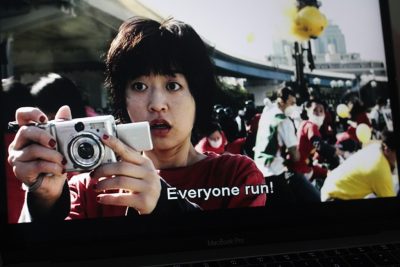
We are then introduced to our protagonists. The film stars Kang-ho Song — who will be very familiar to those who have watched “Parasite” or “Snowpiercer” — as Park Gang-du, the father of Hyun-seo, Nam-joo and Nam-il. They all live with Park Gang-du’s dad, Hee-bong, at a snack stand right off the Han River. The monster emerges from the water and attacks civilians, snatching the young Hyun-seo with its tail and submerging her into the river before swimming off.
The rest of the film’s main storyline deals with the family’s attempts at finding Hyun-seo and the many obstacles that stand in front of them. But unlike the traditional hero versus monster movies, the main obstacle is simply the complete incompetence of the Korean military and the U.S. and South Korean governments. I found myself asking this question so many times: where were the Korean governmental forces to help stop this beast and find the captured people?
To answer this question, Bong includes snippets of what South Korean news channels thought would be important to report on. After people are told to get onto busses away from the area and the surviving family members cry in mourning of the loss of Hyun-seo, the news reports on an U.S. sergeant who lost an arm while fighting the creature and fake virus claims, not on the deaths of South Koreans and the countless people displaced and in panic. Both the sergeant and Gang-du fought the monster. But while the former is lauded for heroism, the latter is taken away and separated from his family.
Including any more instances of how Bong depicts South Korean obedience to the United States in the film would be spoilers, as he so directly forces the viewer to make these connections. The eerily accurate portrayal of the negative U.S. influence from the very first scene to the very last makes it so that midway through the movie, the real villain no longer feels like the monster. The battle scenes with the creature take up such a brief portion of the film when compared to the family’s never-ending struggle against incompetent lying governments.
At times, “The Host” seems like a parody of CGI action Hollywood movies, and I think in many ways it is exactly that. Bong attacks South Korea’s acceptance of decades-long U.S. interventionism through the very art form that it is accepting. This makes for an untraditional action monster movie, where the subtext around the monster is far more frightening than the creature itself.
The film is available to stream for free on a multitude of platforms such as YouTube and Crackle, and is included with an Amazon Prime Video subscription.
Seattle’s indie movie theaters reopen their doors
The most prominent is the long-running and crowd-pleasing Seattle International Film Festival, which took place entirely online in 2021. For its projected return in spring of 2022, Barrett estimates SIFF will likely include about 90 films — less than half the usual 200-plus.
“We’re not 100 percent sure what this next festival will look like,” she says. “We had a terrific experience with the virtual festival. Our [live] attendance tends to be about 100,000, and we guess we had 66,000 views online, though often there’s more than just one person watching. But we also believe deeply in the in-person experience.”
The Central District arts center LANGSTON is also looking ahead to conducting its annual Seattle Black Film Festival in spring 2022, “virtually and minimally in person, if possible,” according to program manager Jazmyn Scott.
Spring plans are also in the making for another popular movie marathon: the Seattle Jewish Film Festival, which annually presents international releases with Jewish themes at the Stroum Jewish Community Center on Mercer Island and other sites. The center also offers additional film programs in its Arts + Ideas cultural series — both virtually and live in a well-equipped auditorium.
The in-person programming restarted “with a few [live] screenings this past spring and summer, as a way to welcome people back into the SJCC and to build community,” reports Pamela Lavitt, director of the festival and Arts + Ideas.
“We’ve learned the majority of patrons actually prefer a hybrid format, so we plan to stick with that,” she says. “We’re currently tracking to a three-week festival, March 24 to April 10, with a blend of in-person weekend screenings and events that really come to life when we are all together.”
More in-person festivals are returning this fall. In October, SIFF will co-host the Tasveer South Asian Film Festival throughout the month (with live events at Broadway Performance Hall and the Egyptian). The Northwest Film Forum will project jazz films as part of the Earshot Jazz Festival (Oct. 13-Nov. 7). And both organizations will hold in-theater screenings for Three Dollar Bill Cinema’s Seattle Queer Film Festival (Oct. 14-24) and the Romanian Film Festival (Nov. 12-21).
And while it’s more a series than a festival, Silent Movie Mondays, the paramount Theatre’s regular run of choice pretalkies (complete with live mighty Wurlitzer organ accompaniment), is coming back to the storied downtown showplace this December.
Though the pandemic and accompanying economic stresses and uncertainties have clearly made this a challenging time for independent cinema outlets in Seattle, there have been bright spots in the long hiatus from public screenings.
Thanks to relief funding and other financial support, SIFF Cinema and other organizations have used the downtime to upgrade facilities. And some have banded together to share resources and foster more collaboration.
Says Dan Hudson, “We talk with Northwest Film Forum and SIFF much more now, about who is going to show what film for which audiences. That has helped clarify even further what people can find at the Grand Illusion, that they may not see elsewhere.”
Ironically, the pandemic has also given indie venues new access to the mainstream movie pipeline. “All those big Hollywood films that were supposed to come out in 2020? Most of them never did,” Beth Barrett says. She points out that the commercial cineplexes will be eager over the next year to catch up with the backlog of delayed, mega-budget action releases (e.g., The Matrix: Four, Top Gun: Maverick and the latest James Bond film, No Time to Die). That will give independent cinemas opportunities to nab the first runs of critically touted but less flashy, or more offbeat, studio fare.
As for competing with the many big new releases showing up on major streaming sites like Netflix, Disney+ and Prime Video, local venue operators aren’t too worried about competition with the in-person experiences that Seattle cinemas can provide.
“I think we’re going to get some great films this year and in 2022 at SIFF,” says Barrett. “The majority of the films we’ll show aren’t streaming currently, so there’s that great possibility of discovering something here you wouldn’t otherwise see. We’ll show movies you won’t find in a Netflix block.”
And Hudson, the Grand Illusion programmer, says he worries more about the ongoing gentrification of Seattle neighborhoods crowding out niche film houses than the Grand Illusion losing its unique appeal on the local scene.
“It’s funny because there are bigger and bigger, cheaper and cheaper TVs available all the time. And there are some hardcore cinephiles in the Seattle area who could maybe approximate the screen size we have and put in a good sound system,” he says. “But we still can show 35- and 16-millimeter films, and the warmth of that analogue film experience still finds a home at the Grand Illusion.”
Shang-Chi: Why the MCU’s first Asian superhero is empowering change
“This is a journey of self-discovery, of growing up, of learning how to finally deal with pain that he’s been running away from his entire life. And that when he is finally able to look inside into his past and embrace good, bad, the joy, the pain, and accept it all as a part of himself,” he says.
Manohar Lal Khattar: RSS Became My Family Beyond Family
Vikas Pathak talks to Haryana Chief Minister Manohar Lal Khattar about his personal life and journey, as part of a series in which Outlook helps its readers know their leaders up close and personal. Khattar recalls how he joined the RSS after the Emergency and talks about his favourite movie, his favourite books and the intersection between his public life and his private life. The interview has been edited for length and clarity.
Tell us about your childhood. Where were you born? Where did you study?
I was born in Nindana village in Rohtak in 1954. We had a shop there. When I was six, my father shifted to another village, Baniyani, and started farming. I studied in a school there till standard fifth and continued my studies from another school in a nearby village, Bhali Anand. I went to college in Rohtak while also helping my father in farming. After finishing my college, I left for Delhi.
What subject did you study in college?
Ans. I studied medical science, as I wanted to become a doctor. But owing to some circumstances I had to drop out of college in 1972. Then I ran a shop in Delhi for eight years. It was around this moment that I entered public life.
How did you enter public life?
The days of the Emergency changed me. People were afraid to speak up. I read in the newspapers that an organization called the RSS had been banned. Bad things about them were fed in the media. Initially, I thought that if their work is so objectionable, they must be a dangerous organization. Then I got to know that its members were arrested for their non-violent disobedience against Emergency, for chanting Bharat Mata ki Jai. So, after the Emergency, I felt I needed to know the RSS better. I joined a shakha at Ranibagh in Delhi and this marked my entry in the Sangh.
How many years did you spend in the Sangh?
From 1977 to 1980, I was an ordinary Swayamsevak. In 1980, I became a full-time Pracharak. For 14 years, I discharged several responsibilities in the Sangh. In 1994, I joined the BJP. From 1994 to 2002, I was the general secretary (organization) for Haryana. From 2002 till 2013, I worked for the party throughout the country.
How was your personal life affected after you entered public life as a full-time Pracharak?
My mother thought that the pracharaks come back home after three years. She asked me to return home when three years passed. But I said my family is now larger and I have to serve it. I would also have arguments with my father, who wanted me, as the eldest son of the family, to take care of my siblings. I would reply that he should think he has only four sons instead of the five.
Which individual, from history or from contemporary politics, has inspired you the most?
Ideas have inspired me more than individuals. As a pracharak, I was told about highly educated seniors like Ashok Singhal and Rajju Bhaiyya. Who could be more inspiring than them? If you talk about contemporary politics, the unique style of functioning of Prime Minister Modi has really inspired me. I got my inspiration for administrative work from him. Ideas that inspire us always remain around even if the people who voice them come and go. Nationalism, social work, these are ideas that always inspire me.
People associate ideas with books. Which is your favourite book?
I am not a voracious reader, but Dattopant Thengdi’s Rashtra Jeewan Ki Disha inspired me a lot. The Bhagwad Gita is another example. I don’t get a lot of time to read it but whatever I read from it is very inspiring. Not that I worship any one book. But whenever I come across books with good values, I read them.
Let me ask you about your favourite film.
I don’t watch many movies. I loved Manoj Kumar’s Upkaar, which had the song mere desh ki dharti… I remember it for the feeling of nationalism it fostered. I used to watch films occasionally. In today’s political life, I feel I see a movie playing around me each day. Each day there are developments that are not less interesting than a movie script. So, I don’t need to watch movies on screen any longer.
But who is your favourite actor?
I haven’t thought much about actors (abhineta). Yes, I have remembered politicians (neta). When I used to meet Atal ji, it was an inspiring experience. I feel very inspired when I meet Modi ji. When I read about Swami Vivekanand’s life, it infuses a new energy in me.
Have you loved sports? Have you played any sport?
In school, I played badminton. In the Sangh Shakha, I loved playing Kabaddi. Even today, if I go somewhere and see Kabaddi being played, I feel like joining in. But with age things change. Now I do yoga. It isn’t exactly a sport, but I practise it for good health.
You have travelled all over. Which is your favourite travel destination?
I like hills. I lived for eight-nine months in Jammu and Kashmir and visited it off and on for three years after. I love the sight of mountains, the snow-clad peaks. It is a dangerous place but I like the mountains. There are some spots I also love in Himachal.
Any one thing about yourself that you would like to change?
In political life, character is important. There was a time when people would be biased against politicians. The popular belief was that a politician was bound to be corrupt. I think if the image of politicians improves, society will progress a lot.
Tell me one thing that you think should change in your state or the country for it to become a better place?
Corruption runs deep in society. Everyone should resolve to not let it spread. This is a big responsibility. Be it myself or anyone else, we should all work towards it.
But won’t it be a challenge since you admit corruption runs deep? How do you propose to counter it?
From the Good Governance Day in 2014, I said let us do everything through e-governance. E-governance is running very well at many levels in many of our departments. I believe this has gone a long way in reducing corruption. From politicians to bureaucrats to several sections of society, there is a propensity to be corrupt. Not even punishment can improve the situation. Building a new value system and a new work atmosphere can help. As we reduce human interface and shift to technology, we will see an increase in transparency and reduction in corruption.
Tom Hanks’ Comfy Finch Suit Sounds Like the New Gold Standard
In director Miguel Sapochnik’s upcoming post-apocalyptic drama Finch, Tom Hanks stars as the titular inventor who finds himself living in almost complete solitude after a cataclysmic event wipes out the vast bulk of the world’s population save for him and his dog. Keen on making sure that his canine companion is taken care of once he dies, Finch sets out to construct an intelligent robot meant to protect the pup, and Finch follows as the unlikely family leans on one another in the end times.
Though Finch’s trailers have made the film out to be far more bright and hopeful that other features with similar themes like I Am Legend and The Road, that isn’t necessarily a reflection of how much easier it was to bring the story to life. During a recent interview with the Hollywood Reporter, where he compared his experiences working as a director on both Game of Thrones and Finch, Sapochnik said that it’s “harder to do something with any sort of hope or lightness for many reasons,” but that it’s immediately apparent when the is working.
While Finch largely revolves around Hanks’ character, who often interacts with a live dog, Sapochnik said that the actor’s grounded, relaxed demeanor played a large role in the smoothness of the production. Because the outside world Finch and his pet live in is so inhospitable to living organisms, he has to don a specialized suit at multiple points throughout the movie to survive the elements. Bulky exosuits are common enough in sci-fi films that everyone’s heard horror stories of people being made to stand around in what amounts to heavy, wearable saunas for hours on end—but Sapochnik described how Finch’s creative team made a point of building something Hanks could reasonably work in.
“He would come onto set in the suit, do his scenes, then sit in a chair, close his visor, turn on the AC and go to sleep,” Sapochnik recalled. “Then when we were ready, he’d open the visor and go. That might not sound unique, but it has this cumulative effect. Everybody else was ‘on’ as a result.”
Finch is releasing just a little over a year after Tom Hanks became one of the first major celebrities to reveal he’d contracted covid-19, and Sapochnik said that the events of the real world definitely ended up shaping the arc of the new film. But rather than trying to “club an audience” with direct parallels between Finch and our reality, Sapochnik said that his goal was always to make a story about a family on a road trip. “The sci-fi is incidental,” Sapochnik said of Finch. “We realized you didn’t need the world turned completely upside down for it to feel very close to home. The problem with making post-apocalyptic movies is we’re getting closer and closer to the truth and that’s kind of terrifying, you know?”
The latest and greatest iPad
Upgrade your tablet to what Gizmodo called “basically a perfect piece of hardware.”
Finch is slated to hit Apple TV+ on November 5.
Wondering where our RSS feed went? You can pick the new up one here.
Hockey games, concerts, movie theatres back to 100% capacity for fully vaccinated people in B.C.
Restrictions placed on indoor and outdoor gatherings are being lifted in British Columbia as the two-dose vaccine requirement for people attending them kicks in.
The revision to the provincial health order is effective Monday, Oct. 25, and comes as two doses of a COVID-19 vaccine are required for anyone over 12 to access those gatherings.
The order had previously restricted capacity limits to 50 per cent for indoor, organized gatherings, but as of Monday, these events will be allowed to operate at 100 per cent capacity in places where the B.C. vaccine card is in effect, Provincial Health Officer Dr. Bonnie Henry announced Tuesday during a live news conference.
However, regional health orders and restrictions currently in effect in Northern Health, Interior Health and the eastern Fraser Valley will remain in place.
These changes apply to:
- Indoor sporting events.
- Indoor concerts, theatre, movie theatres, dance and symphony events.
- Indoor organized events such as weddings, funeral receptions outside of a funeral home and organized parties.
Henry said not all residents may be able to safely attend those events, including immunocompromised people who might not feel ready to be exposed to others in a large group setting. Mask requirements for indoor settings like these are still in place.
The order to remain seated at a table in restaurants and pubs will also be lifted Monday, though indoor mask requirements will remain in effect for all indoor gatherings and for people moving around within restaurants and pubs.
Henry said that by ensuring only fully vaccinated people are allowed into more populated venues, the risk of transmission will be reduced.
“We are not seeing transmission in those settings where the vaccine card is used, where people are checking vaccine status.”
Henry said officials are looking into what other restrictions can be lifted as the COVID-19 situation continues to evolve.
Henry and Health Minister Adrian Dix also shared their frustration with efforts to crack down on businesses flouting
COVID-19 safety rules.
“We’re disappointed to be at this place because health authorities, as you can imagine, are unbelievably busy,” Dix said.
The Fraser Health Authority is seeking an injunction against a restaurant in Hope that refuses to follow COVID-19 health protocols.
“It shows people they don’t respect their neighbours, they don’t respect their business neighbours, they don’t respect their community,” Henry said of the restaurant.
Dix said he understands other businesses may be frustrated by the delay in punishing the offending business, but the government is committed to cracking down on those who refuse to follow health orders.
COVID-19 in schools
During the news conference, health officials announced that the B.C. Centre for Disease Control (BCCDC) will now provide data on COVID-19 in schools on a monthly basis with the first report released Tuesday, Oct. 19.
Each time a student or staff member receives a positive COVID-19 test, public health contact tracing will begin. If the COVID-positive person has been in the school while infectious, a notification will be sent to parents alerting them of a possible exposure, Henry said.
As of Oct. 19, 1,388 notifications of potential exposures for the current school year have been sent to 510 schools.
The BCCDC report says cases in young children, aged five to 11, peaked in late September but are now trending downward. It says the initial increase may have been due to increased testing among children as other respiratory viruses circulated at the beginning of the school year.
Most children are at low risk for getting COVID-19, Henry said, and if they do, they tend to have milder symptoms.
She said there have been 94 COVID-19 hospitalizations in children aged five to 17 since the beginning of the pandemic, 10 of which required critical care. There were no deaths reported in that age group.
The report also says rising cases in children have not resulted in a significant rise in hospitalizations.
As of Oct. 14, 82 per cent of eligible children in B.C. between the ages of 12 and 17 had received at least one dose of a COVID-19 vaccine, and 73 per cent were fully vaccinated.
The big news: 39 women Army officers get permanent commission, and nine other top stories
A look at the top headlines right now:
- Thirty-nine women Army officers get permanent commission after winning legal battle in SC: A total of 72 women officers had approached the Supreme Court after they were denied permanent commission.
- Actor Ananya Panday questioned by NCB for second day in Mumbai drugs case: The case is related to a raid conducted on October 2 by the Narcotics Control Bureau. The agency had raided a party on a cruise ship off the coast of Mumbai and seized drugs on board.
- Court says it will hold police responsible if investigating officers fail to follow orders in Delhi riots cases: A magistrate’s court in Delhi said that investigating officers cannot delay compliance of an order for being unaware of directions.
- The 100 crore vaccine milestone answers questions about India’s ability to fight Covid, says Modi: In an address to the nation, the prime minister said that when coronavirus hit the country, questions were raised about whether India would be able to fight the pandemic and how it would vaccinate such a huge population.
- Police seize two-wheelers in Srinagar, shut down internet in some areas: Many residents alleged that their two-wheelers were seized by police officials, who did not check their documents. The residents were asked to collect their vehicles from the police after October 26.
- I was offered Rs 300 crore to clear deals of ‘Ambani’, RSS officer, claims former JK governor: Satya Pal Malik alleged there was a scam involved in the deals and he cancelled them.
- Trinamool MP Sushmita Dev claims BJP workers attacked her during campaigning in Tripura: In a video, Dev could be seen being manhandled when one of the attackers notice that she was filming the incident.
- Coronavirus may have killed up to 1.8 lakh healthcare workers globally, says WHO: The health body’s chief Tedros Adhanom Ghebreyesus said that data from 119 countries suggest that on average, two in five health and care workers globally are fully vaccinated.
- Police arrest man who placed Quran at Durga Puja pandal sparking communal violence in Bangladesh: Iqbal Hossain, who had been absconding, was found near Sugandha beach area of Cox’s Bazar.
- Alec Baldwin kills cinematographer, injures director after firing prop gun on movie set: The incident happened during the shooting of movie Rust, the Santa Fe police said in a statement. The deceased person has been identified as Halyna Hutchins, 42, who was working as the director of photography.
Summer movie releases continue. Here’s a look at what’s coming to theaters in the next few weeks
As audiences return to theaters, there are plenty of Blockbusters in store for the summer.
From musical adaptations, thrillers and fan-favorite franchises, the upcoming lineup has plenty to choose from.
Here’s a look at the movies scheduled for release in the next couple weeks.
June 11
“In the Heights”
Based on the musical screenplay by Lin-Manuel Miranda, this film tells the story of a bodega owner who closes his store and retires to the Dominican Republic after inheriting his grandmother’s fortune. The cast includes Anthony Ramos, Corey Hawkins and Leslie Grace.
Watch the trailer above.
“The Misfits”
A group of not-so-average thieves recruit renowned criminal Richard Pace after he finds himself wrapped up in a heist that could have serious consequences for him and others. The cast includes Pierce Brosnan, Nick Cannon, Jamie Chung and Tim Roth.
“Peter Rabbit 2: The Runaway”
This sequel catches up with Thomas and Bea, who are now married and living with Peter and his family. Peter ventures out of the garden to the big city, where he meets plenty of characters and causes chaos for the family.
Voice cast includes James Corden, Elizabeth Debicki, Lennie James, Margot Robbie and Rose Byrne.
“12 Mighty Orphans”
This film tells the true story of the Mighty Mites, the football team of a Fort Worth orphanage who, during the Great Depression, went from playing without shoes — or even a football—to competing for the Texas state championships
Cast includes Luke Wilson, Martin Sheen, Robert Duvall and Vinessa Shaw.
June 16
“The Hitman’s Wife’s Bodyguard”
Bodyguard Michael Bryce and hitman Darius Kincaid are back. This time, Bryce — still unlicensed — is forced into action by Sonia Kincaid and the three end up tangled in a global plot.
Cast includes Ryan Reynolds, Samuel L. Jackson, Salma Hayek, Antonio Banderas and Morgan Freeman.
June 18
“Luca”
This animated film shows one boy’s unforgettable summer in a seaside town on the Italian River: complete with adventures with a new best friend, but the underlying threat of a secret sea monster just beneath the water’s surface.
“Luca” is voiced by Jacob Tremblay, Jack Dylan Grazer, Emma Berman, Maya Rudolph, Jim Gaffigan and Marco Barricelli.
June 25
“F9”
Dom Toretto is living the grid with Letty and his son, little Brian, but they know that danger always lurks over the horizon.
Cast includes Vin Diesel, John Cena, Charlize Theron, Helen Mirren and Michelle Rodriguez.