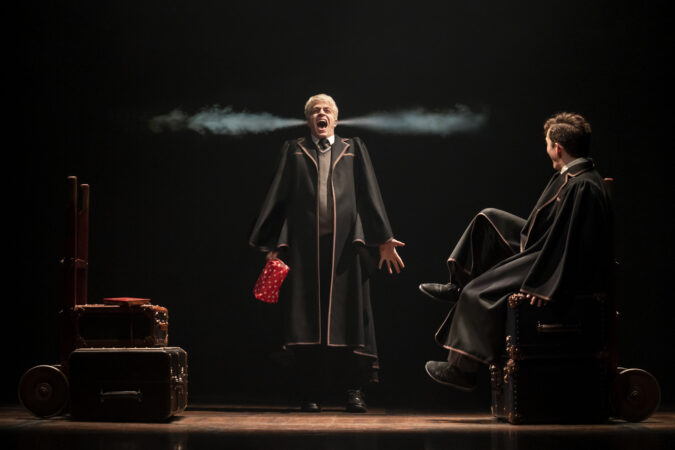
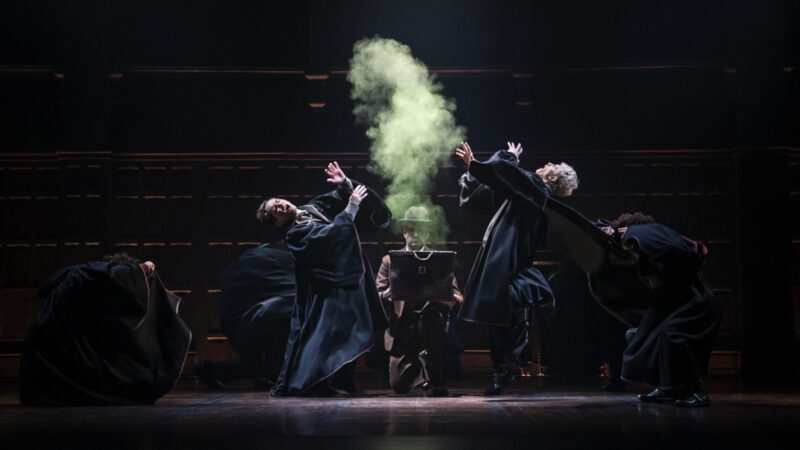
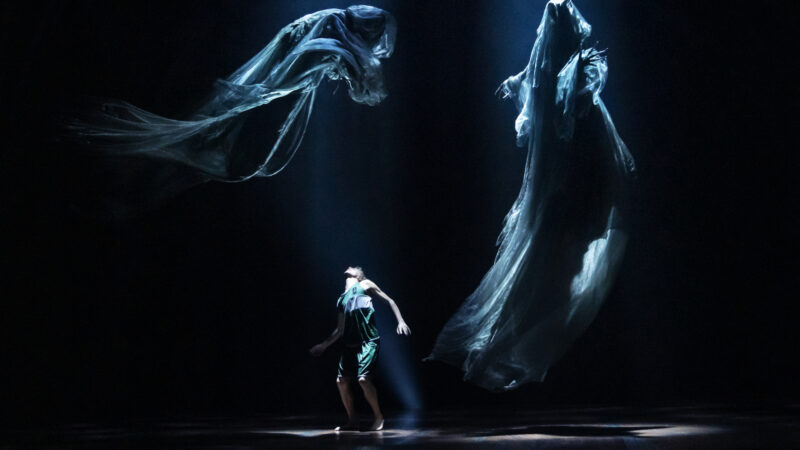
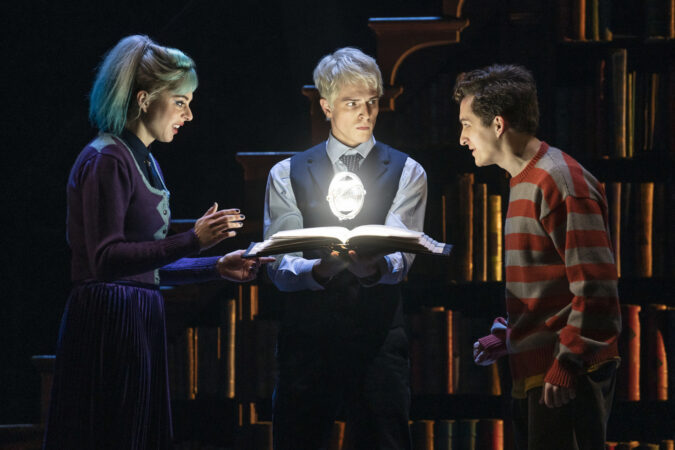
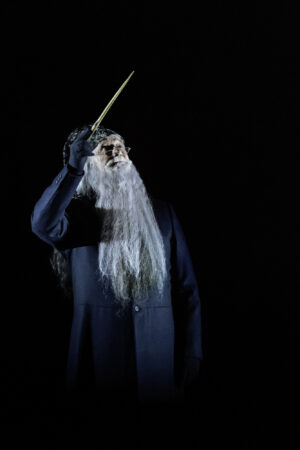
A newly condensed, one-part production of Harry Potter and the Cursed Child has opened on Broadway, and the reviews are in. The play, penned by Jack Thorne, director John Tiffany, and original series author J.K. Rowling, takes place 19 years after the events of Deathly Hallows as the title wizard’s youngest son begins his first year at Hogwarts School of Witchcraft and Wizardry.
The Broadway production stars James Snyder as Harry Potter and Diane Davis as Ginny Potter alongside James Romney as their son Albus Potter; David Abeles as Ron Weasley, Jenny Jules as Hermione Granger, and Nadia Brown as their daughter Rose Granger-Weasley; and Aaron Bartz as Draco Malfoy and Brady Dalton Richards as his son Scorpius Malfoy.
Playbill will continue to update this page as reviews come in.
Rounding out the company are Oge Agulué, Kevin Angulo, Chelsey Arce, Quinn Blades, Michela Cannon, Will Carlyon, Lauren Nicole Cipoletti, Judith Lightfoot Clarke, Ted Deasy, Kira Fath, Stephanie Gomérez, Steve Haggard, Ben Horner, Edward James Hyland, Jax Jackson, Jack Koenig, Spencer LaRue, Rachel Leslie, Sarita Amani Nash, Alexandra Peter, Dan Piering, Kevin Matthew Reyes, William Rhem, Antoinette Robinson, Stephen Spinella, Tom Stephens, Maya Thomas, and Karen Janes Woditsch.
The production features movement by Steven Hoggett, sets by Christine Jones, costumes by Katrina Lindsay, music and arrangements by Imogen Heap, lighting by Neil Austin, sound by Gareth Fry, illusions and magic by Jamie Harrison, and music supervision and arrangements by Martin Lowe. Patricia Dayleg is the newly appointed director of equity, diversity, and inclusion. U.S. casting is by Jim Carnahan. Sonia Friedman Productions, Colin Callender, and Harry Potter Theatrical Productions serve as producers.
Harry Potter and the Cursed Child first opened on Broadway as a two-part experience April 22, 2018. The production went on to be nominated for 10 Tony Awards, winning five, including Best Play.
Check Out New Photos of Harry Potter and the Cursed Child on Broadway
In July 2011, it ended. Adapting the final novel in rags-to-riches author J. K. Rowling’s generation-defining series, Harry Potter and the Deathly Hallows – Part 2 marked the eighth and final film at the core of the Wizarding World. For a full decade, fans aged alongside Daniel Radcliffe, Rupert Grint, and Emma Watson, starring as the heroic trio in the once-in-a-century, intergenerational, right-time-and-place story; a world that captivated Millennials, then grew up with them; a pop culture phenomenon to rival Star Wars; and now, it was over.
Sure, the $8 billion box office revenue of the Potter films are really just a portion of the “Wizarding World” franchise’s $33 billion in earnings since The Philosopher’s Stone‘s publication in 1997 (with the remaining billions due to books, merchandise, video games, home video, and of course, theme parks)… but undeniably, the end of Harry Potter would signal the end of the Wizarding World’s annual billion dollar box office dominance.
Image: Pottermore
… Or would it? In 2013, J. K. Rowling and Warner Bros. announced that they’d begun pre-production on a new film that would serve not just as a new chapter, but a new story altogether in the Wizarding World franchise, set decades before and far from the events of Harry Potter. You have to remember that when Fantastic Beasts and Where To Find Them was announced, fans knew only that it would follow the exploits of explorer and “magi-zoologist” Newt Scamander on his international adventures that would eventually lead him to write the textbook of the same name that would one day end up on Hogwarts school supply lists – a subtle but spectacular connection to existing Potter lore.
Set in the 1920s and ’30s, images were conjured in fans’ minds of the Wizarding World’s Indiana Jones; an explorer and adventurer, braving ancient temples and magical jungles in search of the rarest, wildest, and most dangerous of the Wizarding World’s creatures; a fun, colorful, adventurous, pulpy, and low-stakes exploration of a corner of the Wizarding World we’d never seen. It stood to reason that the globetrotting exploits of Scamander and his research into fantastic creatures could even become a standalone franchise in its own right – a potential made all the more real when it was announced in 2014 that Fantastic Beasts was pre-approved for three films (revised in 2016 to FIVE films) set in – but exploring a vastly different corner from – Harry Potter’s world.
Sounds fun, right? Then, the troubles began.
Fantastic Beasts…
Fantastic Beasts and Where To Find Them made its debut in 2016. To be sure, the film earned positive reviews and earned a high-respectable $800 million. But at least for many, it wasn’t really what they’d expected.
Image: Warner Bros.
For better or worse, the Fantastic Beasts series follows Newt Scamander – not a rugged, Oscar Isaacs, Indiana Jones-esque explorer, but a timid, buttoned-up, and introverted worker for the Ministry of Magic played by the soft-spoken Eddie Redmayne. His adventures begin not in exotic jungles, but in New York City of 1926, where an enchanted suitcase of irridescent, unusual, CGI, Rowling-invented creatures (a divergence from the classic unicorns, dragons, mermaids, centaurs, and spiders of the Harry Potter world) accidentally, anti-climactically opens.
Scamander allies with Tina Goldstein (a former Auror caught in the bureaucracy of the Magical Congress of the United States, or MACUSA) as well as a “No-Maj” (apparently, the American equivalent to the British “Muggle”) New Yorker named Jacob Kowalski. From there… well… let’s ask: do you remember the plot of Magical Creatures and Where To Find Them?
Image: Warner Bros.
We’ll give you a hint: it involves an anti-witchcraft legion of puritans who live in a ramshackle old schoolhouse weirdly set in the middle of Manhattan, whose adopted child Credence (Ezra Miller, in the actor’s second high-profile Warner Bros. franchise after playing DC’s The Flash) has so much repressed magical potential, it turns into a violent force called an Obscurus. MACUSA weirdly sentences Newt and Tina to death because a creature killed a senator, but they escape. Also, there’s a detective played by Collin Farrel who’s actually using a Polyjuice Potion (hey, I remember those!) to disguise that he’s not Collin Farrel, he’s Johnny Depp, playing the “Voldemort” of early 20th-century Wizarding World, Gellart Grindelwald, who was remembered as a long-dead bad guy and one-time Dumbledore foe by Harry Potter’s time.
Look, Fantastic Beasts didn’t have an easy job to begin with in expanding the Wizarding World. It’s okay that the movie was (as reviews put it) “bogged down by exposition” or a bit of a “slog,” having to introduce so much new world-building.
Image: Warner Bros.
And even if viewers can get the strict sense that Rowling doesn’t know much about New York, American government, or America’s home-grown concepts of magic and magical creatures, a New York City of the 1920s is a setting no one would’ve expected from the Wizarding World’s next era. Sure, Fantastic Beasts is a little color-drained, and pretty CGI-heavy, and a little too in-the-weeds with worldbuilding. But even if it isn’t the general aesthetic so many fans pictured, it would be interesting to see how Scamander ends up writing that text book, and with two – er, I mean, FOUR – more movies to go, that was inevitable.
When Evatt died in 2018 aged 87 more responsibilities fell on Elizabeth who concedes that there is no alternative but to put everything under the gavel.
She says: “I have battled as a single person to keep this place going. In 2019 we had bush fires, people were told not to come to the Mountains and our numbers just sank. Then we had floods, more floods, COVID, more floods, bush fires again then a compulsory lockdown for six months. So many businesses in the Blue Mountains just bled out because it was too hard. It was a labour of love, but my love has just fallen through the cracks.”
Noddy original illustration by Beek.Credit:Rhett Wyman
Continuing our private tour from what was once the grand billiard room we take in toys of Ginger Meggs, Popeye, Biggles book first editions. Upstairs Barbie is here in all her many guises. She started out as a college girl in sensible clothes before becoming a hippie and Barbie as Twiggy and Marilyn Monroe and Barbie as a person of colour.
There are wartime propaganda dolls – the Mussolini “black shirt” doll and the Nazi ‘Hitler youth’ dolls. A cautionary sign on the glass cabinet states: “These historical toys are examples of pernicious Nazi propaganda aimed at indoctrinating German children. Ultimately, they contributed to war crimes and atrocities.”
CASETiFY has unveiled an extensive tech collection inspired by the beloved wizarding world of Harry Potter.
Set to drop later this week, the collection takes inspiration from the four Hogwarts houses—Gryffindor, Hufflepuff, Ravenclaw and Slytherin—and iconic early Hogwarts experiences.
Fronted by Tom Felton, who played Draco Malfoy in all eight films, references in the collection include Harry’s first interaction with the Mirror of Erised (available exclusively on the CASETiFY Co-Lab app), his first broomstick and his face-off with the Basilisk in the Chamber of Secrets.
The drop also includes CASETiFY’s first Lenticular Case, engineered to capture the magical qualities of the wizarding world through “moving photos.” When titled from side to side, the Lenticular Case will unveil the Marauder’s Map to the rightful owner.
Wizards and muggles alike can expect to find a range of designs on a range of CASETiFY’s signature styles, such as the ultra-durable Impact Case series, Reflective-Plate Material Cases, Compostable Cases and the Impact Crush series from the sustainable Re/CASETiFY Collection. To complement the exclusive phone case collection, fans can shop a full accessory range with matching house colours for all their devices, including Apple Watches , AirPods and AirPodsPro.
Modelled after the fastest and smallest ball in the game of Quidditch, customers can also enjoy a highly-designed 3D Golden Snitch Airpods Case, complete with the inscription “I Open At The Close” and a beaded phone strap complete with Hogwarts’ mascots.
Fans can now access the waitlist on the CASETiFY website. The Harry Potter collection is available online and in CASETiFY stores on March 31.
Zynga, a global leader in interactive entertainment, has announced that Harry Potter: Puzzles and Spells, its magical match-3 puzzle mobile game, will feature a special in-game series of events to coincide with the release of Warner Bros. Pictures’ new film, Fantastic Beasts: The Secrets of Dumbledore, which is now playing in theatres worldwide. Fans are invited to experience the theatrical release of WB’s new Fantastic Beasts: The Secrets of Dumbledore with a special in-game series of events in Harry Potter: Puzzles and Spells.
Experience the wizarding world of Fantastic Beasts in Harry Potter: Puzzles and Spells
The limited-time Fantastic Beasts celebration events in Harry Potter: Puzzles and Spells encourage players to experience the wizarding world of “Fantastic Beasts: The Secrets of Dumbledore” by incorporating magical characters and monsters from the film franchise. Newt Scamander, the legendary Magizoologist, makes his debut appearance in the game as a guide and host in the in-game event, which starts today.
We’re incredibly excited to announce the latest Harry Potter: Puzzles Spells in-game event series in conjunction with the release of Fantastic Beasts: The Secrets of Dumbledore. The film series has created a massive global fan following, and we are excited that our players can see the film’s most beloved characters on the mobile screen.
Yaron Leyvand, Executive Vice President, Games at Zynga
Players can earn badges to gather the Niffler, a charming magical creature known for collecting sparkling objects and treasures, as a special event bonus. For the first time, players can keep the Niffler as a permanent monster they can utilize in future games – but they must act swiftly to take advantage of this opportunity.
The special Magical Creatures Season, which runs from late April to late May 2022, allows players who have been swept up in the Fantastic Beast Celebration to delve even deeper into Harry Potter: Puzzles and Spells. When activated, this in-game event allows players to unlock the Qilin, probably the wizarding world’s most revered magical beast, to aid in the completion of puzzles.
As Albus Potter and Scorpius Malfoy, Ben Walter and Nyx Calder keep the buddy story between two bullied teens alive, funny and true. The adolescent vulnerability (and volatility) they bring to the roles are a pleasure to watch, even if this version resorts to needless dredging up of homoerotic subtext rather than the more tentative, refined and ambiguous suggestion in the original.
Gareth Reeves and Lucy Goleby as a married Harry and Ginny Potter somehow keep an impression of their characters’ deep bond, and David Ross Paterson as Snape remains a snaky delight.
Some of the supporting cast are more short-changed by the edits: the brilliant and amusing contrast between Paula Arundell’s Hermione and Michael Whalley’s Ron is neatly sketched but loses the detail that made it so endearing.
And one notable deficiency, narrative-wise, is the lack of foregrounding to Delphi Diggory (Jessica Vickers), companion to Albus and Scorpius. It’s hard to generate an emotional reaction to the significant plot twist she plays a part in, and the flip side of the orphan story she represents, when she barely appears in the play’s first half.
A Harry Potter Wizarding Wands event has popped up at a shopping centre that’s under an hour away from Surrey. Reading’s Oracle Shopping centre was chosen to host the event that will see each wand light up.
Each of the wands will illuminate in the evening from Wednesday, March 30 until April 5. A light show will be performed to music from both the Harry Potter and Fantastic Beasts movies.
The wands are exact replicas of the wands used by fan favourite characters in the Harry Potter and Fantastic Beasts franchises. Some lucky fans became the first to pose next to the replicas on Wednesday, March 30.
READ MORE: Harry Potter’s Tom Felton to star alongside Doctor Who sidekick in West End play
The Reading event is part of a UK-wide tour of the installation that celebrates the release of Fantastic Beasts: The Secrets of Dumbledore. The film is set to hit cinemas on April 8, three days after the final night of the illuminations in Reading.
Locations for the tour were chosen by a public vote. They included The Oracle Shopping Centre in Reading for a week after the illuminations appeared in Hull, Birmingham and Stoke-on-Trent.
The first of her novels, “Harry Potter and the Philosopher’s Stone,” was included in a 153-book long-list for the Big Jubilee Read, based on a public vote. (The book was released in the US with the title “Harry Potter and the Sorcerer’s Stone.”)
The title was dropped when a panel of industry experts cut the list of 153 down to 70, The Times of London reported.
“There was a big discussion about JK Rowling,” Susheila Nasta, one of the competition judges and emeritus professor of modern literature at Queen Mary University of London, told the newspaper.
“A space was cleared for someone equally as good but whose work was not as well-known,” Nasta said. “There were some very tricky decisions.”
Nasta did not mention the criticism of Rowling’s views, which have made her a polarizing figure in the UK.
BBC Arts said that excluding Rowling from the reading list was not related to her views, the Telegraph reported.
Rowling has faced accusations of transphobia for years
She has been called a TERF (trans-exclusionary radical feminist) after appearing to say that transgender activism was “erasing the concept of sex,” which she argued is harmful for women and lesbians, as Kat Tenbarge reported for Insider.
Daniel Radcliffe, for example, wrote an essay for The Trevor Project saying that “trans women are women” and that he felt “compelled to say something.”
Emma Smith’s enchanting book about books borrows its title from Stephen King, who describes them as “uniquely portable magic”.
Smith is a professor of Shakespeare Studies at Hertford College, Oxford, a bookish environment if ever there was one, and in Portable Magic she celebrates not only the history and evolution of books, but their function and totemic status as the manifestation of ideas in a physical form – their very “bookhood”.
The usual suspects are all here – the Chinese printers of the 7th-century BC, Gutenberg and his Bibles, the publishing tycoons, and the authors of everything from the scrolls of Alexandria to paperback smut. But front and centre is the book itself, and Smith’s contagious fascination with the material, decorative and talismanic aspects of the packaging and dissemination of the printed word. We learn that not only did Gutenberg’s 1455 edition of the Bible run to a remarkable 1282 pages, but that it took six pressmen two years work to produce around 170 copies in total. Hardly a bestseller, despite its epochal place in publishing history, and it’s hardly surprising that Gutenberg fell foul of his creditors and was bankrupt 10 years later.
F. Scott Fitzgerald went to his grave believing The Great Gatsby to be a failure.Credit:Getty Images
Portable Magic sparkles with gems of trivia that often conceal deeper truths about the evolution of reading and publishing. For instance, in 1940, the year of F. Scott Fitzgerald’s death, his royalty cheque for The Great Gatsby amounted to an underwhelming $13. It was its inclusion in the works selected by the Council for Books in Wartime, a committee of publishers, librarians and literary luminaries, for distribution to all American servicemen during World War II, that immortalised Fitzgerald’s work with an initial print run six times his publisher Scribner’s output in the years since its 1925 debut. Fitzgerald went to his grave believing his masterwork to be a failure, a failure that has sold in the millions since the war, but Smith’s exploration ranges far beyond the quirks of fate that make or break the reputations of writers and publishers.