A Harry Potter-themed event at a New Zealand book festival has been canceled over author J.K. Rowling’s controversial comments on gender.
Organizers of Featherston’s Booktown Karukatea eliminated a quiz about the popular young adult series after Rowling tweeted a series of opinions that some called transphobic, according to Stuff.
The best-selling British author was swiftly met with backlash by many in the LGBTQ community, and some stars of the Harry Potter films.
The controversy started when Rowling panned an article for using the term “people who menstruate” instead of “women” last year.
“If sex isn’t real, there’s no same-sex attraction. If sex isn’t real, the lived reality of women globally is erased,” she tweeted.
Organizers said they consulted with literary experts and LGBTQ community members before shelving the popular segment, according to the article.
“The overwhelming response was there was a risk around causing distress to particular members of the community and that was the last thing we wanted to do,” festival board chairman Peter Biggs said.
“We always thought Booktown should be an inclusive, welcoming place for everyone, so we took the decision not to go with Harry Potter.”
J.K. Rowling came under fire after tweeting several seemingly transphobic opinions that were widely criticized. Reuters
Some local gay advocates told the outlet they agreed.
“I think it’s a strong decision that shows they’re really trying to be an inclusive community and support their rainbow and transgender young people,” Tabby Besley, of Inside Out charity, reportedly said.
The May 6 book festival is set to examine “cancel culture,” which one local feminist activist said was ironic, according to the outlet.
“I think they might be trying to capitalize on the current fad of cancel culture,” Jenny Whyte said, according to Stuff.
“Featherston Booktown has a session selling tickets to a panel discussing cancel culture, so there’s an irony certainly.”
Whyte, who identifies as a lesbian, told the outlet she does not think Rowling’s comments were transphobic.
“It’s really funny that all the way from the UK where a world-famous writer has gotten into trouble for expressing quite compassionate and reasonable views, all the way down to tiny little Featherston. It encapsulates the whole madness of it quite well,” she reportedly said.
The RSS has also always extended its helping hand whenever the country has faced a national crisis. It has often leveraged its organisational machinery to help the country tide through various adversities. This time around, they have stepped forward to help revive a massive British era hospital in Karnataka as the state faces the scourge of a renewed bout of the coronavirus outbreak, a report published in India Today said.
Bharat Gold Mines Limited Hospital or BGML Hospital as it is popularly known was lying abandoned for more than two decades now. It was established in 1880 by Dr TJ O’Donnell and his brother JD O’Donnell and has the capacity of housing 800 beds. It was one of the largest hospitals in Asia in the early 20th century.
With the COVID-19 caseloads in Karnataka’s Kolar district spreading at an inexorable pace, MP S Muniswamy realised that it will take more time to set up a new hospital to administer the rising number of coronavirus cases. He instead decided to revamp and operationalise the British-era hospital that was lying defunct for over 20 years now. For this, he roped in the services of RSS and BJP volunteers to quickly overhaul the hospital and convert it into a COVID care centre.
Discussing his plan to convert the mouldering hospital into a COVID-19 centre, Muniswamy said, “After deliberating with the Sangh Parivar and other organisations, we decided to set up a 200+ bed Covid Care Centre. Some 250 volunteers from the BJP and RSS worked hard to get this ready. Now the cots and electricity work is done and the hospital should be up and running in 2-3 days’ time.”
Source: India Today/Nolan Pinto
Muniswamy had written a letter to Union Minister of Coal and Mines Pralhad Joshi seeking permission for the district administration to make use of this massive hospital as a Covid Care Centre. According to the authorities, the hospital was one of the biggest in Asia of its time and was amongst the first to get electricity and an X-ray unit when the mines were functional for over 120 years.
Volunteers of Sangh Parivar help in bringing KGF hospital back to life
As the plan to convert the hospital that untouched for almost 20 years into a COVID-19 centre firmed up, RSS and BJP volunteers took it upon themselves to clean the hospital. As per Praveen S, RSS Karyakarta in KGF, who is supervising the work, more than 400 tractor loads of garbage was removed from the hospital.
Praveen also added that the biggest challenge facing the RSS volunteers was to clean the hospital. “The hospital was in a dilapidated condition when we first came to the place on Day 1. There were bats flying around, and 2-3 inches of mounds of mud scattered around the expanse of the hospital. It was full of cobwebs. Many people were doubtful if we could complete the task at hands. However, the volunteers of RSS, BJP, VHP, Seva Bharati, Jana Jagaran Samiti were unwavering in their resolve to clean the hospital. We started this work on April 27 and by May 7, the entire cleaning of this five-acre campus was completed,” he said.
Currently, work is in progress to get the facility fully functional as a hospital, once all the required infrastructure is put in place. There will be four rooms with ICU facilities in the hospital. Electrification and plumbing work is underway in full swing. The authorities have also decided to utilise the 140-year-old iron cots.
“The cots are almost 140 years old and weighs more than 100 kg. They are sufficiently sturdy and you require at least 3-4 people to lift them up. While the forgings are all old techniques, you can nevertheless use the cots for another century or more,” Praveen told in an interview with India Today.
Newswise — There are many reasons to pursue diversity in medicine: social justice, providing a counterforce against societal bias, bringing new points of view to the clinic. There is also the emerging understanding that overcoming systemic racism helps ensure that everyone has a chance to access advanced education and training.
To help drive this change, the Department of Neurological Surgery at the University of Miami Miller School of Medicine has established the Black Lives Matter Fellowship to support Black students who want to conduct advanced work in neuroscience or neurosurgery.
The idea began to germinate during an online symposium in June 2020: Black Lives Matter: A priority today for neurosurgery, our community and our nation. The meeting brought together Dean Henri Ford, Dr. Barth Green, poet Guy Johnson, basketball great Alonzo Mourning and others to discuss the problems that inspired the Black Lives Matter movement.
Later that summer, funds from neurosurgery faculty, scientists and students allowed the Miami Project to Cure Paralysis to bring on a pre-med student, who was mentored by Jae Lee, Ph.D., professor of neurological surgery. The Jerome and Sonya Green Foundation provided additional support for summer 2021, expanding the program to four scholarships.
“The fellowship is available for Black high school, college or medical students to support those who wish to gain clinical or basic research experience in the neurosciences and/or neurosurgery at the University of Miami,” said Allan Levi, M.D., Ph.D., professor and chair of the Department of Neurological Surgery. “It’s an incredibly tangible way we could contribute and make an immediate difference.”
The four BLM scholars were chosen from 23 applicants and will come to the Miller School to learn, conduct research and share their ideas. “Our final four are just out-of-this-world talented,” said Dr. Levi.
Waverly Rose Brim is working toward a Master of Science in artificial intelligence at The Johns Hopkins University Whiting School of Engineering and plans to apply to medical school. Brim wants to develop artificial intelligence clinical support software and will begin by developing basic science imaging techniques that avoid ionizing radiation.
“I propose innovating a new imaging modality that will harness the human body’s inherent electrochemical capability,” Brim said in her application. “The basic science tool to engineer this technology is the genetically encoded voltage indicator (GEVI – a protein that glows when it senses current). The GEVI readout would be interpreted by artificial intelligence.”
Ariel Walker is a first-generation college graduate and a second-year medical student at Wayne State University. Watching her father suffer a stroke at 35 inspired her to help other stroke patients, particularly those in underserved groups.
“My goals for the summer are to engage in meaningful neuroscience research, specifically cerebrovascular neurosurgery aimed at targeting underrepresented populations at risk for developing hypertension and/or stroke,” she said in her application. After medical school, Walker looks forward to entering a neurosurgery residency.
Ashia Hackett is a fourth-year medical student at Ross University School of Medicine and wants to be a pediatric neurosurgeon. She is inspired by the neurosurgeons who cared for her sister.
“I was a young child who witnessed and came to know phenomenal neurosurgeons via their surgical skills, compassion, and dedication,” said Hackett in her application. “It was almost inevitable for me to enter the field of neurosurgery. Now, more than 10 years later, I can’t imagine pursuing any other.”
Krisna Maddy is a first-year student at the Miller School of Medicine. She has been deeply influenced by her Haitian parents, who are both physicians.
“Through witnessing my parents’ lives as physicians while we were living in Haiti, I learned that medicine and its ability to heal people and communities was one of the few fights worth fighting for,” she said in her application. “I am determined to cultivate a culture of bravery and sense of social good to come out of my life’s work.”
In addition to financial support, the program will give these students unique opportunities to work with some of the Miller School’s luminary neurosurgeons and neuroscientists.
“We match them with mentors, who will teach them how to conduct research and hopefully get an opportunity to publish peer-reviewed articles,” said Dr. Levi. “In turn, this will improve their applications for further training, whether it’s in neurosurgery, neurology or a Ph.D. in neuroscience.”
After falsifying the supreme sacrifice made by the 85-year-old RSS Swayamsevak Narayan Dhabadkar, Loksatta silently edited its farce ‘fact-check’ report based on an unverified Tweet.
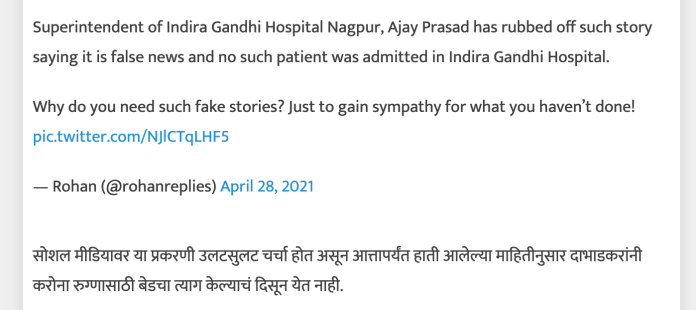
Loksatta had run a ‘fact-check’ story discrediting the sacrifice of Dhabadkar and his family based on an unverified video which now stands deleted, uploaded by a Twitter handle named ‘rohanrtweets’. The report had claimed that the story of the sacrifice by the octogenarian is false and no such patient was admitted at the Indira Gandhi Hospital in Nagpur.
However, the fact is that Dhabadkar was admitted at Indira Gandhi Rugnalaya run by Nagpur Municipal Corporation, while Loksatta report was seemed to be based on people talking to Indira Gandhi Government Hospital run by the Maharashtra Government, where he was not admitted.
Deleted Tweet of the user who uploaded unverified news
The report received a backlash on social media by users who were quick to flag the discrepancy and falsehood of the report. Loksatta’s English counterpart- the Indian Express itself negated the fact-check carried by the Marathi newspaper by confirming the sequence of events with the hospital authorities.
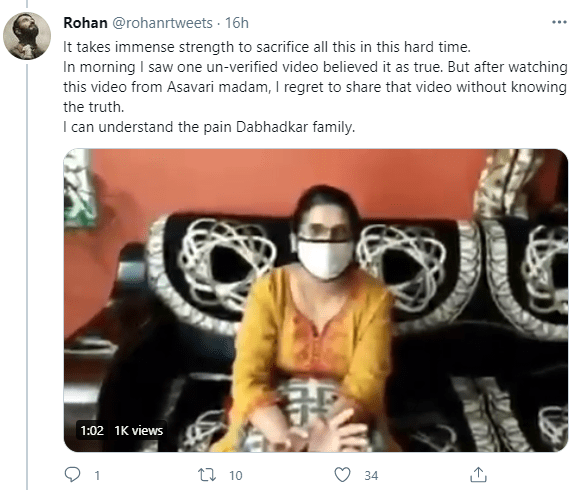
A video was uploaded by Asawaree Dhabadkar, Narayan Dhabhadkar’s daughter to set the record straight.
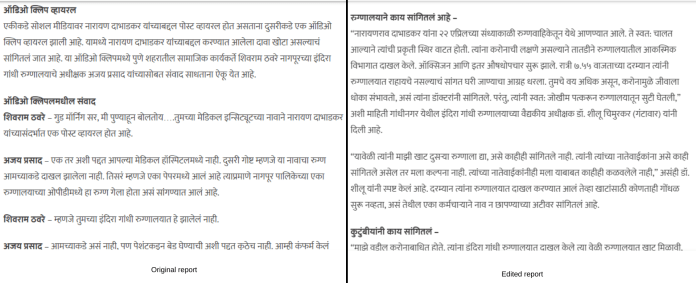
Loksatta then quietly edited its report and quickly added a statement by Anil Sambre, the Vidarbha region campaign chief of the Rashtriya Swayamsevak Sangh to validate Dhabadkar’s sacrifice. The statement said, “The incident involving our senior RSS volunteer Narayanrao Dabhadkar is true. He begged the hospital to discharge him, give his bed to others, and be allowed to go home. However, Dabhadkar is being deliberately misrepresented on social media by some people.”
Edited article by Loksatta
Loksatta had also quoted the original Tweet from where it had picked up the story. The Tweet now stands deleted with the user apologizing for spreading falsehood.
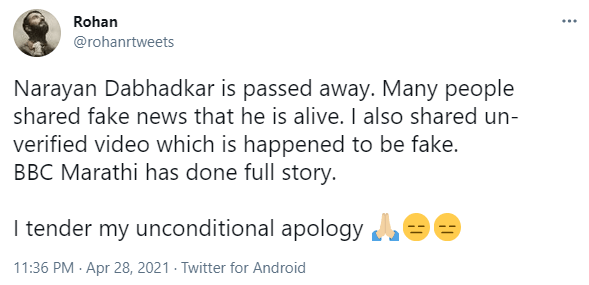
Here’s the sequence of his Tweets
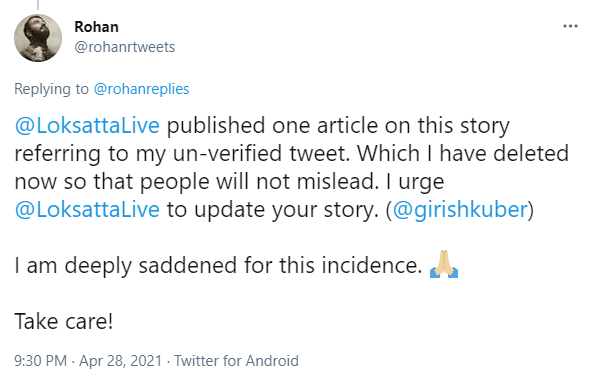
The Twitter user ‘rohanrtweets’ confessed to Loksatta publishing an article based on his unverified video and requested them to update their story. His Tweet reads, “@LoksattaLive published one article on this story referring to my un-verified tweet. Which I have deleted now so that people will not mislead. I urge @LoksattaLive to update your story. I am deeply saddened for this incidence.”
rohanrtweets confesses to uploading unverified video
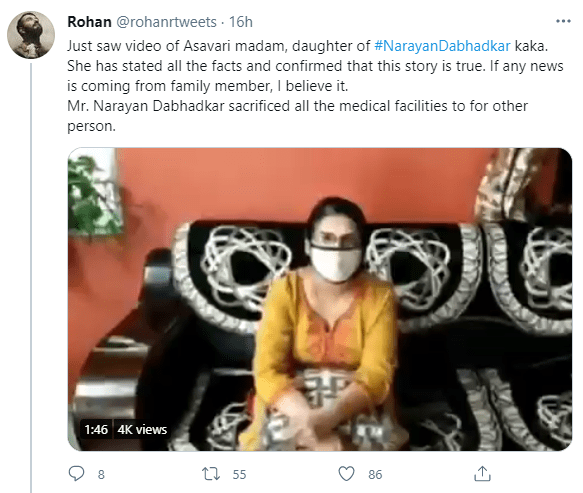
Replugging Asawaree Dhabadkar, Narayan Dhabadkar’s daughter’s video narrating the actual incidence, he wrote, “Just saw video of Asavari madam, daughter of #NarayanDabhadkar kaka. She has stated all the facts and confirmed that this story is true. If any news is coming from family member, I believe it. Mr. Narayan Dabhadkar sacrificed all the medical facilities to for other person.”
“It takes immense strength to sacrifice all this in this hard time. In morning I saw one un-verified video believed it as true. But after watching this video from Asavari madam, I regret to share that video without knowing the truth. I can understand the pain Dabhadkar family,” he continued in another Tweet.
The user has tendered an unconditional apology for circulating fake and unverified video.
He also said that many people had shared another fake news that Narayan Dhabadkar’s death was being faked and that he is still alive. However, that is incorrect as Dhabadkar had indeed died, giving up medical facilities for someone else.
Summer afternoons are best spent in a comfy, shaded spot, a glass of lemonade at hand, engrossed in a book. We asked Monitor staff to share their summer favorites.
I spend a lot of time in upper Maine, and nearby is the Big Chicken Barn, one of those huge junk/antiques/old books barns that dot New England. Two summers ago I picked up a used copy of the first volume of “A Dance to the Music of Time” series by Anthony Powell for some reason. “A Question of Upbringing” is a novel that portrays a sort of social realism for upper-class England starting in the 1920s, going through World War II, and into the ’50s and ’60s. I could not put it down, and over a year and a half I tracked down the rest of the series (it’s a 12-volume set) and read the whole thing as a great antidote to the 2020 election chaos in Washington.
My wife even bought me a Powell biography that also identifies the real people behind all the characters.
Why We Wrote This
What do reporters and editors read over their summers? We asked the staff to share their go-to books for laid-back days. They offered suggestions that span many genres and moods.
Powell was probably better known back in the 1970s as a friend of Martin Amis and George Orwell, etc. I picked it up because I’d heard the book referenced in some class I took as an English major, lo, those many years ago.
I know this is a kind of weird summer read, but I found it immensely relaxing.
– Peter Grier, senior Washington correspondent
Last year, books about race flew off bookstore shelves. “The Color of Water: A Black Man’s Tribute to His White Mother,” a memoir by James McBride, fell into my lap, a castoff from a relative who was cleaning house. I was immediately hooked by McBride’s prose and the mysteries of his fierce Jewish mother, who raised 12 Black children without ever discussing race. Entangled in this rich, yet breezy memoir are threads of what it means to be an “other” that echo loudly 25 years after its original publication.
– Noelle Swan, Weekly editor
I bought Wayétu Moore’s “She Would Be King” in the early fall of 2018 at a book festival in St. Louis. The cover’s hues of serene blues and an illustration of a dark-skinned woman with fiery red hair caught my eye. Moore’s captivating prose weaves in and out of time and place from Virginia to Monrovia, Liberia, telling the story of warriors and heroes with supernatural abilities designed for liberation. And at the end, the tales of survival and rebirth made me, a person of Liberian heritage but estranged from that part of my identity, feel just as full of a resurrected hope as the characters Moore made.
– Ashley Lisenby, multimedia reporter and writer on race and equity
While renting a house in coastal Rhode Island years ago, I saw a worn copy of Pat Conroy’s “The Prince of Tides.” The fact that it had been made into a major motion picture almost discouraged me from reading it, but when I opened the first page, Conroy’s musical descriptions of the South Carolina coast pulled me in. I’ve been a fan of his ever since.
Something I’ll be reading this summer: I’m a big fan of the short story, and have had T.C. Boyle’s “Stories II: The Collected Stories of T. Coraghessan Boyle” in my bookcase for several years. I’ve been avoiding it because it’s 900 pages long, but I started this week and am enjoying it so much I ordered a used version of the preceding volume, “Stories: The Collected Stories of T. Coraghessan Boyle” from my favorite used book store – another 800 pages.
– Greg Fitzgerald, communication manager
The American coming-of-age story, “A Tree Grows in Brooklyn,” sat on the shelf in my childhood home, but I didn’t get to it until recently, when my book club decided to read a “classic” for a change. No wonder Betty Smith’s novel became an immediate bestseller when it was first published in 1943. Rich in detail and heart, it takes you to the tenements of Brooklyn in 1912, where 11-year-old Francie Nolan collects junk for pennies with her brother, their practical mother scrubs floors to keep a roof over their heads, and their charming, singing-waiter father battles drink. But Francie finds beauty among the ashes, resilience in hardship, and love in flawed people. Just like the tree that grows from cement outside her window, she thrives.
– Francine Kiefer, West Coast bureau chief
You know that old saying about how everyone wants to write a book? (I mean, I’m one of those wannabes myself.) Lily King’s “Writers Lovers” cuts right through the cliché. The story follows a woman in her 30s navigating the anxieties and absurdities of life as an aspiring novelist. But despite its all-too-real portrayal of the agony of writing – not to mention trying to get published – the book somehow made me want to risk the attempt even more. Maybe it was the pleasant tinge of ’90s nostalgia throughout (the story is set in 1997), or the aching vulnerability of the main character, Casey. Either way, a great read for those who love to write – or want to understand people who do.
– Jessica Mendoza, multimedia reporter
“Harry Potter” is synonymous with summers in Maine for me. Our three sons were just the right age for the books as they arrived – in a brilliant bit of marketing – one by one every July, Harry’s birthday month. We’d often be visiting the boys’ grandparents then. We’d rush out to buy the latest volume and race home to start reading it aloud in the electronic media-free home. Even better was when the audio version arrived. Then we’d pile into the family van after dinner and go for “‘Harry Potter’ rides,” listening to the cassettes as the sun set and the moon rose through pine trees and across seascapes on the winding rural roads of Downeast Maine.
– Owen Thomas, The Home Forum editor
The feeling of summer starts in the first paragraph of “Beautiful Ruins,” when “shards of sunlight broke on the flickering waves.” But that’s not all that makes this a favorite vacation read. There’s the “dying actress” in her wide-brimmed hat, the scenes of the Italian coast, the love stories across time and place, the laugh-out-loud trials of a young Hollywood script reader – and above all, author Jess Walter’s glistening sense of satire and humanity.
– Stephanie Hanes, environment writer
One of my favorite books is set at Walden Pond, my favorite Massachusetts swimming spot. Little-known fact: Henry David Thoreau once accidentally burned 300 acres of the surrounding woods. The inferno also threatened the nearby town of Concord. This 1844 incident inspired John Pipkin’s literary novel “Woodsburner.” The tale follows Thoreau and several fictional characters as the encroaching blaze transforms their lives and their way of thinking. Since its 2009 release, this page-turner has largely been forgotten. But its story is indelible.
– Stephen Humphries, chief culture writer
I never knew comics could attain the power of great literature until I came upon the work of Yoshihiro Tatsumi. The Japanese artist pioneered a realistic, socially conscious style of manga, called gekiga, in the 1960s and ’70s. His two collections, “Abandon the Old in Tokyo” and “Good-Bye,” often explore the inner crisis of working-class men amid Japan’s postwar economic boom. Taut and cinematic, Tatsumi’s stories are about things people don’t want to admit to themselves, yet you can’t look away.
– Jingnan Peng, multimedia producer
If you are looking for a read that goes down as smoothly as green grapes on a hot beach, pick up Alexander McCall Smith’s series “The No. 1 Ladies’ Detective Agency.” It follows the adventures of Precious Ramotswe, Botswana’s premier lady detective. Mma Ramotswe wants nothing more than help people by solving their problems, er, mysteries. You won’t want to stop once you start. It’s a good thing you’ll have the summer to catch up and get ready for the 22nd installment, “The Joy and Light Bus Company,” which will be released this fall.
– Kendra Nordin Beato, staff editor and writer
David Sedaris’ essays impel me to read aloud and laugh communally – at the beach, on a road trip, and sometimes at the dinner table. “The Best of Me” is his umpteenth anthology, but his acid-eyed candor (sparing no one, including himself) and compassionate heart bring a fresh, absurdist lens to the unexpected – from sensible French health care to heady American real estate.
– Clara Germani, enterprise and development editor
As a novel that’s become emblematic of the original Roaring ’20s, “The Great Gatsby” may be suited to a summer that could herald the start of another age of excess, as the pandemic recedes. But F. Scott Fitzgerald’s 1925 novel isn’t a paean to hedonism. Far from it: Jay Gatsby’s quest ends in failure and death. His gauzy parties are tragicomedies, seen through the eyes of narrator Nick Carraway. I read and reread “The Great Gatsby” for its deft storytelling and probing of the morality of its era, one both remote and recognizable a century on.
– Simon Montlake, senior writer
When genius architect-turned-recluse Bernadette Fox disappears, her teenage daughter must find out where she’s gone – and where she came from. Humor and warmth pervade Maria Semple’s second novel, which offers a sharp satire of the Seattle elite and a moving tale of a mother-daughter bond. Told in part through police reports, TED Talk transcripts, and private emails between PTA moms, “Where’d You Go, Bernadette” is tough to put down.
– Lindsey McGinnis, junior editor
The sparkly, paint splotched cover of “Untamed” by Glennon Doyle called out to me when I was stranded in the Wi-Fi dead zone that was my new apartment. In this bestselling memoir, Doyle takes you through a journey of self-discovery and courage. Mundane snippets of everyday life – from airports to soccer practice to phone calls – are woven with the color of Doyle’s innermost thoughts on relationships, work, and family. “Untamed” reveals the hidden superpower in us all: “our Knowing.” The lessons on how to harness this superpower are shared, not in the demanding tone of a coach on the sidelines, but in the tender voice of a sister giving advice. I was left feeling empowered to examine my own social conditioning and with the weird desire to sit in silence with the whirlwind of my own thoughts.
– Tara Adhikari, intern
I have two history reads from last summer. My husband and I went on a cross-country road trip and one of our stops was Kansas City, Missouri, to see the Negro Leagues Baseball Museum and the American Jazz Museum, which are right next door to each other in the city’s historic district. As a result of that visit I picked up two books. The first was “The Best Pitcher in Baseball: The Life of Rube Foster, Negro League Giant” by Robert C. Cottrell. Many baseball fans know about Satchel Paige and the great ball players from the Negro Leagues, but not as much about the founder of the league. The business guy behind it all has a story as well.
The second book was “Wide-Open Town: Kansas City in the Pendergast Era,” a collection of essays about the city in the years between the two world wars.
– Mary Ann Lomascolo, Project Management office manager
Versatile British actor Paul Ritter, who appeared in the “Harry Potter” franchise and played a key figure behind nuclear disaster in “Chernobyl,” has died, his agent said Tuesday. He was 54 and had been suffering from a brain tumor.
Also Read | Get ‘First Day First Show’, our weekly newsletter from the world of cinema, in your inbox. You can subscribe for free here
A familiar face to British television viewers and theatregoers, Ritter played Martin Goodman, the eccentric father of a London Jewish family, in the Channel 4 sitcom “Friday Night Dinner.”
He also played ill-fated nuclear engineer Anatoly Dyatlov in the HBO drama “Chernobyl” the wizard Eldred Worple in “Harry Potter and The Half-Blood Prince;” and a devious political operative in the James Bond film “Quantum of Solace.”
Ritter was a frequent cast member in productions at Britain’s National Theatre, including “All My Sons,” “Coram Boy” and “The Curious Incident Of The Dog In The Night-Time.” He also appeared in “Art” at London’s Old Vic and on a West End stage as Prime Minister John Major, performing opposite Helen Mirren as Queen Elizabeth II in the royal drama “The Audience.”
The actor was nominated for a Tony Award in 2009 for his performance in Alan Ayckbourn’s farce “The Norman Conquests” on Broadway.
Actor Russell Tovey said Ritter was “one of the nicest and best actors you’ll ever meet.”
Actor-comedian Rob Delaney tweeted that Ritter had “knocked it out of the PARK in Chernobyl. Watching it I consciously thought, ‘Oh, we have a new movie star.’ Between that how funny he was in Friday Night Dinner… just unreal talent.”
Agency Markham, Froggatt Irwin said Ritter died Monday night “peacefully at home with his wife Polly and sons Frank and Noah by his side.”
“Paul was an exceptionally talented actor playing an enormous variety of roles on stage and screen with extraordinary skill,” the agency said. “He was fiercely intelligent, kind and very funny. We will miss him greatly.”
Developed by Avalanche Software (Disney Infinity) and set for release in 2021, the title is described as an open-world RPG that takes players beyond Hogwarts to new and familiar locations, as they “live the unwritten and embark on a dangerous journey to uncover a hidden truth of the wizarding world.”
As the game story begins, players grow their magical abilities by mastering spells, brewing potions and taming fantastic beasts.
“Hogwarts Legacy is filled with immersive magic, putting players at the centre of their adventure to become the witch or wizard they choose to be,” Warner said in a prepared statement.
“They will grow their character’s abilities as they master powerful spells, hone combat skills and select companions to help them face off against deadly enemies. Players will also encounter missions and scenarios that will pose difficult choices and determine what they stand for.”
David Haddad, the president on Warner’s games division, added: “Hogwarts Legacy gives players control over their own experience with RPG gameplay unlike anything else in the Wizarding World, which will continue to build fan appeal in the Portkey Games label.
“Avalanche has brought to life this rich and deep world, full of action-packed magic, as well as a detailed, mysterious story to engage fans and gamers alike.”
Avalanche GM said: “It’s such an honour to work on such an amazing franchise and the team is dedicated to delivering an authentic Wizarding World experience that both Harry Potter and RPG fans will enjoy.
“Hogwarts Legacy is so special because it allows players to immerse themselves in a new narrative that is filled with complex characters, and, of course, magic.”
It’s 2021, and a new Collector’s Edition wand is out! Rather than being just a bit of wood to sit on your shelf, these wands do so much more. This item also acts like the other interactive wands found in Ollivander’s.
If you haven’t been to Universal Orlando to visit Hogsmeade and Diagon Alley, I’ll give you the rundown. Certain shops and areas throughout the two-park encompassing land have designated spots for those with wands. Step up to the display or prop, wave your wand, and watch the magic happen.
Stuff happens. Lots of stuff. Stuff everywhere. I won’t ruin it for those who haven’t been. Fans of the books and films really love this level of immersion, t hough. Oh, if only Galaxy’s Edge copied Universal’s homework a bit more when it comes to that.
I truly hope my daughter doesn’t find out about this… She loves Harry Potter, but that trip isn’t cheap! Basic wands cost $55, while the CE version below runs at $70.
Universal Orlando Resort
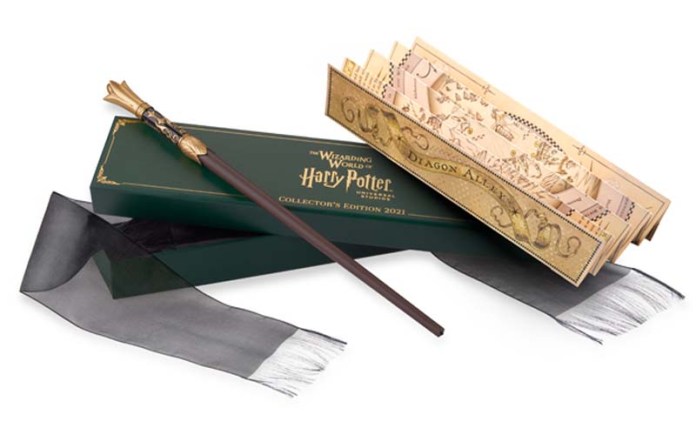
The wand is sculpted in resin and features a hand-painted grip.
Here’s what’s included with the 2021 Collector’s Edition wand:
Interactive wand
Collectible wand box
A map that marks all the locations where you can cast spells in ‘The Wizarding World of Harry Potter’ at Universal Orlando Resort.