logo
Already a member? Login here

Harry Potter´s archives ↓

Harry Potter actor Katie Leung says she faced racist attacks for playing Cho Chang, was asked to keep quiet

Katie Leung, who played the role of Cho Chang in the Harry Potter movies, has said that she faced racist attacks after she was cast in the franchise. She also revealed that she was asked by her publicists to deny what she experienced.

Leung said while speaking on the Chinese Chippy Gir‪l‬ podcast, “I was, like, googling myself at one point, and I was on this website, which was kind of dedicated to the kind of Harry Potter fandom. I remember reading all the comments. And yeah, it was a lot of racist s***.”

Leung’s character was introduced in Harry Potter and the Goblet of Fire, the fourth film of the series. She was a student of Hogwarts School of Witchcraft and Wizardry, and belonged to the Ravenclaw house. Robert Pattinson’s character Cedric Diggory was her boyfriend before he was killed by Voldemort.

Later, she became Harry’s love interest. She appeared in three more Harry Potter movies: Harry Potter and the Order of the Phoenix, Harry Potter and the Half-Blood Prince and Harry Potter and the Deathly Hallows – Part 2.

Leung added that she found an entire website spewing hate for her. She talked to her publicists about it,. “I remember them saying to me, ‘Oh, look, Katie, we haven’t seen these, these websites that people are talking about. And you know? If you get asked that, just say it’s not true, say it’s not happening,’” she added.

James and Oliver Phelps were unaware which Weasley twin they were playing in Harry Potter

English actors and brothers James and Oliver Phelps played the role of mischievous twins Fred and George Weasley in Harry Potter movies. Now, the brothers have revealed that they did not know which twin they were supposed to be playing until a few minutes before the table read for the first movie — Harry Potter and the Philosopher’s Stone. While James played the role of Fred, Oliver portrayed George.

The brothers revealed the tidbit to their co-star in the franchise Evanna Lynch on their podcast Normal Not Normal. The topic of the episode was Lynch’s upcoming memoir. Lynch played the role of Luna Lovegood in Harry Potter movies. Oliver said on the latest podcast episode, “We’re talking five minutes before we’re supposed to start, we still had no idea who was Fred and who was George.” The actor added that when he enquired the casting director about the same, she thought he was kidding.

Oliver added, “Now we always like to think they just … ‘Oh, you didn’t get the memo about the huge meeting we had in Burbank with like 50 people on the call. But in hindsight, it was probably either Chris, David, or J.K. Rowling just saying … ‘James is Fred.’”

Published by Headline Books, Lynch’s memoir chronicles her struggle with an eating disorder, recovery and commitment to her dreams. “In one way, this book is a memoir about my struggle with an eating disorder. However, it’s not really a book about thinness and eating; it’s about rebuilding yourself after, literally recovering yourself,” she wrote on Instagram while announcing the memoir recently.

The World’s Only Harry Potter Flagship Store Welcomes Customers Through The Doors For The First Time

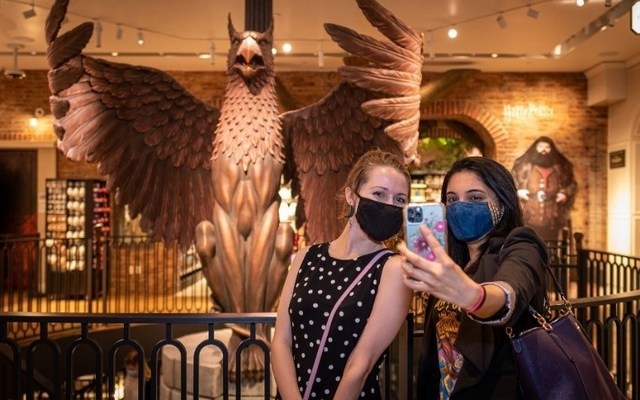
NEW YORK, June 3, 2021 /PRNewswire/ — Today, Harry Potter fans from across the world were welcomed into Harry Potter New York as the flagship store opened its doors to the public for the first time. Greeted by a 220lb model of Fawkes the Phoenix, fans discovered a host of magical creatures and hand-made props throughout the immersive retail experience including Voldemort’s horcrux, Nagini, bursting through the ceiling in an area inspired by the Dark Arts.

The World’s Only <a href='http://www.movierental.com/link/potter'>Harry Potter</a> Flagship Store Welcomes Customers Through The Doors For The First Time

The World’s Only Harry Potter Flagship Store Welcomes Customers Through The Doors For The First Time

With 15 themed areas and thousands of products, every aspiring witch and wizard will find something magical to add to their collection. Fans explored areas inspired by Honeydukes to find Bertie Bott’s Every Flavour Beans and Chocolate Frogs before stopping under the Dirigible Plum tree to find their favourite creature soft toy. Customers were invited to step into Hagrid’s boots to see how they measure up and duel other customers at the store’s interactive wand table.

”We’re delighted to be welcoming fans to Harry Potter New York for a completely new shopping experience,” said Sarah Roots, EVP Warner Bros. Worldwide Tours and Retail. “Not only will visitors find the largest range of Harry Potter and Fantastic Beasts products under one roof, they will also get to discover up-close some of the hand-crafted props that were seen in the films, use our unique photo opportunities and experience the incredible theming throughout the store.”

Harry Potter New York has a virtual queueing system in place. When customers visit the store, they will scan a QR code to join a virtual queue and return when notified. Harry Potter New York is open from 10am9pm Mon-Sat and 11am-7pm on Sundays.

Fans can keep up to date by following Harry Potter New York’s social channels or signing up to our newsletter.

Facebook.com/HarryPotterNewYork
Twitter.com/HarryPotterNY  
Instagram.com/HarryPotterNY

Notes to Editors

COVID-19 – For the safety of customers and colleagues, masks are required when visiting Harry Potter New York. The store is operating with a reduced capacity to ensure physical distancing is maintained.

About Wizarding World

More than two decades ago, a young Harry Potter was whisked onto Platform 9¾ at King’s Cross Station, and readers everywhere were swept along with him into a magical universe, created by J.K. Rowling. In the years since, the seven Harry Potter bestsellers have inspired eight Blockbuster movies, an award-winning stage play, and, more recently, the start of the Fantastic Beasts five-film series. People of all ages have been enthralled by these extraordinary adventures, set within an expanding universe, inspired by the vision of J.K. Rowling. 

For today’s growing worldwide fan community, and for generations to come, the Wizarding World welcomes everyone to explore more of this magical universe — past, present and future. The Wizarding World also provides fans with an instant, trusted kite-mark of quality and authenticity.

Harry Potter New York will be part of an expanding portfolio of Warner Bros. owned Wizarding World experiences that include Warner Bros. Studio Tour London – The Making of Harry Potter, Warner Bros. Studio Tour Tokyo and the Platform 9 ¾ retail shops. 

Sign up to receive more information at HarryPotterStore.com 

#HarryPotterNY

SOURCE Harry Potter New York

Related Links

http://HarryPotterStore.com

OnePlus Watch Harry Potter leak is something we never saw coming

Every so often, OnePlus makes partnerships with brands and franchise holders in order to advertise both its devices as well as another company’s products. So far, those partnerships have been limited to phones, mostly because those are its main products anyway. The arrival of the OnePlus Watch, however, also comes the opportunity for new ties and the company may have pulled enough strings to pull of a OnePlus Watch Harry Potter Limited Edition.

Click here to read more

Chimamanda Ngozi Adichie’s cancel culture screed is a distraction from her transphobic comments

One of the worst aspects of any cancel culture debate is the tendency to obscure, deny, and dismiss as invalid any actual harm caused by whatever sparked the debate. Frequently, this cycle is tied to transphobia: Prominent public figures who’ve been criticized for making transphobic statements have frequently mounted angry backlashes against “cancel culture” as a way of denigrating their critics.

The latest person to fall into this pattern is the well-known feminist author Chimamanda Ngozi Adichie.

Earlier this week, Adichie published a lengthy and eloquent takedown of cancel culture on her personal website. In the essay, which has an estimated reading time of 16 minutes, she personally discusses two former students of hers, people who she feels have personally attacked and maligned her as a transphobe.

Though Adichie does not name either of the two former students, one of them appears to be Nigerian writer and queer activist OluTimehin Adegbeye. The other appears to be writer (and Vox Book Club selected author) Akwaeke Emezi, who is nonbinary. Both have spent the past several years criticizing a series of Adichie’s public statements that have seemed to increasingly embrace transphobic ideology and language — a framing Adichie claims is false.

Since 2017, Adichie has drawn criticism from trans activists for seeming to embrace rhetoric championed by trans-exclusionary radical feminists (TERFs), who argue that trans women are not women — and for dismissing her critics when called out. Adichie doesn’t really confront this history in her essay. Instead, she characterizes the two former students as manipulative, and accuses them of using progressive social justice rhetoric to mask motivations that are, respectively, “calculating and insincere,” and “seeking attention and publicity to benefit themselves.”

It’s not precisely clear what prompted Adichie’s essay, though many observers have questioned her motives in choosing to publish it during Pride Month. That timing, along with the letter’s tone, has made Adichie’s post come off as a direct attack against the individual students the essay refers to, even if she does not name them.

Notably, the essay glosses over and decontextualizes criticisms the two former students have made against her, in order to claim that their statements were both personal and “violent.” For example, without directly quoting anyone, Adichie writes that one of the students in question “asked followers to pick up machetes and attack me” — an apparent reference to a January Twitter thread in which Emezi wrote: “I trust that there are other people who will pick up machetes to protect us from the harm transphobes like Adichie [J.K.] Rowling seek to perpetuate. I, however, will be in my garden with butterflies, trying to figure out how to befriend the neighborhood crows.”

Adichie devotes the final third of her essay to condemning a polarized social media climate, essentially lashing out against cancel culture, which she describes as “obscene.” She writes:

There are many social-media-savvy people who are choking on sanctimony and lacking in compassion. … People who wield the words ‘violence’ and ‘weaponize’ like tarnished pitchforks. …

I have spoken to young people who tell me they are terrified to tweet anything, that they read and re-read their tweets because they fear they will be attacked by their own. The assumption of good faith is dead. What matters is not goodness but the appearance of goodness. We are no longer human beings. We are now angels jostling to out-angel one another. God help us.

Across social media, this finale to Adichie’s essay has been greeted by many with praise and glee. Though others have expressed reservations because of her attitude toward cancel culture and her minimization of her own words, much of the reception has indeed been positive. The public loves a good takedown, and hers is one of the most savage we’ve had in a while.

It’s also the most pernicious.

In a rush to praise the most quotable parts of Adichie’s cutting essay, many on the left have joined notorious transphobes, TERFs, and their allies, including signatories of the infamous 2020 Harper’s open letter against the concept of cancel culture.

As with that letter, which was signed by several figures who had publicly expressed transphobic views, transphobia has inevitably attached to the conversation around Adichie’s essay. On Twitter, those who say they are boycotting Adichie in response to learning of her transphobia are being harassed. Adegbeye has locked her Twitter account; Emezi’s has been flooded with detractors.

Worst of all, a conversation that should have been about transgender identity has been reframed. Now it’s about how “difference of opinion doesn’t mean hatred” and how social media “amplifies pathological and anti-social tendencies.” Adichie’s essay minimizes and obscures her original actions and speech, and fans of the essay have joined her in that effort. They’re helping to further discredit Adegbeye and Emezi and the message they’ve been trying to amplify.

We’re having the wrong conversation — not the one about cancel culture, but the one about whether one of the most famous feminists in the world is actually transphobic, and what it means for trans women if she is.

Looking at the history of Adichie’s run-ins with the trans community, it’s clear that Adichie, not her critics, placed herself in this position, and that like many people who’ve faced similar callouts by vulnerable communities, she’s now calling out “cancel culture” as a tool of misdirection.

Adichie’s public clashes with trans women and their allies date back to 2017

Adichie shot onto the global stage in 2006 with the publication of her acclaimed novel Half a Yellow Sun. Since then, she’s been a prominent author and an even more prominent feminist. In 2014, her viral TED talk (which was later published as a book) We Should All Be Feminists drew raves and wound up sampled in Beyonce’s song “Flawless.” Suffice to say, she’s not just a feminist — she’s a prominent feminist voice and, for many people, a crucial entry point to the entire concept of feminism.

In 2017, Adichie sat for an interview where she explained feminism for Britain’s Channel 4 News. In it, she responded to the question, “If you’re a trans woman who grew up as a man … does that take away from becoming a woman — are you any less of a real woman?” (For the purposes of this argument, let’s set aside the issue with asking this question of a cisgender woman who has no idea what the experience of being a trans woman is like.)

Adichie answered:

When people talk about, “Are trans women women?” my feeling is trans women are trans women. But I think if you’ve lived in the world as a man, with the privileges the world accords a man, and then sort of change — switch gender, it’s difficult for me to accept that then we can equate your experience with the experience of a woman who has lived from the beginning in the world as a woman and who has not been accorded those privileges that men are.

I don’t think it’s a good thing to conflate everything into one. I don’t think it’s a good thing to talk about women’s issues being exactly the same as the issues of trans women. What I’m saying is that gender is not biology. Gender is sociology.

Adichie’s point that trans women have very different experiences than cisgender women is well-made and very important. Trans women experience higher rates of sexual assault and domestic violence, homelessness, suicide, and suicide attempts than cisgender women, and they’re more likely to be re-victimized when they seek support. Further, Adichie’s insistence that gender is tied to sociology, not biology, is a crucial distinction in the debate over trans rights — one backed by science.

But Adichie’s response also felt alarmingly aligned with the rhetoric of TERFism. People who buy into TERFism explicitly paint trans women as manipulative straight cisgender men, sexual predators just using a fake identity as “trans women” to get close to cisgender women in order to assault them. Millions of people subscribe to strains of this dangerous belief, including prominent public figures like Harry Potter creator J.K. Rowling.

Adichie’s statements shared a number of commonalities with TERFism, starting with the idea that trans women “change — switch gender,” inaccurate phrasing which seems to discount gender dysphoria and the feeling of gender-centered disconnect between one’s brain and one’s body that many trans people experience throughout their lives.

Her depiction of trans women as being born with substantial amounts of male privilege also hewed uncomfortably close to the TERF argument that trans women don’t lose male privilege if they transition. As the transgender actress Laverne Cox has said, “the binary narrative, which suggests that all trans women transition from male privilege, erases a lot of experiences.”

Most especially, Adichie’s refusal to say the oft-uttered words, “trans women are women,” and instead insist that “trans women are trans women” is a phrase that can easily stand in for a denial of trans identity. As Emily Crockett explained for Vox in 2017, “when trans advocates and allies say that ‘trans women are women, they’re not actually trying to say that transgender women are the same as cisgender women (women who aren’t transgender). They’re trying to say that these differences shouldn’t disqualify trans women from the broader category of ‘womanhood.’”

Adichie’s original comments in the interview regarding her wariness about “conflating women’s issues” with “trans women’s issues” made it difficult to tell whether she believes trans women do belong to that broader category of womanhood. Consequently, when trans activists heard Adichie use phrases as loaded as these, they were immediately on alert. Adichie later responded in a Facebook post in which she apologized and called her critics “valid” but also doubled down on much of her rhetoric about male privilege and inherent differences between cisgender women and trans women.

If Adichie had stopped speaking about this issue, the moment might have retained its ambiguity and lack of clarity — though it’s worth noting that, a year later, she seemed to dismiss the entire debate as “trans noise.”

In 2020, Adichie spoke out again, this time in defense of a transphobic manifesto published by J.K. Rowling, and her new comments framed her earlier ones in a much different light.

Rowling’s piece is rife with overt expressions of harmful TERF ideology, depicting trans teens as being merely influenced by Tumblr culture rather than experiencing actual dysphoria, and tying gender to biology despite clear scientific consensus to the contrary. Instead of acknowledging the 50 percent of trans people who experience sexual abuse or assault, Rowling uses her own status as a survivor of domestic violence to explain why she’s so afraid that trans women might be a threat to cisgender women, loudly expressing fear of what might happen “when you throw open the doors of bathrooms and changing rooms to any man who believes or feels he’s a woman.”

From start to finish, it is textbook transphobia, published by a woman with incredible cultural influence.

In November 2020 — during Transgender Awareness Week — the Guardian published an interview with Adichie in which she articulated her dislike of cancel culture. Then, out of nowhere, she offered a defense of Rowling’s “perfectly reasonable” piece, calling her “a woman who is progressive, who clearly stands for and believes in diversity,” and decrying the social media outrage against her as “cruel and sad.”

To date, the reaction to Rowling’s manifesto remains one of the clearest examples of a pattern that Adichie’s essay now upholds. From the moment Rowling published her manifesto, much of the conversation around it centered on how left-wing zealots wanted to “cancel” a beloved children’s author — with the result being that the cancel culture backlash frequently obscured the harm at the center of a transphobic argument.

Condemning cancel culture has become a reliable way to obscure transphobia. That has real, harmful consequences for trans people.

The public support of Rowling’s contemporaries — figures like Adichie and the 58 British public figures who defended Rowling in an open letter last fall — furthers the narrative that anyone who’s upset is just an angry social justice warrior. Meanwhile, trans and nonbinary people like me are left smarting from the damaging impact of her words, which empower other public figures to promote a toxic, deeply regressive argument that denies trans women their humanity.

The idea that Adichie, with all her understanding of the struggles that trans people face, could read Rowling’s words and frame them as part of a “progressive worldview” is maybe the gaslight of all gaslights. I cannot see it as anything but a full embrace of TERFism.

I also find it impossible to interpret her new essay as anything but another iteration of a pattern in which railing against cancel culture becomes a tool to dismiss legitimate arguments about the hateful thing you said and did.

This conversation should be about trans identity. It should be about how awful it is for trans and nonbinary people to see beloved figures like Rowling and Adichie promoting an ideology that insists we’re not really the gender we say we are, that we’re liars and sexual predators, that we’re chasing a social media fad and performing wokeness for leftist clout, that we’re making it all up. It should be about figuring out why women with so much education and so much initial empathy wind up adopting a belief system so dedicated to othering people who are already vulnerable and at-risk.

It should be about how political debates about trans identity negatively impact the mental health of 94 percent of trans teens. It should be about the damage that is done when respected public figures like Adichie and Rowling use their massive influence to air transphobic views under the guise of “perfectly reasonable” debate about whether trans women are women.

It should not be about what a sick burn Adichie delivered.

It is not difficult to write a takedown of cancel culture, or to explain why it’s so painful to be denied a good-faith conversation with people you have a personal relationship with. (Though according to the essay, Adichie apparently disliked and distrusted her two former students from the outset.)

It takes much more courage to grapple with the reason they denied you that interaction. That’s what Adichie should be doing now, instead of extending the pain she caused others to many more of her trans readers.

Adichie’s essay is a distraction. She should not, now, get to own the conversation about the harmful impact of her words and actions.


Will you support Vox’s explanatory journalism?

Millions turn to Vox to understand what’s happening in the news. Our mission has never been more vital than it is in this moment: to empower through understanding. Financial contributions from our readers are a critical part of supporting our resource-intensive work and help us keep our journalism free for all. Please consider making a contribution to Vox today from as little as $3.

Harry Potter faces competition as amateur magicians use the lockdown to master tricks

Many magicians work on perfecting the disappearing act. But in the case of Amaan Mahtani, it is his family that does the disappearing act, when he has a trick to practise on them… for the 10th time in a day.

The 11-year-old magic enthusiast spends at least four hours every weekend and an hour-and-a- half on weekdays, perfecting his craft. A fan of magic ever since his grandfather showed him the disappearing thumb trick at the age of six, Amaan says he managed to seriously pursue magic when the lockdown last year made everything go virtual, and outdoor play time shrunk drastically. “I took a magic course on Udemy, and constantly keep learning from YouTube channels such as MLT Magic Tricks, EvanEraTV and SpideyHypnosis,” he says.

Amaan’s repertoire now includes 30 tricks, including mentalism. “I came up with a few myself after a lot of trial and error,” he says. As we speak over a video call, he makes sponge balls disappear and reappear out of thin air. Gradually, his friends too became invested in the hobby. “I give them a few pointers but never part with secrets of the trade,” he laughs, adjusting his bow tie — Amaan’s always dressed for the part, with dreams of making it to America’s Got Talent some day.

Penn  TellerPenn  Teller

Thanks to free classes on YouTube channels, many have been drawn into the fascinating world of magic. International entertainers such as Penn and Teller are available on MasterClass teaching their skills for a small fee. “Knowing a few fun tricks can make one stand out at parties and other gatherings. It’s also a great ice-breaker,” says Chennai-based magician Arun Loganathan who has been teaching the craft for the last few years.

<a href='http://www.movierental.com/link/potter'>Harry Potter</a> faces competition as amateur magicians use the lockdown to master tricks<a href='http://www.movierental.com/link/potter'>Harry Potter</a> faces competition as amateur magicians use the lockdown to master tricks

Since 2020,he started taking virtual classes for students of all age groups — seven to 70 — from within the country as well as Switzerland, the US and Papua New Guinea. This means a lot of late nights and early mornings for Arun. “I have woken up at 3.30 am to teach a student in Philadelphia,” he says.

“The demand has gone up by 65% in one year,” says Arun adding that people are comfortable with online classes as they are more accessible and customised. His students are a mix of novices and those that learn off YouTube, who then approach him to learn advanced magic or the finesse and flourishes that go with the act. It is interesting to note that people do not mind spending hefty sums on acquiring a skill that may just be for recreational purposes; some of Arun’s international clients pay upto a lakh for 30 days.

Magicians are normally known to bamboozle their audience but Arun sometimes feels the tables turn when his young students already know the trick he is teaching and come up with different techniques to solve it. Thanks to Arun’s experience of over two decades in the field, he finds ways to keep challenging them.

While kids form 60% of the student base, magician Nikhil Raj from Bengaluru notices that his sessions for adults are mostly booked by corporates. “I conduct a 50-minute session for them which includes mentalism, illusions, conjuring and hypnotism,” says 25-year-old Nikhil, whose dad was also a magician.

<a href='http://www.movierental.com/link/potter'>Harry Potter</a> faces competition as amateur magicians use the lockdown to master tricks<a href='http://www.movierental.com/link/potter'>Harry Potter</a> faces competition as amateur magicians use the lockdown to master tricks

Although Nikhil has been conducting workshops for many years, the last year has been especially busy with over 500 children taking online classes. Sometimes parents learn along with their kids, at times it is the grandparents who learn to entertain their grandchildren… the clientèle is diverse. After completing their course, many of them also put up virtual shows for their families and friends.

Nikhil says that his workshops also weave in personality development and communication skills. “Magic workshops are a lot more than just learning tricks. It prepares you to face any situation that might arise during a show. There could be hecklers… You need to deal with them in a calm manner and make them your fan,” says magician Akshaya over a call from Pune.

Trained by her father, the 25 year-old has been performing on stage since she was three. She did her last show this year in Goa, in the month of April, and was all set to perform at a wedding in New York later this year, when the second wave of COVID-19 disrupted all plans.

<a href='http://www.movierental.com/link/potter'>Harry Potter</a> faces competition as amateur magicians use the lockdown to master tricks<a href='http://www.movierental.com/link/potter'>Harry Potter</a> faces competition as amateur magicians use the lockdown to master tricks

“COVID-19 is the reason I started teaching online last year in September, otherwise I would have never done it,” says Akshaya, who has conducted over 40 classes in the last eight months. Though she believes that magic should be experienced live, she says, “Virtual has its own charm and advantages. A lot of things can be done virtually that may not have been possible in a live show. But I can’t disclose what they are,” she laughs mysteriously.

Flair of the craft

Learning magic requires a lot of patience, hard work and constant practice. Not all students have the discipline to persevere. Those that stay are the ones with undying curiosity and dogged determination. “There is a saying, ‘You don’t get into magic, magic gets into you!,” says Akshaya.

“There is a joy when people look in wonder and ask ‘how did you do it’,” says Amaan, who often practises in front of the mirror — not because he is vain — to make sure he can see himself performing from all angles. “You have to make sure that you don’t give away anything from any angle,” he adds.

Akshaya records her practice sessions to make sure every movement is going according to plan. Sleight of hand is important. ‘You can learn the basics but you have to train your hands too’, is the common refrain.

While practitioners of this art form are often associated with vibrant costumes, over the top equipment and material, Arun, Nikhil and Akshaya are being practical and keeping it simple for now. “Because of the lockdown not everyone can access materials and kits, so it is best to use household items like pens, coins, cardboard…,” says Nikhil. “Ultimately, what matters is the finesse with which one performs a trick.”

Harry Potter event canceled over JK Rowling’s comments on gender: ‘Causing distress’

entertainment_29889_2
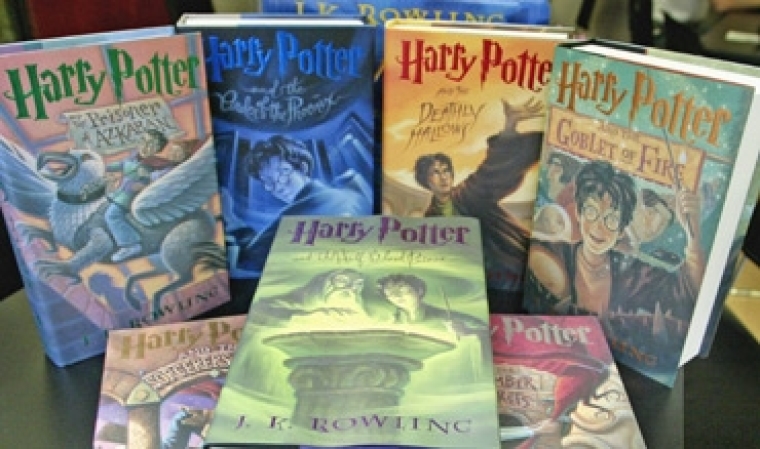
The seven-book print set of Harry Potter books autographed by author J.K. Rowling are seen at the National Braille Press in Boston, Wednesday, Oct. 3, 2007. Rowling rarely signs books, and the copies being auctioned, as part of the nonprofit’s annual fundraiser, by the Boston based press are the only known signed complete set in the U.S. | (Photo: AP Images / Bizuayehu Tesfaye, File)

Organizers of a book festival in New Zealand have canceled an event featuring the popular children’s book series Harry Potter over past comments on the transgender debate made by author J.K. Rowling.

The news website Stuff reported that the upcoming Featherston Booktown Karukatea Festival, an annual event scheduled to occur this weekend in New Zealand’s Wellington Region, decided to remove a Harry Potter-themed quiz because of the past comments on gender and women’s rights made by Rowling. 

Fantastic Beasts: The Crimes of Grindelwald
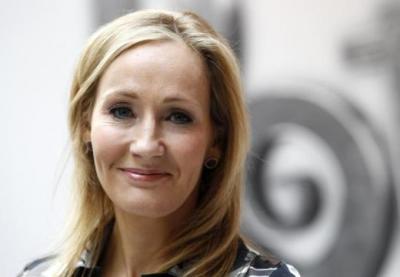
Writer J.K. Rowling | Reuters/Suzanne Plunkett

This action comes as this year’s book festival is slated to focus on the phenomenon of “cancel culture.” 

The term “cancel culture” refers to the effort embraced by many in popular culture to silence people with unfashionable views on certain topics by boycotting their products or canceling their engagements with organizations or events.  

According to Stuff, this year’s festival “will feature a panel discussion hosted by veteran broadcaster Ian Fraser examining the phenomenon of cancel culture and its impact on New Zealand art and literature.” 

In response to the outcry over the inclusion of the Harry Potter-themed quiz in the program, the festival’s board chairman, Peter Biggs, stressed that decision to pull the quiz event was not made “lightly.” 

However, the festival elected to nix the segment after consulting with members of the LGBT community, the literary sector and local supporters.

“The overwhelming response was there was a risk around causing distress to particular members of the community and that was the last thing we wanted to do,” Biggs said. “We always thought Booktown should be an inclusive, welcoming place for everyone, so we took the decision not to go with Harry Potter.” 

Rowling, a self-described feminist, came under fire last year for comments that critics have deemed transphobic. 

Addressing an op-ed that contained the phrase “people who menstruate” in the headline, Rowling sarcastically tweeted: “I’m sure there used to be a word for those people. Someone help me out. Wumben? Wimpund? Woomud?” The point of that tweet was to highlight that the correct “word for those people” is women. 

In a separate Twitter thread sent out on the same day, Rowling pushed back on the idea that “sex isn’t real.” 

“If sex isn’t real, there’s no same-sex attraction. If sex isn’t real, the lived reality of women globally is erased,” she wrote.

“I know and love trans people, but erasing the concept of sex removes the ability of many to meaningfully discuss their lives. It isn’t hate to speak the truth.”

Additionally, Rowling has criticized the use of cross-sex hormones. 

In an early July tweet, she specifically warned that “the long-term health risks of cross-sex hormones have now been tracked over a lengthy period,” adding “these side effects are often minimized or denied by trans activists.”

In December, Rowling revealed that she had received “heartbreaking letters” from women who regret taking cross-sex hormones. 

She stressed that “everybody should be free to live a life that is authentic to them, and that they should be safe to do so.” However, the author illustrated a need to have “a more nuanced conversation around women’s rights and around the huge increase in the number of girls and young women who are seeking to transition.” 

While most people who spoke with Stuff about the decision to pull the Harry Potter quiz from Booktown expressed support for the decision, one resident of Featherston held a divergent view.

Jenny Whyte, a lesbian and feminist activist, accused the book festival of “trying to capitalise on the current fad of cancel culture.”

“Featherston Booktown has a session selling tickets to a panel discussing cancel culture, so there’s an irony certainly,” she added. 

In addition, Whyte said that she shared some of Rowling’s views, describing them as “quite compassionate and reasonable.” She said that the fact that a “world-famous writer” from London faced pushback in “tiny little Featherston” over her views “encapsulates the whole madness of [cancel culture] quite well.”

Why Harry Potter: Wizards Unite failed to find the magic

A decade ago, with the movie release of Harry Potter and the Deathly Hallows: Part 2, the IP was at the peak of its power.

Estimated to be worth $25 billion, the assumption was it would continue an upward trajectory, moving into other mediums and spinoffs films, such as Fantastic Beasts and Where to Find Them.

Of course, there had been plenty of successful games but nothing of note on mobile. 

Then it happened. Warner Bros. went for the big guns.

In November 2017, it was announced that developer Niantic would take on the IP as its next big follow up to the smash hit that was (and still is) Pokémon GO.

Surely a match made in mobile heaven. Being able to explore the Wizarding World, brew potions and cast spells is exactly what every young muggle dreams of.

But 18 months on, the location-based title began rolling out, and immediately you could see the issues.

As someone that reviewed Wizards Unite, I was enthralled by the idea initially, but it became very clear that this was more of a Pokémon GO clone than a true Harry Potter experience.

That seems to have been the problem from day one, with nothing changing now nearly two years on.

Living in the shadow of Niantic’s catch ’em all phenomenon, Wizards Unite focused on bringing Pokémon GO players across, instead of making a case as to why “Potterheads” should jump in. That was its first mistake.

During the conclusion of my review, I stated that “for the game to really shine more needs to be done than duplicating features from its successful older brother,” and that “the enchanting community of Wizards Unite is fictitious.”

Two damming issues have persisted. Without a strong community behind it, there was no one to tell others to get involved.

Everyone remembers those first few months with Pokémon GO. The sun was high in the sky, no lockdown in sight and every street corner was bustling with trainers looking to take down gyms, or go in search of a wild Charizard.

Wizards Unite never experienced that same global buzz.

Market saturation?

Now was the reason for this the Harry Potter license? Unlikely, as this was before J.K. Rowling became controversial.

Was it saturation? Not really. The Fantastic Beasts franchise had just kicked off, generating a large sum of money and wasn’t seen as the train wreck many consider it today.

Was it the platform? Again, history says otherwise.

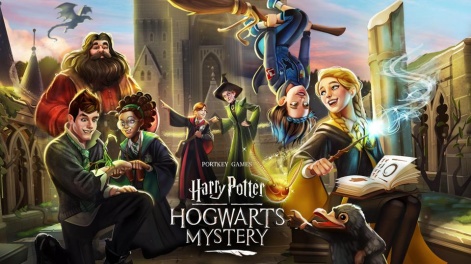
In April 2018, Warner Bros. partnered with Jam City to develop Harry Potter: Hogwarts Mystery.

While critics were mixed on the RPG, fans reception seemed much more positive, which capped off its first year with $110 million in spending. A respectable number – one that has continued to grow, surpassing $300 million only last week.

Hogwarts Mystery generated 100 million dollars in the last 11 months.

Wizards Unite, on the other hand, has scrapped its way to $37 million from 20 million downloads (via Sensor Tower) since June 2019.

To put that in more perspective: Pokémon GO has made $1 billion in revenue… in 2020 alone. Zynga’s Harry Potter: Puzzles Spells surpassed $62 million recently too, and that was only released in September 2020.

It’s incredible just how big of a swing and miss this sequel has been.

Something that the upcoming triple-A action RPG Hogwarts Legacy will be wary of, yet is expected to still prosper. So the harsh reality is this looks to be down to chosen genre.

Outside of Pokémon GO, location-based games have failed to set the world alight.

Location lacking

Jurassic World Alive from Ludia is the only other one that springs to mind with a semi-decent revenue stream ($40 million in nine months). The behemoth that is Minecraft wasn’t even enough, now set to shut down in June. Good luck to The Witcher: Monster Slayer.

The ongoing global pandemic is another factor but while the majority of industries have struggled to survive, video games have thrived. Games have adapted to the conditions and as Pokémon GO proved, many achieved their best years to date.

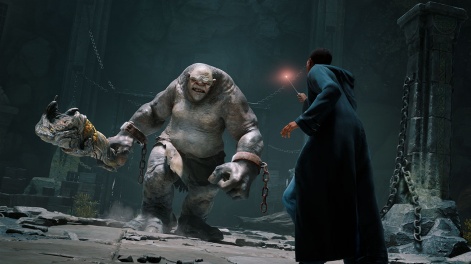
Hogwarts Legacy is set to be the next major video game based on the Harry Potter franchise in 2022.

It’s still a common occurrence to see high marketing for the worldwide catch ’em all, yet Wizards Unite flounders in the abyss.

At first, there were trailers put in cinemas, billboards and posters scattered everywhere, and an energetic social media campaign about recruiting wizards, all amounting to nothing.

The reality is that it’s already too late.

With how contracts work, Warner Bros. inevitably will be waiting for a term to expire before they pull the plug and Avada Kedavra Wizards Unite forever.

It’s a real shame, as there is so much potential for a sprawling, adventure-filled, exciting, magical, memorable experience with Harry Potter. This isn’t it though.

A live-action ‘Harry Potter’ TV show is reportedly in early development

We may be getting a “Harry Potter” TV series.

According to The Hollywood Reporter, Warner Bros. is in very early development on a live-action series for

HBO Max

THR reports HBO Max has “engaged in multiple conversations with potential writers exploring various ideas” on how to bring the franchise to streaming. According to THR, no one is attached to any series.

Representatives for both WB and HBO Max denied in a statement to THR saying, “There are no Harry Potter series in development at the studio or on the streaming platform.” 

Still, with so many streamers now in play and Disney expanding its Marvel Cinematic Universe onto the small screen with “WandaVision” and multiple “Star Wars”-themed shows for years to come, WB and HBO Max have to be considering which of their most valuable properties may lend themselves to similar profitable small-screen series.

HBO is already developing a prequel series to “Game of Thrones” along with a Batman-themed “Gotham” show. There’s certainly room for expansion within the wizarding universe. 

A sequel play, “Harry Potter and the Cursed Child,” follows the adventures of his child Albus Severus years later as he goes to Hogwarts.

WB could even rewind the clock and give us a prequel series on Harry’s father James and his godfather Sirius Black. “Padfoot and Prongs” has a nice ring to it.

Read more: What we know about the 3rd ‘Fantastic Beasts’ movie, so far

For now, the third “Fantastic Beasts” film, a “Harry Potter” spin-off, is still set for release in July 15, 2022.

Representatives for Warner Bros. did not immediately return Insider’s request for comment. 

Hogwarts Legacy: Is it wrong to buy the new Harry Potter game?

After months of speculation, Sony finally revealed Hogwarts Legacy during its PS5 September showcase. This open-world RPG will debut next year for both current- and next-gen systems, and give Harry Potter fans an opportunity to create and customize their very own witch or wizard in an original story set in the 1800s. Generally speaking, it’s the kind of game that Harry Potter fans have dreamed of playing for years — and thanks to J.K. Rowling, it’s not at all clear whether they should actually pick it up.

For those who haven’t followed the controversy, Harry Potter author J.K. Rowling has spent the last few months making insensitive remarks about transgender women, then doubling down on those comments. It would take too long to reiterate the whole story, but Glamour has an excellent breakdown on what Rowling said, how her peers responded, and why the issue has persisted for three months and counting. Over the past few years, Rowling has occasionally espoused other transphobic ideas, particularly in her books

  • PS5 release date, price, specs, controller and pre-orders
  • Xbox Series X release date, price, pre-orders, specs and games
Page 109 of 141:« First« 106 107 108 109 110 111 112 »Last »