When the Primm family moves into a house on East 88th Street in New York City that was once owned by Hector Valenti, their young son, Josh, struggles to adapt to his new school and friends. All of that changes when Josh discovers Lyle in his attic.
Lyle is a singing and dancing crocodile that loves baths, caviar and great music. The two become fast friends, but when Mr. Grumps, an evil neighbor, has Lyle thrown into the zoo, the Primms band together to show the world that family can come from the most unexpected places.
Academy Award winner Javier Bardem is Hector Valenti who loses the house on a bet about Lyle’s ability to perform. I was shocked that Bardem is charming as the song and dance man Valenti; I am so used to seeing him in heavy dramatic roles.
Constance Wu of “Crazy Rich Asian” fame is Mrs. Primm. I love her; she is great in this film.
Scoot McNairy plays her husband Mr. Primm. Thirteen-year-old Winslow Fegley steals the show as the Primm’s son Josh as he and Lyle travel the streets of New York at night.
The screenplay “Lyle, Lyle Crocodile” by William Davies is an adaptation of the “The House on East 88th Street” by Bernard Waber. It is is a wonderful adaptation and the story moves along with never a dull moment.
“Lyle, Lyle Crocodile” was directed by Josh Gordon and Will Speck. The original songs for the film were written by executive producers Benj Pasek and Justin Paul along with Ari Afsar, Emily Gardner Xu Hall, Mark Sonnenblick, and Joriah Kwamé. Matthew Margeson composed the musical score. Visual effects were by Framestore, Method, OPSIS and Day for Nite.
This is a must see for the entire family. Even little ones will fall in love with Lyle. He is never a threat. You will love him at first sight when Valenti buys him at the pet store.
There is no sex or foul language to worry about. It is a delightful way to spend a couple of hours.
“Lyle, Lyle Crocodile” is currently showing at both Alton and Edwardsville. I give it 5 stars.
A new paper in Oxford Open Economics, published by Oxford University Press, explores “Potterian economics”—the economics of the world of J.K. Rowling’s Harry Potter series. Comparing such economics with professional economic models indicates that while some aspects of this economy are in line with economic models, many other aspects are distorted, contradicting professional economists’ views.
Evidence suggests that the public’s economic literacy is low and that it acquires much of the knowledge about economics through books, newspapers, etc. There is also evidence that literature affects readers, shaping their views. It is, therefore, possible that the 7-book series may exert influence and reflect on the public’s economic perspectives and sentiments. A conservative estimate suggests that more than 7.3% of the world’s population has read the Potter books and millions more have seen their movie versions. Given such extraordinary popularity of the books, their effect on the economic sentiments of the public might be considerable.
The researchers found that the economics of these books mix ideas from different models and worldviews. For example, the Potterian economic model is critical of market-based systems, yet it belittles government. The government is corrupt, yet it has public support.
The money used in the Harry Potter books is made of precious metals (like in the old English monetary system), yet its purchasing power is unrelated to its commodity value (like fiduciary money). The conversion rates between the Galleon, Sickle, and Knut are prime numbers which make transactions that involve more than one type of coin very inconvenient. Also, the money is not easily storable, divisible, portable, and homogeneous, which are essential for it to serve as an efficient medium of exchange or store of value. Lack of divisibility forces retailers to use round prices, leading to inefficient grid pricing. For example, prices denoted in Galleons only change by Galleons, and thus retailers cannot respond to small shocks. Lack of portability means that carrying coins is cumbersome, and thus characters in the Harry Potter books store them at Gringotts bank, where withdrawals and deposits are costly, requiring time and lengthy procedures.
The researchers find that arbitrage opportunities are not exploited, and efficiency-improving transactions go unnoticed. For example, there is a large gap between the commodity value of a gold Galleon and its exchange value which points to an arbitrage opportunity: Wizards could melt the gold, sell it to muggles as a commodity, and then exchange the muggle money for Galleons. However, characters in the novels do not seem to take advantage of this opportunity, although it promises immense profits and no risk. Not even the bankers, including the greediest ones, seem to notice it.
The Gringotts bank, which has a monopoly, does not serve as an intermediary between savers and investors, and it does not offer loans because of biases and prejudices against financial service providers, yet the books are often viewed and described as rejecting stereotypes.
The researchers also note that characters in the Harry Potter books do not seem to experience technological progress, except in the magical broomstick industry, where new models are introduced each year.
“A naïve reader of Harry Potter would get a distorted view of economics,” said Daniel Levy, one of the paper’s authors. “Consider some of the lessons we learn from Potterian economics: markets are not fair for transactions are zero sum; the political process is not transparent; markets encourage crony capitalism; capitalists want to enslave the proletariat; businessmen are deceptive and devious; wealthy people are mean and unethical; no interest is paid on deposits; there is a monopoly on information; power is concentrated; ignorance about foreigners is the norm; domestic producers are protected from foreign competition even if they are inefficient; paper checks are non-existent; creative thinking is rare; human capital does not accumulate; public employees have life-time job-security irrespective of their efficiency; the public sector is the default employer; downward social mobility is the norm; there is a constant class struggle. This is only a partial list.”
“The shortcomings listed above characterize many real economies,” Levy continued. “This perhaps explains why the Potterian economic model resonates with people. Despite its inaccuracies, it is consistent with folk economics, which while perhaps problematic for human flourishing in a Smithian sense, captures and reflects popular views on many economic and social issues.”
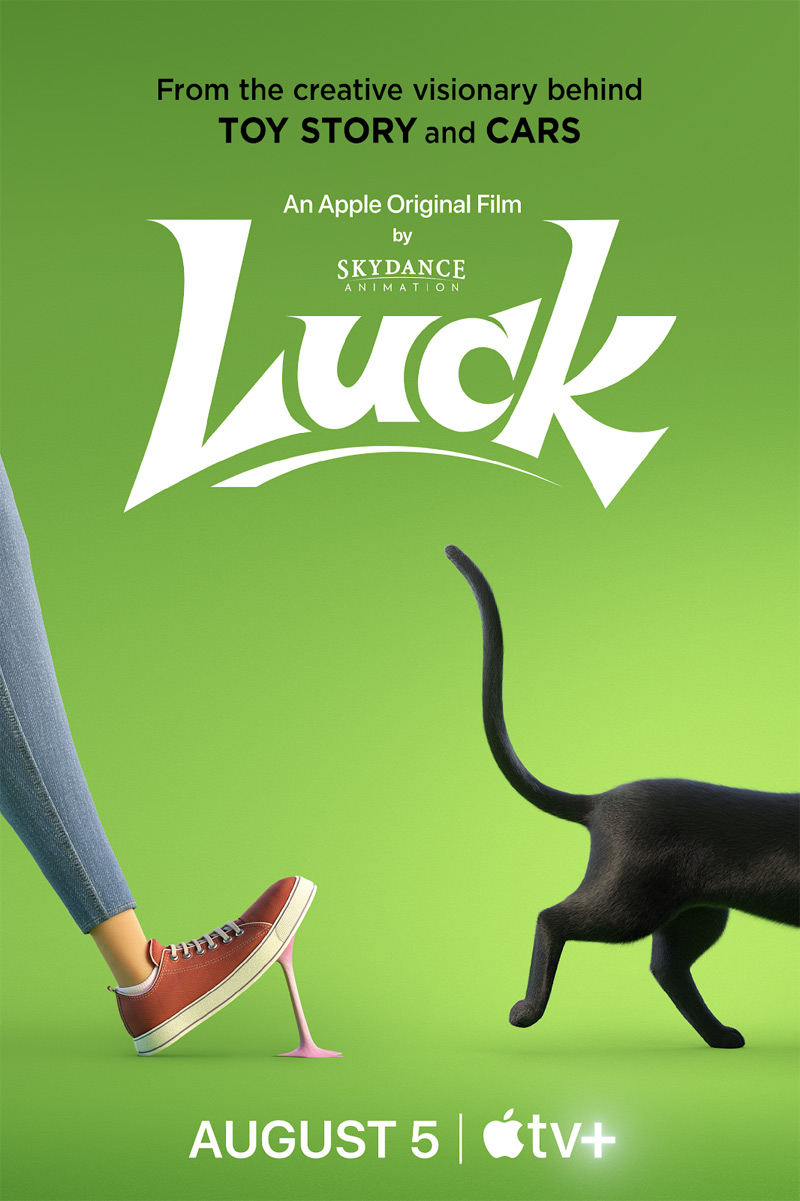
“You humans are a complicated lot… no human has ever stepped foot in this place, and with a little bit of luck, they never will.” Apple TV has unveiled a teaser trailer for their new animated adventure called Luck, made by Skydance Animation (also of Blush). From Apple Original Films and Skydance Animation comes the story of Sam Greenfield, the unluckiest person in the world! Suddenly finding herself in the never-before-seen “Land of Luck”, she must unite with the magical creatures there to turn her luck around. Think you know about luck? Thankfully, Bob the Cat is about to drop some truth. The film stars the voices of Eva Noblezada as Sam Greenfield, Simon Pegg as Bob the Cat, Academy-Award Winner Jane Fonda, Lil Rel Howery, Flula Borg, John Ratzenberger, and Whoopi Goldberg. This is a fairly fun teaser that reminds me of Pixar’s Inside Out, I just hope the film features a good story beyond the intro to Bob Sam.
Here’s the first teaser trailer (+ poster) for Peggy Holmes’ Luck, direct from Apple TV’s YouTube:
From Apple Original Films and Skydance Animation comes the story of Sam Greenfield, the unluckiest person in the world, who when she stumbles into the never-before-seen Land of Luck, sets out on a quest to bring some good luck home for her best friend. But with humans not allowed, her only chance is teaming up with the magical creatures who live there to do it.Luck is directed by an award-winning choreographer turned filmmaker named Peggy Holmes, directing her second feature after Secret of the Wings previously, and some direct-to-video films. The screenplay is written by Kiel Murray, Jonathan Aibel, and Glenn Berger. It’s produced by David Eisenmann, David Ellison, Dana Goldberg, and John Lasseter. Made by Skydance Animation. The project will be featured at the upcoming 2022 Annecy Film Festival as a work-in-progress. Apple will debut Luck streaming Apple TV+ starting on August 5th, 2022 this summer season. Interested?
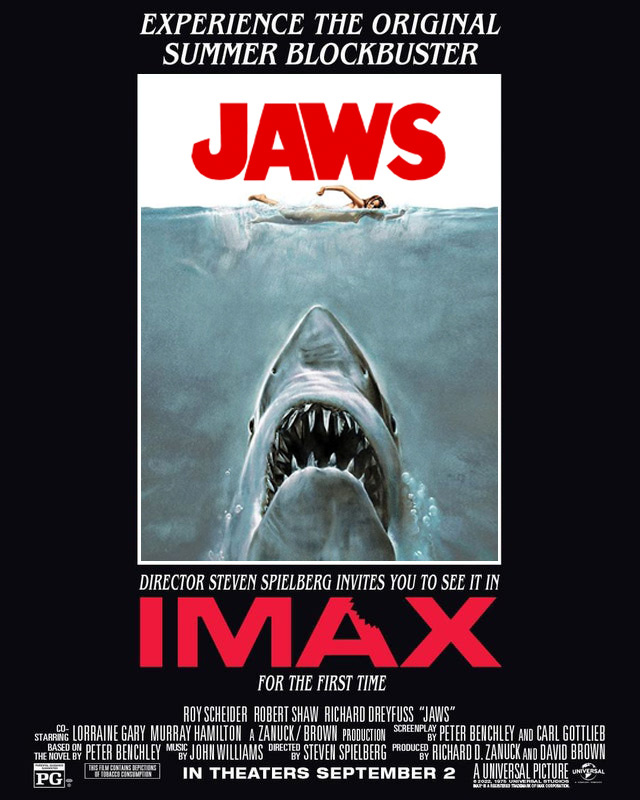
Bruce is back on the big screen again!! Universal has released a new IMAX trailer for the 2022 IMAX re-release of Steven Spielberg’s classic Jaws, the original shark movie that scared us all out of the water years ago. Jaws is known as the movie that launched the “summer movie season”, opening originally in theaters in June of 1975, becoming a massive hit in the US and eventually worldwide. When a killer shark unleashes chaos on a beach community off Cape Cod, it’s up to a local sheriff, a marine biologist, and an old seafarer to hunt the beast down. Starring Roy Scheider, Robert Shaw, Richard Dreyfuss, Lorraine Gary, and Murray Hamilton. Universal is re-releasing two of Spielberg’s classics in IMAX – with E.T. landing first on August 12th, then Jaws at the start of September exclusively in IMAX cinemas. Check your local listings! Everyone knows and everyone loves Jaws – it was recently turned into a successful stage play showing in London called The Shark is Broken. Jaws was also one of the key movies featured in the NetflixVoir series about loving movies. If you’ve never seen it on the big screen, here is your chance! Don’t miss out on this.
Here’s the official 2022 IMAX trailer (+ poster) for Steven Spielberg’s Jaws, direct from YouTube:
Re-release intro: “Universal is honored to have been a part of so many extraordinary, unforgettable Steven Spielberg films over the past 47 years, including Jaws in 1975, E.T. in 1982 and Jurassic Park in 1993,’ said Jim Orr, president of Theatrical Distribution for Universal Pictures. “No filmmaker, it’s fair to say, has had a greater or more enduring impact on American cinema or has created more indelible cinematic memories for tens of billions of people worldwide. We couldn’t think of a more perfect way to celebrate the anniversary of E.T. and the first Universal-Spielberg summer Blockbuster, Jaws, than to allow audiences to experience these films in a way they’ve never been able to before.” Jaws is directed by visionary American filmmaker Steven Spielberg, his fourth feature at the time – after making Firelight, Duel, The Sugarland Express, and just before making Close Encounters of the Third Kind and 1941. The screenplay is written by Peter Benchley and Carl Gottlieb; based on the original novel by Peter Benchley first published in 1974. Universal will re-release Jaws in IMAX theaters nationwide September 2nd, 2022 before the end of the summer.
When teenagers Eli and Oskar meet in the play Let the Right One In, the beginning of a chilling, yet deeply compassionate, vampire story are not entirely obvious.
This is the story of two outsiders. Oskar, bullied at school and living in a sterile housing estate in a Swedish suburb with his smothering mother, and Eli, an elfin otherworldly character who has just moved into the neighbourhood.
A fledgling friendship begins, but so do a series of gruesome murders in the area. Are they connected to Eli? Who is she? “I’m nothing,” she says to Oskar. “Not a child. Not old. Not a boy. Not a girl. Nothing.”
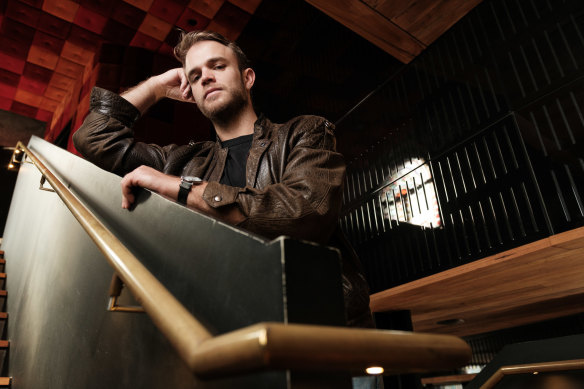
Alexander Berlage: ‘It’s fundamentally a beautiful storyline of two teenagers trying to find a connection.’Credit:Oscar Colman
Alexander Berlage, who is directing the production by Darlinghurst Theatre Company, describes Let the Right One In as a supernatural horror coming-of-age teenage romance.
Hollywood stars Tom Holland and Zendaya have taken their romance to France as they were spotted on a romantic date in Paris over the weekend.
The British actor and the Emmy Award-winning actress were pictured holding hands as they joined a special tour at the Louvre.
They were seen listening attentively as a tour guide gave an explanation of the artwork displayed at the famed museum, reports aceshowbiz.com.
For the outing, Holland looked stylish in a long-sleeved, black-and-white striped sweater which he tucked into the waist of his black pants.
As for Zendaya, she opted for a smart chic look in a light blue, oversized blouse with the long sleeves rolled up towards her elbows.
Her hair was pulled into a fashionable up do with bangs framing the side of her head. She accessorized with a pair of glasses along with a black cross-over body bag and a black watch on her left wrist.
She appeared to be holding a gold-coloured camera in her left hand.
Zendaya had been spotted earlier in the city of love to attend the Paris Fashion Week, which came to an end on October 4.
Holland and Zendaya have been romantically linked to each other since July 2021, when they were caught sharing kisses inside a car. The two have connected earlier in 2016 when they worked on their first Spider-Man movie, ‘Spider-Man: Homecoming’.
“They’re both not one to make their relationship public,” a source recently informed Us Weekly about the young couple’s romance.
“They’re private when it comes to dating, so any photos that have come out would’ve just been them going about their business and not knowing photographers were around.”
Despite their busy schedules, Tom and Zendaya have always made time for each other. Last month, the ‘Euphoria’ star celebrated her birthday with her boyfriend by hitting the Big Apple for some fun dates.
A week before, the couple was zipping around on scooters in Budapest, where the actress was filming ‘Dune 2’.
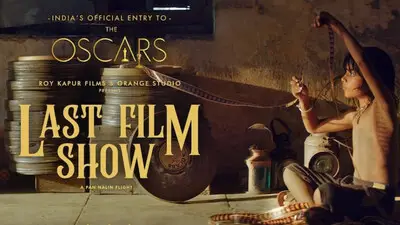
A day before its official release, India’s official Oscar entry “Last Film Show” will be screened in 95 theatres across India, with tickets priced at Rs 95, the makers announced on Monday.
Titled “Chhello Show” in Gujarati, the coming-of-age drama is India’s official entry for the best international feature film category at the 95th Academy Awards.
The film will be screened at the ‘last shows’ on Thursday, a day prior to its Friday release.
“There has been immense excitement among fans for our film ‘Last Film Show’ (Chhello Show) and we are all too happy to release it on the ‘Last Show’ of Thursday.
“Also, what better way to celebrate its selection at the 95th Oscars than by releasing it in 95 cinemas at a wonderful price of Rs 95,” director Pan Nalin said in a statement.
Inspired by Nalin’s own memories of falling in love with movies as a child in rural Gujarat, “Last Film Show” is set at the cusp of the digital revolution.
Set in a remote rural village of Saurashtra, the film follows the story of a nine-year-old boy who begins a lifelong love affair with cinema when he bribes his way into a rundown movie palace and spends a summer watching movies from the projection booth.
Related stories
In a joint statement, producers Siddharth Roy Kapur of Roy Kapur Films and Dheer Momaya of Jugaad Motion Pictures said they are thrilled with “Last Film Show” release on the big screen.
“With our exhibitors on board, we are releasing the film in the final shows of Thursday across 95 cinemas at a Rs 95 ticket price. This is our humble way of honouring the love and excitement audiences across India have shown for our film. See you at the movies,” they said.
“Last Film Show” is produced by Roy Kapur Films, Jugaad Motion Pictures, Monsoon Films and Chhello Show LLP.
The film is being distributed in the country by Roy Kapur Films in partnership with PVR.
It will be released by Samuel Goldwyn Films in the USA and by Orange Studio in France. Shochiku Studios and Medusa are bringing the film to Japanese and Italian cinemas, respectively.
The story of Barney, an awkward middle-schooler and Ron, his new walking, talking, digitally-connected device. Ron’s malfunctions set against the backdrop of the social media age launch them on a journey to learn about true friendship.
Directors:
Sarah Smith,
Jean-Philippe Vine,
Octavio E. Rodriguez |
Stars:
Jack Dylan Grazer,
Zach Galifianakis,
Ed Helms,
Olivia Colman
Happy endings are relative, though. If a film conforms to the R.S.S.’s vision of India, Ramesh excuses any manipulations of fact; if it departs from that vision, Ramesh believes that its creators seek to “tarnish” India’s image. He cited “The Empire,” a show on Disney’s Indian platform, about Babur, the Muslim warrior who founded the Mughal dynasty in India, in 1526. Why make a show that humanizes Babur, Ramesh wondered. He doesn’t consider Muslim rulers to be Indian, even if they were born in the country. “They were invaders,” he said. “Sacred Games,” a noirish Netflix series, depicted a Hindu man plotting an act of terrorism. Ramesh thought that it was propaganda: “You want to show Hindus as terrorists because you don’t want to acknowledge Islamic terrorism.” “Tandav”? Also propaganda. But he forgives directors who invert history, depicting Hindu kings defeating their Muslim foes in battles that they actually lost. “You have to show something that will inspire people,” he said. And when I asked him about “The Kashmir Files”—about how brazenly polarizing it was, how its tenor was far from sukaant—he claimed unflappably that it was all fact. “You should know the history,” he said.
The B.J.P. likes to attribute its success to a Hindu awakening. Ramesh, similarly, thinks that Bollywood would be wise to heed a newly aware public that will brook no offense. If Amazon feels daunted by the lawsuits against “Tandav”—if it feels compelled to make shows and movies for Hindu partisans—that doesn’t worry Ramesh: “They must be happy that we do court cases. We don’t go and destroy their buildings.” His own efforts to set Bollywood right were minor, but they represented the importance that the R.S.S. vests in cinema. “We recognize that this is the most powerful medium, which controls minds, which influences the opinions of people,” he said. “A film is a mirror of society,” he went on—a tired, tedious idea, although it struck me that the Hindu right, to obtain the precise reflection it wants, is recasting not just society but also the mirror itself.
The writer Saadat Hasan Manto, who crafted some of the darkest, funniest short stories of the twentieth century, once adored the cinema, sometimes watching three films a day. In the late nineteen-forties, just before the British Raj ended, Manto joined Bombay Talkies, the first great Indian studio. The subcontinent was bloodily being pulled apart into India and Pakistan. “Hindu-Muslim riots had begun,” Manto wrote later, “and as wickets fall in cricket matches, so were people dying.” In these precarious times, one of the studio’s heads, Savak Vacha, a Parsi, set about reorganizing Bombay Talkies, promoting several employees who, like Manto, happened to be Muslim. “Vacha began to receive hate mail,” Manto wrote. “He was told that if he did not get rid of the Muslims, the studio would be set on fire.” Manto felt responsible; how would he face his colleagues if the studio were visited by violence? His friend Ashok Kumar, Bollywood’s earliest superstar, tried to reassure him. “ ‘Manto, this is madness. . . . It will go away,’ ” Manto recalled him saying. “However, it never went away, this madness. Instead, as time passed, it became more and more virulent.”
There was, perhaps, never a prelapsarian India—an India resounding with religious harmony—but “in many ways Bollywood, in its beginning, was one of the most cosmopolitan employers,” Debashree Mukherjee, a scholar of South Asian cinema at Columbia University, told me. In part, this was a political alignment with freedom fighters like Mahatma Gandhi and Jawaharlal Nehru, who wanted India to be a plural country. But it was also born out of necessity, Mukherjee said, because the movie industry was created as a patchwork of many other trades. “Some of the earliest financing came from Gujarati Muslims, and some of the earliest writers were from the Parsi theatre scene,” she said. Lyricists wrote songs in Urdu, a language inflected with Arabic and Persian and fostered by Muslim nobles as a medium of high culture. On a set, the dress dada might be a Hindu tailor and the art dada a Muslim painter. “The workforce was diverse, which remains the case today,” Mukherjee said.
Onscreen, Indian Muslims tended to be typecast, but in mainstream Bollywood this wasn’t so unusual: every character tended to be typecast. When Muslims led the story, they often figured as Mughal nobles, as courtesans, or as players in what the film scholar Ira Bhaskar calls the “Muslim social,” in which older, feudal ways of life tilted at the twentieth century. The stock of secondary roles included the benevolent Muslim elder (Khan Chacha, or Khan Uncle), the soulful poet or composer, and the best friend.
The Muslim type appeared even in “Amar Akbar Anthony” (1977), a landmark film that enshrined the ideal of religious tolerance. “Amar Akbar Anthony” is unabashed Bollywood—long and exuberant, with a baroque plot and half a dozen musical numbers. Three brothers, separated in childhood, are adopted into different faiths, and grow up to be the film’s dashing heroes, each neatly falling in love with a woman from his own religion. The movie’s conclusion is never in doubt. Its energy springs instead from the question of how its various ends are obtained: how the brothers realize that they’re brothers, how they find their long-lost parents, how they win their women, how they defeat a crime lord who has tried to destroy their family. The film ends in a joyful, syncretic reunion—the Nehruvian nation transposed onto the family in the clearest possible fashion. In this idyll, Akbar, the Muslim brother, could have clerked in a bank or run a magazine; instead, he sings Urdu qawwalis, and his love life is its own little Muslim social.
“It’s only in the late nineteen-eighties, and really with greater and greater frequency in the nineteen-nineties, that mainstream films start showing Muslims as gangsters, smugglers, and then terrorists,” Bhaskar said. Not by coincidence, she pointed out, these were also the decades when the B.J.P. grew as an electoral force. In 1992, after calling for the destruction of a mosque in the temple town of Ayodhya, B.J.P. and R.S.S. leaders watched as their followers tore the building down in a matter of hours. The demolition ignited riots, ushering India toward its present condition of chronic, quivering polarization. In 2010, Bhaskar met the director Yash Chopra, who had made many staunchly secular movies between the sixties and the eighties. “We couldn’t make those kinds of films today,” he told her. The plural ideal had withered too much. “Back then, we had faith in it.”
But perhaps it has been a mistake to regard cinema as a moral compass, to treat it as anything other than what it is: a machine to make money by pleasing as many people as possible. “Some of the criticism that Bollywood is frivolous or misogynistic has come from the well-meaning liberal left, which looked down upon the form,” Nandini Ramnath, a film critic for the Indian news Web site Scroll.in, told me. Ramnath believes that Bollywood’s prime confection—the family entertainment—appeals to audiences not despite its vanilla universality but because of it. “If the left was anxious that such films weren’t prescriptive enough or noble enough—well, now the right wants films to be prescriptive in its own way,” she said. The leaders of the B.J.P. are “brilliant at creating the impression that they’re omniscient and omnipotent,” she added. “And I think the clearest signal is: think twice before you say or do anything, because you don’t know who it’s going to offend, and you can assume it’s going to offend us.”
In Bollywood taxonomy, the director Dibakar Banerjee makes “gentry films”—films for people whom the industry regards as the “thinking public, classy folks,” Ramnath told me. (A second kind, she said, are “mass pictures”—movies for everyone.) Banerjee’s sly, charming début, “Khosla Ka Ghosla,” or “Khosla’s Nest” (2006), featured a young engineer who postpones his plans to immigrate to the U.S. so that he can thwart a local don’s schemes to annex his family’s land. Another movie, “Shanghai” (2012), which kicks off with a deadly attack on a leftist academic, is broadly inspired by Vassilis Vassilikos’s novel “Z.” Banerjee, who is fifty-two, waited out much of the pandemic with his family in their house in the Himalayan foothills. On Zoom, he tends to stare into the distance and gather his thoughts before answering a question, a habit that often made me think the image had frozen. Then he’d slap at a mosquito on his arm, and I’d know he was still online.
In 2017, Banerjee felt an itch. He’d been reading with horror about the lynchings of Muslims and about the murder of a journalist named Gauri Lankesh, all at the hands of Hindu extremists. This was, he said, “a special eruption of the poison”—and yet much of the country seemed not to sense its dreadful import. “The middle class was aware only of a daily, ubiquitous ‘othering’ of people in our lives,” he said. “I really wanted to make a film about it.” The following year, Banerjee signed a contract with Netflix, for a movie tentatively called “Freedom,” and shot the bulk of it in the course of thirty-six days at the beginning of 2020, largely in Mumbai. “We had another five days of exterior sequences left, but that didn’t happen, because the Indian lockdown started,” he said.
Earlier this year, Banerjee sent me a Vimeo link to his finished film, which confronts the bigotry infecting India. Banerjee approaches his theme slowly and sideways, through the story of one Muslim family. The family’s first generation, living in Kashmir during the unrest in 1990, finds itself sundered from its Hindu friends. In the second generation, a young woman wants to buy an apartment in present-day Mumbai, but no one will sell to her. (Muslims in Indian cities commonly struggle to find places to live, a form of discrimination practiced by Hindu homeowners and residents’ societies.) In 2042, the woman’s son, a novelist, lives in an even more ghettoized Delhi—a geofenced city where the state machinery determines what people can do based on their social-credit score. The wretchedness of this future spills out of the movie; later, I seemed to remember every frame as being gloomy and grim, even though several scenes are brightly lit. “We’ve lived through enough history to understand what’s going on now,” Banerjee said. “Now we can extrapolate, which is what my film does.”
During the years that Banerjee wrote and shot his movie, the takeover of Bollywood quickened. By 2019—an election year—new power brokers had emerged in the industry, seemingly from nowhere. One of them, the son of a legislator allied with the B.J.P., directed “The Accidental Prime Minister,” which pilloried the Congress leader who had governed India before Modi. (“It felt like propaganda even as I was making it,” Arjun Mathur, one of the film’s actors, told me. “I really regret doing it.”) Another produced a fawning bio-pic of Modi. One director told me about Mahaveer Jain, a producer who “was a nobody” but who now partners with some of Bollywood’s biggest studios and filmmakers. Jain, who said that he couldn’t meet me because he was unwell, is often described as the B.J.P.’s chief Bollywood liaison. In January, 2019, he helped choreograph a meeting between Modi and a band of A-listers, which yielded a selfie that blazed through the Indian Internet. Conspicuously, not one person in the photo was Muslim.
Sometimes there are more deliberate flexes of muscle. In the summer of 2020, under the pretext of probing an actor’s suicide, federal authorities launched an investigation into the drug habits of some of Mumbai’s most famous stars. Among them was Karan Johar, the city’s most influential filmmaker—a director who runs a sprawling production firm, a TV host who jokes on his talk show with his Bollywood friends, and, as the son and the nephew of famous producers, a twenty-four-karat nepo kid. Kshitij Prasad, a young executive producer who was then with Johar’s company, was called in for questioning, and he later said that the officers seemed keen to pin something—anything—on Johar or on another celebrity. “They kept insisting I was supplying drugs to the industry,” Prasad said. (The investigating agency has denied Prasad’s version of events.) When Prasad refused to coöperate, he was sent to prison for ninety days, then released on bail. The threat of a tax raid has also become a weapon, one director told me. When he was raided himself, investigators noticed that he’d been donating small monthly sums to news sites like Scroll and the Wire, which often criticize the government. “They said, ‘Don’t contribute to any of these publications,’ ” he said. “So I had to stop.”