“The Aviation Industry cannot be equated with a chips manufacturer. This is a matter of National Security. We must be very careful. His links with Recep Tayyip Erdoğan, the current President of Turkey, is a matter of concern and must be thoroughly checked before arriving at a decision,” SJM convenor Ashwini Mahajan told the Indian Express.
Mahajan added that the “controversial” appointment was already being talked about everywhere. “The good thing is the government is already seized of the matter and is doing a thorough scrutiny. I am not saying the Tatas have done this deliberately. It is one of those things that get overlooked,” he said even as he underlined the friendship between Erdogan’s Turkey and Pakistan.
He, however, clarified that the SJM had not made representation in this regard to the government.
Subscriber Only Stories
PremiumPremiumPremiumPremium
The Tata Group appointed Ilker Ayci as Air India’s MD and CEO earlier this month to be effective on or before April 1. Appointment of foreign CEOs require clearance from the government.
Ilker Ayci was chairman of Turkish Airlines since 2015, and his resignation from the post was announced by the airline on January 27 this year — the same day Tatas were handed over Air India by the Centre.
During his professional career, Ayci has been an advisor to the then Mayor of Istanbul, Recep Tayyip Erdoğan, in the Metropolitan Municipality of Istanbul, where he took part in a number of development projects in Turkey’s largest city. Erdoğan is currently the President of Turkey.
Under Erdogan, Turkey has been seen to turn more Islamic and grown closer to Pakistan. Erdogan has in the past couple of years repeatedly raised the issue of Kashmir in his address to the UN General Assembly. He had also raised the Kashmir issue during his visits to Pakistan.
During his visit to Pakistan in February, 2020, Erdogan while addressing a joint session of Pakistan Parliament expressed concern over the situation in Jammu and Kashmir (JK) and compared the “struggle” of the Kashmiri people with his country’s fight against foreign domination during World War I.
Following this, the government had summoned Turkey’s then Ambassador Sakir Özkan Torunlar and issued a strong demarche. The Ministry of External Affairs (MEA) had then said Erdogan’s remarks reflected “neither an understanding of history nor of the conduct of diplomacy” and would have “strong implications” on India’s ties with Turkey.
In September last year, Erdogan in his address to the General Debate, said, “We maintain our stance in favour of solving the ongoing problem in Kashmir for 74 years, through dialogue between the parties and within the framework of relevant United Nations resolutions.”
In 2020 also, Erdogan in his pre-recorded video statement to the General Debate had made a reference to Jammu and Kashmir.
India at that time termed it as “completely unacceptable”, saying Turkey should learn to respect the sovereignty of other nations and reflect on its own policies more deeply.
A newly-filed U.S. civil suit claims Daryl Katz, the billionaire owner of the Edmonton Oilers, paid a teenage ballet dancer $75,000 in exchange for “her sexual favours.”
The unproven allegations come in response to a sexual abuse lawsuit launched by seven aspiring ballerinas in 2021 against Mitchell Taylor Button, a dance teacher, and his wife Dusty Button, once a principal member of The Boston Ballet.
Earlier this month, Taylor Button and his wife filed a third-party counterclaim in U.S. District Court in Nevada, admitting to a consensual “throuple sexual relationship” with Sage Humphries, the lead plaintiff in the suit. The cross-claim says their “loving and supportive” affair began in 2017, when Humphries was 18, but alleges she had been involved in three prior sexual relationships as an underage teen with much older men, including Katz.
The third-party claim seeks to hold those men liable for any damages, with the filing stating that if there’s a price to be paid, “it should be paid by those who actually engaged in illegal acts with her.”
A lawyer representing Katz denied the allegations.
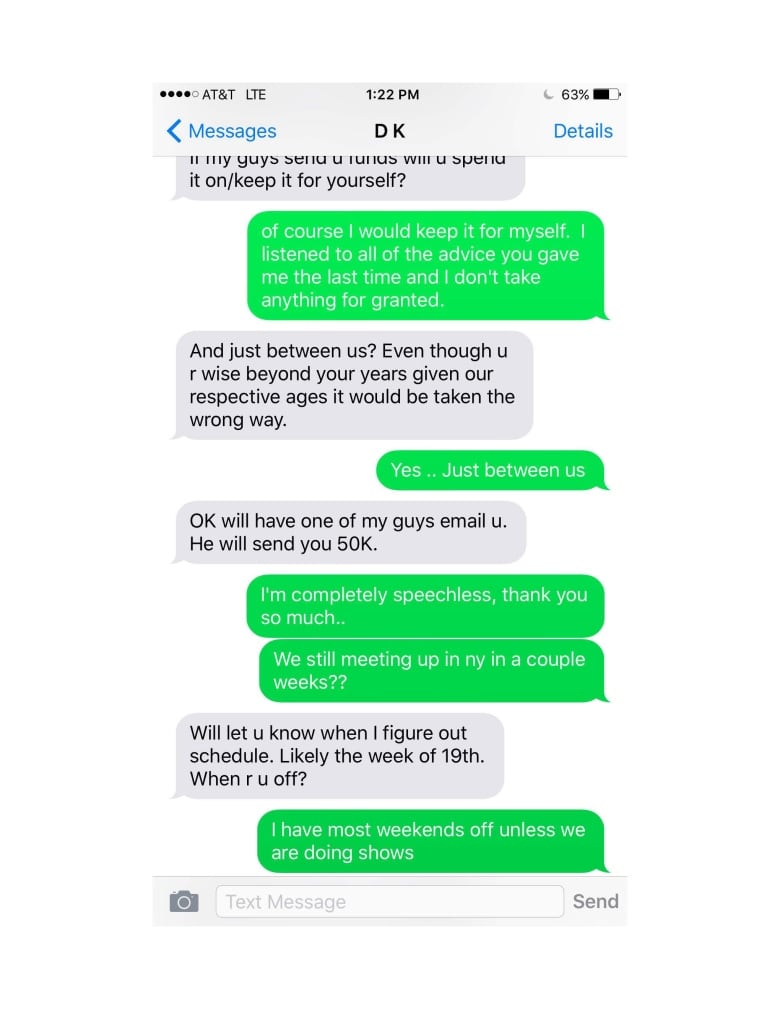
Screen shots of alleged texts
The lawsuit makes a number of unsubstantiated allegations about Katz, Humphries, and her family.
“Humphries was literally a child prostitute to a billionaire,” the claim says, “and her mother assisted her in laundering the money she was paid and in trafficking her to Katz.”
Among the exhibits attached to the filing are screen shots of texts allegedly exchanged between Humphries and Katz, as well as an iPhone contact under the billionaire’s name, listing a number with a 780 area code, most commonly associated with the Edmonton area.
A text exchange, allegedly between Katz and teenage ballerina Sage Humphries, filed as part of a U.S. civil suit. (U.S. District Court, Nevada)
“If my guys send u funds will u spend it on/keep it for yourself?” Katz allegedly wrote. “And just between us? Even though u r wise beyond your years given our respective ages it would be taken the wrong way.”
“Yes .. Just between us,” Humphries purportedly replies.
“OK will have one of my guys email u. He will send you 50K,” says the message attributed to Katz.
The court filing says Katz was 53 at the time, while the dancer was 17.
A ‘distraction and a shakedown’
Robert Klieger, the lawyer representing Katz, told CBC News that his client never had a sexual relationship with Humphries. But the pair did meet on two occasions in the spring of 2016 with regards to a project that the 17-year-old was pitching to Katz’s film company, Silver Pictures.
“One of Daryl’s friends connected him with Sage because Sage was working with some producing partners on shopping a motion picture project that they had put together, basically, and it was based in the ballet world,” said Klieger.
Klieger said he was unable to verify the authenticity of the texts in the court filing, but confirmed that the Edmonton Oilers owner did arrange for $75,000 to be sent to Humphries as part of their business dealings.
“They ultimately decided to pass on the project. But during the period of time that the project was under consideration, they asked for some help to keep with the funding of the project to keep it going. And that’s the $75,000 that is at issue,” said Klieger.
A March 2016 self-portrait of ballerina Sage Humphries from her Instagram account. She was 17 at the time, and pitching Canadian billionaire Daryl Katz on a Hollywood movie. (Sage Humphries/Instagram)
Klieger said Katz will vigorously defend his reputation against the “baseless and scurrilous” claims in the suit.
“It’s designed to be a distraction and a shakedown,” he said.
A ‘meaningless sideshow’
The third-party action doesn’t explain how or when the screen shots were obtained, but the time and battery levels displayed suggests they were accessed on multiple occasions. The original civil suit filed by Humphries states that she handed over her iPhone and passwords to Taylor Button so that he might assist her in building a social media following.
To date, no responses have been filed to the third-party motion. In a statement to CBC News, the lawyer representing Humphries and the other dancers dismissed the action as a “meaningless sideshow.”
“As is typical of abusers facing serious litigation, the Buttons have filed counterclaims that distract from and distort the truth and weaponize the serious allegations of abuse that have been brought against them,” wrote Sigrid McCawley, managing partner at Boies Schiller LLP.
“Their counterclaims falsely implicate others and are an unfounded attempt to portray the women they abused as liars.”
Marc Randazza, the Las Vegas attorney representing Taylor Button and his wife, declined to comment on the filing.
“We are not trying this case in the press,” he wrote in an email.
Randazza describes himself as a “First Amendment lawyer,” and his website highlights a number of areas of expertise, including civil rights, defamation, the adult entertainment business and the “protection of erotic expression.”
He has attracted media attention for some of his controversial clients, including Alex Jones, the Infowars conspiracy theorist, and Andrew Anglin, publisher of the Daily Stormer, a neo-Nazi website. He has faced disciplinary proceedings from the Florida, California and Nevada State bar associations
Prior sex-for-money allegations
This is not the first time that Katz has been the subject of sex-for-money allegations.
In 2017, R.J. Cipriani, a professional gambler, filed a defamation suit against G.F. Bunting+Co, a public relations crisis management firm that was then representing Katz.
The suit alleged that Katz propositioned Cipriani’s wife, model and actress Greice Santo, during a Hawaii photo shoot, offering her $20,000 a day for sex. Katz allegedly wired Santo a total of $35,000 — money she later donated to charity after rejecting the arrangement.
At the time, a spokesman for Katz denied the allegations, calling them “false, malicious and entirely without merit.”
Asked about the 2017 case, Katz’s lawyer, Robert Klieger, said “there was nothing to that,” offering to put CBC News in touch with Cipriani.
“There’s no continuing animosity or anything between them,” said Klieger. “But I can’t go into details of exactly how they resolved that.”
The Minions movie franchise, which began with 2010’s Despicable Me, follows reformed supervillain Gru and his army of small, yellow henchmen, who quickly became the subject of endless online memes.
As many as 1,284 representatives of the sangh all across India have arrived for the Akhil Bharatiya Pratnidhi Sabha, which is being held at Shree Nishkalanki Narayan Tirthdham Prernapith.
These also include representatives from 36 sister organisations of the RSS including Vishwa Hindu Parishad, Bajrang Dal, Mazdoor Sangh among others. Bharatiya Janata Party president JP Nadda and general secretary BL Santhosh are also part of the meet.
The sangh functionaries and representatives will participate in several closed door meetings with Bhagwat and sarkaryavah (general secretary) Dattatreya Hosabale to decide on the organisation’s future course of action.
Subscriber Only Stories
PremiumPremiumPremiumPremium
According to Sangh leaders, the organization plans to expand 1 lakh shakhas from its current 66,000 shakhas active across the country.
In a press conference organized at the venue on Friday morning, Manmohan Vaid, joint general secretary, RSS said, “The activities of the sangh had slowed down after Covid-19 lockdown and since March 2020, we have resumed our work in 98.6% of the places where we were active. A total of 60,000 shakhas are running currently out of which more than 60 per cent are being run by school and college students. We intend to reach to one lakh shakhas by 2025 which will mark 100 years of RSS foundation. We have seen particular interest shown by youth aged between 20 to 35 years of age who want to join the sangh but are not aware of the procedure. From 2017 to 2022, every year 1.25 lakh youth have filled details on our website.”
Vaid further said that of the 1,284 representatives, 414 are volunteers of Akhil Bharatiya Karyakari Mandal, 178 are Akhil Bharatiya Pratinidhi elected from 3.5 lakh active workers, 51 are sangathan mantris and 540 are prachar pramukh.
Vaid said that the three-day meet will see Sangh leaders discuss key issues in contemporary times including promoting social harmony to bridge caste divide.
“Several swayamsevaks are working in the area of societal change where social harmony is a key issue. A message is to be given against the caste divide and the ongoing practise of discrimination of higher and lower in order to divide the society. That all of us are one sons of Bharat Mata in the society,” said Vaid.
Vaid also lauded praises on RSS volunteers for their relief work during the pandemic.”It was only in India that a civil society showed such awareness against the pandemic. In other countries, only the administrative machinery worked,” he said.
“You want to wipe everybody out?”paramount has revealed a brand new official trailer for their 4K re-release of the entire The Godfather trilogy. Back in January we posted the trailer for just the first movie, but now there’s a trailer for all three – being re-released together in a 4K Ultra-HD Blu-ray package this March. The set will include The Godfather, The Godfather: Part II, and Coppola’s recently re-edited version of the final film, Mario Puzo’s The Godfather, Coda: The Death of Michael Corleone. It includes legacy commentaries by Coppola, as well as access to digital copies of each movie. “I am very proud of The Godfather, which certainly defined the first third of my creative life,” said Francis Ford Coppola. “With this 50th anniversary tribute, I’m especially proud Mario Puzo’s The Godfather, Coda: The Death of Michael Corleone is included, as it captures Mario and my original vision in definitively concluding our epic trilogy. It’s also gratifying to celebrate this milestone with paramount alongside the wonderful fans who’ve loved it for decades, younger generations who still find it relevant today, and those who will discover it for the first time.” Featuring this because it’s an iconic trilogy, and it’s always fun to see classics given fresh new trailer.
Here’s the new 4K re-release trailer for Francis Ford Coppola’s The Godfather trilogy, from YouTube:
Coppola’s masterful film adaptation of Mario Puzo’s novel chronicles the rise fall of the Corleone family and the film trilogy is rightfully viewed as one of the greatest in cinematic history. In preparation for the 50th anniversary of the first film’s original release on March 24, 1972, paramount and Coppola’s company American Zoetrope undertook a painstaking restoration of all three films over the course of three years. Every effort was made to create the finest possible presentation for today’s audiences who can watch the films using new technology that has advanced dramatically since 2007 when the last restoration was completed by eminent film historian and preservationist Robert Harris. Using that work as a blueprint, the team spent thousands of hours to ensure that every frame was evaluated to create the most pristine presentation while remaining true to the original look and feel of the three films. In celebration of the 50th anniversary of Coppola’s Academy Award-winning masterwork The Godfather, paramount will release all three films in the epic trilogy on 4K Ultra HD for the first time ever on March 22nd, 2022, with all the films having been meticulously restored under the direction of Coppola. For details, visit their official site.
“It is a far, far better thing that I do, than I have ever done,” Sydney Carton thinks on his way to the guillotine. That far better thing is dying tragically, for many reasons: to save an innocent man, to fulfill his own redemption, and—of course—to make us cry at the end of A Tale of Two Cities. The death scene is one of the sharpest tools in a writer’s toolbox, as likely to wound the writer themself as the reader—for if a well-written death scene can be thrilling, terrifying, or filled with despair, so can a poorly written one be bathetic, stupid, and eye-rolling.
But let’s not talk about those. Let’s talk about the good ones, the deathless death scenes. We’ve assembled the 50 greatest fictional deaths of all time—the most moving, most funny, most shocking, most influential scenes from books, movies, TV, theater, video games, and more. Spoilers abound: It’s a list that spans nearly 2,500 years of human culture, from Athens to A24, and is so competitive that even poor Sydney Carton and his famous last words couldn’t make it. (We even split Mafia movie deaths into their own list, because who can choose?) We’ve also talked to many of the creators behind the scenes on our list to ask them how they wrote them, why they killed off characters we loved, what makes a great death scene, and what final moments from fiction have stuck with them all their lives.
We’ve made this list during a pandemic, as real-life death has stalked us all, more tangible than ever. After all, one of the many things art can do is to help us navigate the pitfalls of life, and there’s no deeper pitfall than the final one. Here are the scenes that have shown us all what the big goodbye might actually be like, when it comes.
Author: Euripides Year: 431 B.C. Original medium: Play Also: Opera, movie
Imagine
Imagine the horror in Athens’ Theatre of Dionysus at the premiere of Medea, as the audience heard the desperate cries of Medea’s two sons while she ruthlessly stabbed them to death. (As the story was commonly known at the time, the children were murdered by others, in revenge. Euripides amped up the tragedy by making Medea herself the killer.) And then imagine the shock as Medea and the two little corpses rose above the stage on the mechanism usually reserved for appearances by the gods, taunting her unfaithful ex Jason with the bitter fruit of his betrayal. Over the centuries, the play has evolved in viewers’ eyes from a chronicle of madness to a proto-feminist revenge tale, but no matter how the story is framed, the power of that climactic killing has not faded with age.
Author: The Beowulf poet Year: Circa 975 Original medium: The oral tradition Also: Book, movie, opera
The
The great warrior Beowulf stakes his claim as the English tradition’s first recorded superhero in a bloody battle against a worthy foe: Grendel, a man-eating monster from the marshes, descendant of Cain, whose skin cannot be pierced by human swords. Beowulf rips off his freakin’ arm and sends the beast back to the marshes, “beaten in battle, bloodying the path,/ Hauling his doom to the demons’ mere.” The hell spawn gets to tell his side of the story in John Gardner’s remarkable 1971 novel Grendel, where his death is not a moment of heroism but of dumb luck and blunt tragedy.
Author: William Shakespeare Year: Circa 1606 Original medium: Play Also: Opera, movie
Macbeth
Macbeth may be a monster, but Shakespeare gives him the greatest of all Shakespearean deaths. His wife dead, Macbeth knows that life is meaningless—“a tale told by an idiot”—but decides, in his great fury, to go down swinging. We may recoil at Macbeth’s crimes, but we thrill at his rage, and Shakespeare recognizes the glory of this hopeless last stand, giving Macbeth some really great lines on his way out—including some immortal last words: “Lay on, Macduff,” he howls, “And damn’d be him that first cries, ‘hold, enough!’ ”
Author: Charles Dickens Year: 1841 Original medium: Book Also: Movie, TV show
Perhaps
Perhaps you’ve read the famous (and possibly apocryphal) tale that New Yorkers stormed the docks to learn of this beatific child’s fate in issues of Charles Dickens’ weekly serial arriving by ship. But it also made grown men and women weep openly throughout the English-speaking world. And years later, the scene gave Oscar Wilde—who wrote, “One must have a heart of stone to read the death of Little Nell without laughing”—the ideal piece of Victorian sentimentality on which to sharpen his wit.
Author: Victor Hugo Year: 1862 Original medium: Book Also: Musical, movie
It’s
It’s a hard-knock life for a Parisian grisette, and the misfortunes piled atop beautiful Fantine are legion: her illegitimate daughter abused, her employment terminated, her hair and teeth sold, her virtue lost. She dies abed still waiting for Jean Valjean to bring her daughter back to her. The scene was already immortal for its pathos (or bathos, depending on your taste) before the 1985 musical extravaganza made Fantine a tragic heroine for a new century with her tearjerking death song, “Come to Me.” However you feel about the song, the novel’s vision of a tragically overwhelmed young woman learning that her benefactor, Monsieur Madeleine, is really the thief Valjean retains a blunt power even today. The news is one more truth than her poor body can bear, and, “fumbling about her like a drowning person,” she falls dead.
Author: Louisa May Alcott Year: 1869 Original medium: Book Also: Movie, musical, play, TV show
Sweet
Sweet Beth dies a sweet death, fading away in her bed as her parents “guide her tenderly through the Valley of the Shadow.” For generations of young readers, Beth has provided an unmatchable example of a saintly, selfless life and its saintly, selfless end; death is a respite from her suffering, and to the last, she is encircled in love and kindness. But Louisa May Alcott wrote Beth’s death in stark opposition to the real experience of her own sister Lizzie, who suffered terribly and lashed out at her family in her pain. Alcott intended Beth’s death to be read as a rebuttal to the typical ends of fictional characters—“seldom except in books do the dying utter memorable words,” she wrote—but Beth’s death is the purest fiction, one that has influenced our view of “a good end” for a century and a half.
Author: Arthur Conan Doyle Year: 1893 Original medium: Short story Also: Movie, TV show
Arthur
Arthur Conan Doyle, desperate to write serious literature, was determined to kill off his most famous character. “I must save my mind for better things,” he wrote, “even if it means I must bury my pocketbook with him.” Holmes’ death—the great detective plummeted over Reichenbach Falls, Watson learns, in a fight with his nemesis Moriarty—was spectacular, but readers were absolutely not having it, and 10 years later, Doyle revealed that actually, Holmes survived his fall. The outcry at Sherlock Holmes’ death was an early warning to future creators that once you reach a certain level of success, the characters you invent belong to the fans as much as they belong to you.
Author: James Joyce Year: 1907 Original medium: Short story Other medium: Play, movie, musical
Most
Most deaths in fiction are primarily about the mystery and finality of death: one character’s story coming to an end. Michael Furey’s death in “The Dead” is about the mystery of other living people. After a long night of revelry with family, Gabriel Conroy feels a surge of passion for his wife, but she is melancholy, thinking of a boy she once loved, Michael Furey, who died at 17 after a dramatic late-night visit in the rain. At first upset, Gabriel is filled with tenderness for her and the romance of her youth—“It hardly pained him now to think how poor a part he, her husband, had played in her life”—and that tender feeling soon spreads to all of Ireland, whose people “one by one … were all becoming shades.” We barely know Michael Furey, but our souls swoon softly, too, to think of his little grave in the snow of a lonely churchyard.
Author: Victor Fleming Year: 1939 Original medium: Movie Other medium: Book, TV show, musical
“I’m
“I’m melllllting!” You remember Margaret Hamilton’s shriek. In L. Frank Baum’s 1900 novel, the Wicked Witch’s death is less horrifying, more comic (“Well, in a few minutes I shall be all melted, and you will have the castle to yourself,” she grumps to Dorothy); the film’s screenplay, by Noel Langley, Florence Ryerson, and Edgar Allan Woolf, tightens it up. But it’s thanks to Hamilton’s indelible performance that the scene, so long and so gruesome, remains embedded in the memory of every child who ever saw it. It’s also embedded in our cultural memory, endlessly parodied, copied, and remixed in the decades since. The Wicked Witch’s demise is the archetypal just desserts for a horrid villain, the comeuppance evil deserves but so rarely receives. What a world, what a world.
Author: Antoine de Saint-Exupéry Year: 1943 Original medium: Book Other medium: Play, movie, comic
Generations
Generations have loved and been very slightly bewildered by The Little Prince, a collection of veiled allegories disguised as a novel for children. But there’s nothing veiled about the Little Prince’s death, as on the anniversary of his arrival on Earth, he sets off to find the snake who will end his time on this planet with one bite. As the pilot watches, weeping, the prince falls silently to the sand, “gently as a falling tree.” The next day, his body is gone; he’s returned to his tiny planet and his sheep. Puzzling out the mysteries of The Little Prince is a rite of passage for a sensitive young person, as is mourning the loss of this wise innocent, too good for this world.
Author: Shirley Jackson Year: 1948 Original medium: Short story Other medium: Radio drama, movie
The
The ending of “The Lottery” isn’t really unresolved—Shirley Jackson makes it clear what is happening to Tessie, the mother who draws the “winning” slip of paper in her New England town’s annual sacrificial rite. But we only see the first stone hit her, and the story ends as the townsfolk fall upon her, while we’re still trying to make sense of it all. Nothing compares to your first time through “The Lottery,” realizing belatedly you’ve been reading a horror story all along, and the howls of eighth graders today call to mind the flood of angry, offended, or just plain bewildered letters that flowed into the office of the New Yorker when the magazine first published the story.
Author: Shinobu Hashimoto (screenwriter) and Akira Kurosawa (director) Year: 1950 Original medium: Movie
Only
Only one thing is certain in Rashomon: A man has died. The film is about the impossibility of knowing anything more. Freely adapted from two short stories by the early-20th-century master Ryūnosuke Akutagawa, Rashomon makes uncertainty its subject, as we watch the samurai die four different ways in four different versions of the story. There have been many imitations, parodies, and adaptations over the years, but Rashomon remains the definitive statement on how much “truth” depends on the motivations of the teller.
Author: Edith Lindeman and Carl Stutz Year: 1953 Original medium: Song
Originally
Originally written for (but never recorded by) Perry Como—imagine that version!—“Red Headed Stranger” achieved fame when Willie Nelson constructed his 1975 outlaw country concept album around the song, an old favorite he once sang as a lullaby to his children. The death at the song’s center is even more shocking for its understatement: A pretty woman greets the redheaded stranger when he arrives in town. He buys her a drink and then prepares to leave, and she, laughing playfully, makes a move toward his horse. “He shot her so quick,” Nelson sings quietly, “they had no time to warn her”: He was “wild in his sorrow” for his lost wife, and she paid for it. In a trice the song transforms from romance to murder ballad, and the entire mythology of outlaw country came of age in that moment.
Author: Flannery O’Connor Year: 1953 Original medium: Short story
How
How a person acts in their final moments can reveal new and surprising facets to a character, and—held at gunpoint by a killer—the selfish, snobbish grandmother in Flannery O’Connor’s dark comedy finds a kind of twisted grace. Her head clears, she reaches for the Misfit, and declares, “You’re one of my own children!” The instant she touches his shoulder, he shoots her through the heart. O’Connor, a devout Catholic, explored morality in extremis in her remarkable stories, and “A Good Man” asks a simple question through a haze of blood: What life are you living? Would you, like the grandmother, be a good person, if only it had been somebody there to shoot you every minute of your life?
Author: J.R.R. Tolkien Year: 1955 Original medium: Book Also: Movie
How
How do you end an adventure that’s epic and personal, one that spans an entire world but also focuses on the struggle of one person to resist evil? J.R.R. Tolkien ended Frodo’s journey to Mordor by allowing him, for one terrible moment, to succumb to the power of the ring—and then watch as his partner in torment, Gollum, bites Frodo’s finger off, claims the ring in triumph, and falls to his death. In one stroke, the story’s cosmic problem is solved—the ring destroyed—while its most compelling villain is given the shocking, glorious death he deserves. Peter Jackson’s movie trilogy, in further foregrounding Gollum’s story, lends his fate even more pathos.
Illustration by Slate. Images by paramount Pictures.
Author: Joseph Stefano (screenplay) and Alfred Hitchcock (director) Year: 1960 Original medium: Movie
People
People remember the death of Marion Crane (Janet Leigh) because it takes place in a shower, and because of Bernard Herrmann’s music, and the editing, but it’s really none of these things that makes it the most shocking horror death there ever has been and the most shocking horror death there is ever likely to be. It’s that when Marion Crane dies, Alfred Hitchcock kills off his movie’s only protagonist, halfway through the movie. (The novel, by Robert Bloch, focused on Norman Bates.) Some movies since have attempted to do the same thing—to frightening or sometimes hilarious effect—but none of them will ever be able to re-create the shock of when Hitchcock pulled this trick for the very first time.
Author: Stan Lee and Steve Ditko Year: 1962 Original medium: Comic Other medium: TV show, movie, musical
At
At this point, the trope of a character sacrificed just so our hero can realize the weight of his duties is pure comic book cliché. But that’s because no one will ever employ it better than in the very first Spider-Man comic. Cocky, disillusioned Peter Parker lets a thief escape—and then his Uncle Ben is shot and killed by the very same thief! Blunt manipulation? Yes. Effective? Hell yes. Spidey’s tears (“My fault—all my fault!”) make him the most human, and therefore the most relatable, of all superheroes. With great power comes great responsibility—and terrible guilt, when you fall short.
Author: Tom Stoppard Year: 1966 Original medium: Play Other medium: Movie
Death
Death is the subject of Tom Stoppard’s impossibly clever and improbably deep breakthrough comedy, in which two minor functionaries bumble through Hamlet, never knowing that their lives are dispensable in the service of the tragedian’s plot. Ros and Guil play word games, hurt each other’s feelings, do their best to fulfill their purpose—but at the end, they stand alone, together, mulling their inexorable fate. “There must have been a moment, at the beginning, where we could have said—no,” one of them laments. “But somehow we missed it.” And then, the tableau of corpses.
Author: Arthur Penn Year: 1967 Original medium: Movie
David
David Newton and Robert Benton’s French New Wave–accented screenplay for Bonnie and Clyde stressed that in the ambush that ends the movie, we never see Bonnie or Clyde getting shot, nor do we see their dead bodies. (Instead, the screenplay instructed that we hear the guns but see two still photographs of the stylish pair in action.) Director Arthur Penn instead ended his film with a shocking, horrifying orgy of violence, Warren Beatty and Faye Dunaway shaking as squibs exploded all over their bodies. It’s a familiar scene now, but at the time it repulsed traditional critics, even as it sent young audiences out of the theater on a fizzy-pop high. The first film of the American New Wave may have borrowed the techniques of its European forebears, but it ended in a gruesome all-American bloodbath that changed the face of movies forever.
Author: Ursula K. Le Guin Year: 1969 Original medium: Book
In
In its final third, Ursula Le Guin’s masterpiece transforms from a tale of political intrigue on a faraway planet into a desperate survival tale—and an unexpected love story. The evolution of the relationship between Terran ambassador Genly and the alien Estraven (gender-fluid, like everyone on their planet), from mistrust to dependence to a soul’s connection, helps readers reconsider the ways that our own preconceptions limit our empathy. That those differences prove to be the root of Genly and Estraven’s bond, not their undoing, is a remarkable feat of humanist imagination by Le Guin. And it makes the sacrifice of Estraven even more painful for the reader. We, too, have just started to understand them, and to love them as Genly did.
Author: Richard Adams Year: 1972 Original medium: Book Other medium: Movie, TV show
At
At the end of the long journey that makes up Adams’ epic of rabbit relocation, Hazel, the novel’s hero, is finally granted the rest he deserves. Throughout Watership Down, death has been frightening, horrifying, deeply sad, but the novel’s gentle final page is a reminder that death can be kind, too—the natural end to a long and fruitful life. As Hazel departs with the Black Rabbit of Inlé, he leaves his body behind and pauses for a moment to look back at his rabbits, marveling at “the extraordinary feeling that strength and speed were flowing inexhaustibly out of him into their sleek young bodies.” Hazel brought his rabbits to their new home, and now he can go to his own.
Author: Gene Reynolds and Larry Gelbart Year: 1975 Original medium: TV show
When
When McLean Stevenson, who played commanding officer Henry Blake, left the hit sitcom M*A*S*H at the end of its third season, producers Reynolds and Gelbart decided that he shouldn’t just fly away from the show; he, like so many of the soldiers then in Vietnam, shouldn’t make it home. In the final scene of Everett Greenbaum and Jim Fritzell’s screenplay—withheld from the actors until after Blake’s jolly farewell was filmed—a shaky Radar enters the operating theater and tells the cast, “Lt. Col. Henry Blake’s plane was shot down over the Sea of Japan. It spun in. There were no survivors.” Stevenson, still on set, was furious, and so were viewers, outraged that a lighthearted comedy would let the realities of war intrude so shockingly. The scene paved the way for the mix of comedy and realism that has made not only for innumerable Very Special Episodes but also entire series that continue to mix the two in new and daring ways.
Author: Douglas Adams Year: 1978 Original medium: Radio show Other medium: Book, TV show, play, movie
Some
Some poor characters are created by their authors as mere cannon fodder, and nowhere is this narrative device more hilariously satirized than in Douglas Adams’ Hitchhiker’s Guide, originally a BBC Radio serial. Miles above the surface of an alien planet, a sperm whale is called into existence by nothing but the capriciousness of fate (well, of the author). We get to hear the whale’s yearning, excited internal monologue for exactly one minute and 37 seconds: It’s happy to be alive, intrigued by the wind, delighted by its tail, and absolutely enthralled by this big flat thing, the ground, coming at it very, very fast. “I wonder if it will be friends with me,” the whale wonders, and then, in the most repulsive yet poignant sound effect description ever written, we hear a “sperm whale hitting the ground at several hundred miles per hour.”
Author: Toru Iwatani Year: 1980 Original medium: Video game
What
What fictional entity has as much experience with death as an arcade character, for whom existence is but a never-ending cycle of death and reincarnation? Pac-Man wants only to eat delicious dots, but he is always hunted and he’s always, eventually, caught. And when he dies, he doesn’t simply bounce off the screen, like Mario, or curse his bad luck, like Q*bert. Instead, Pac-Man’s mouth expands and consumes his entire body. Horrifying! What really cements Pac-Man’s death as iconic, though, is the sound effect that plays when he meets this end, an electronic wail followed by two splats. You’re hearing it in your head right now, and you know what it means: The End, unless you can dig another quarter out of your pocket.
Mr. Hooper in Sesame Street
Author: Norman Stiles Year: 1983 Original medium: TV show
Unlike
Unlike most of the deaths on this list, the death of Mr. Hooper came about as a result of the death of a real person: Will Lee, the actor who played Sesame Street’s shopkeeper. The show’s writers, led by Norman Stiles, wrestled with how to handle the loss of one of the series’ original human characters. In the end, they decided to treat it straightforwardly. The adults take Big Bird carefully and kindly through an explanation of death: Death means he’s not coming back, because he can’t come back, and that’s the way things have to be. And other people can tell Big Bird stories and make his birdseed milkshakes. And everyone’s sad about it, but everyone can remember Mr. Hooper and how much we loved him. The landmark episode aired on Thanksgiving, so parents could answer children’s questions, and it’s still remarkably poignant to see Sesame Street’s human performers wrestle with their emotions while also delivering a sensitive, developmentally appropriate message about the finality of death.
Author: Larry McMurtry Year: 1985 Original medium: Book Other medium: TV miniseries
Lonesome
Lonesome Dove, an epic set along a Western cattle trail in the 1870s, is full of tragic deaths. But the “best”—the most heartbreaking, the most plot-satisfying—is that of Gus McCrae on page 880. McCrae’s friendship with fellow ex–Texas Ranger Woodrow Call is the backbone of the book, and McMurtry writes about McCrae’s death—which comes about due to his own stubbornness and generosity—with the same kind of emotional restraint that the men bring to their relationship. McMurtry wrote his novel, he said, in an attempt to critique the mythology of the Old West, but such is the power of Gus McCrae’s death, and Woodrow Call’s grief, that Lonesome Dove now is the mythology of the Old West.
Author: Stephen King Year: 1986 Original medium: Book Other medium: Movie
In
In It, Stephen King writes about children, their primal fears, and the friendships that bond them, and among the gruesome dismemberments and jarring deflowerings of this baroque, fascinating novel, its opening scene stands alone. Six-year-old Georgie loses his paper boat down a storm drain, and waiting for him down there is giggling, menacing Pennywise the clown, with his bright blue tie and his stink of the depths. Does Georgie want a balloon, Pennywise asks. “They float,” he says, “and when you’re down here with me, you’ll float too.” Up and down the placid small-town street, the citizens of Derry, Maine, hear Georgie’s screams, and when they rush out and turn him over, he’s already dead, his wide eyes filling with rain. As an overture, it’s perfect; it hits all the notes the novel will eventually play, of innocence, corruption, terror, and gore, and introduces a villain who would soon become iconic.
Author: Toni Morrison Year: 1987 Original medium: Book Other medium: Movie
At
At the heart of Beloved is a simple equation: Sethe will not let her children return to slavery, and so when the horsemen come, she makes a terrible decision. “She was trying to out-hurt the hurter,” Stamp Paid explains later, and the short scene in which Toni Morrison presents Sethe’s murder of her children is almost unbearable to read. Among the dead is Beloved, the “crawling-already?” baby whom Sethe clutches to her breast and who returns, first as a ghost, and then as a young woman full of life and foreboding. These six astonishing pages, placed at the novel’s precise midpoint, are the fulcrum upon which Morrison’s masterpiece balances: On one side is the past that Sethe and her fellow former slaves can never outrun, and on the other is the future that looms ahead, hopeful and impossible at the same time.
Author: Spike Lee Year: 1989 Original medium: Movie
Spike
Spike Lee modeled the death of Radio Raheem (Bill Nunn) after that of Michael Stewart, a Black graffiti artist killed in 1983 by New York City transit police. Radio Raheem was not the most beloved person in the neighborhood, but his martyrdom stems from his sheer defiance in the face of everyone: not just the cops but the people who merely want him to turn his boombox down, the racist pizza place owners, those who would diss his Love and Hate rings. Countless activists, artists, and filmmakers still shout out his name on social media and in rallies—he’s not real, but he very much could have been, and that pain is still deeply felt. In the film, Raheem’s death helps spark the literal fires that soon erupt in Bed-Stuy, as those who have been repressed far too long make it clear they aren’t going to take it anymore. Lee’s film was met by critics darkly forecasting copycat violence in response to its release. Years later, on the dvd’s commentary track, Lee replied. The white audiences, he said, were “more concerned about the destruction of property … than they were about the death of Radio Raheem.”
Author: Garry Trudeau Year: 1990 Original medium: Comic strip
At
At a time when people with AIDS were feared, ostracized, and essentially invisible in mainstream culture, a touching story of living with AIDS (and dying from it) played out in the funny pages. Over the course of a year, irreverent Andy—a gay attorney first introduced in the strip years before—endures treatment, jokes with his doctor, and yearns to hear Pet Sounds on CD. He dies with a pristine “Wouldn’t It Be Nice” playing on the stereo. Three newspapers canceled Doonesbury due to the storyline, but Lippincott’s death was another signal moment for the longtime strip, leading to a Pulitzer Prize nomination for Trudeau and transforming readers’ views of the epidemic. A special square of the AIDS quilt hangs in the offices of the NAMES Project, featuring Lippincott’s name and the poignantly funny bio from his self-written memorial service: “Community leader, conservationist, author, Olympic medalist, and winner of the Nobel Peace Prize.”
Author: Charles Burnett Year: 1990 Original medium: Movie
When
When Harry (Danny Glover) arrives at the home of a striving Black family in South Central Los Angeles, he’s at first a welcoming reminder of days gone by, the life they left behind in the rural South. But he’s also something deeper, more sinister, a trickster, and his malevolent presence brings intergenerational family trouble to a boil. After a violent night, Harry is unwelcome in the house but still happy to pleasantly drink a cup of tea in the living room. “How long is Harry gonna hang around?” someone asks, and at that moment he slips on some marbles left on the kitchen floor and drops dead. As the community comes together in mingled celebration and mourning, Harry—a connection to the lives they left behind—remains sprawled on the floor, covered in a homemade quilt, his patent leather shoes sticking out into the living room. Charles Burnett’s masterpiece is part folk tale, part X-ray of 1980s middle-class Black L.A., and in the death of Harry, the story reaches its perfect conclusion.
Author: Callie Khouri Year: 1991 Original medium: Movie
“Let’s
“Let’s not get caught,” Thelma says as the cops lock and load behind them. “Let’s keep going.” Their road trip across the American West has already transformed these two women from victims to avenging angels (and galvanized America, when Thelma Louise hit theaters). Now Thelma asks her friend to make the journey endless. Director Ridley Scott fought to keep screenwriter Callie Khouri’s epic final moment: Louise floors it, the women clasp hands, and the blue Thunderbird hurtles off the edge of the goddamn Grand Canyon. It’s a death turned into a perverse triumph, a moment of desperation transformed into exhilaration, as the car freezes in midair, hubcap spinning away into the sky. We never see them fall, so we’re given a gift: We may imagine that their road trip does keep on going, that they’re still out there, raising hell and kicking ass, forever and ever, amen.
Author: De La Soul Year: 1991 Original medium: Song
By
By the late ’80s and early ’90s, bloody murder was a fixture in hip-hop. Many rappers told real-life stories of their friends who were killed; many of these were so-called gangsta rappers. De La Soul did something different with the song “Millie Pulled a Pistol on Santa”—it’s not a street saga, but instead a song about the hidden sins of domestic sexual assault, presaging a feminist rebellion in music and popular culture. Millie begs others to believe what her social-worker father Dillon is doing to her, and when she can’t take it anymore, she acts. Posdnuos’ last verse sets the scene up vividly: Macy’s department store, little brats all around, Millie floating in like a zombie, with a gun, and yelling that her father—a mall Santa—is actually a demon. The final line of the song echoes in silence, shattering and sudden: “Millie bucked him, and with the quickness it was over.”
Author: Tony Kushner Year: 1992 Original medium: Play Other medium: TV movie, opera
Lawyer
Lawyer and fixer Roy Cohn spends all of Angels in America insisting he’s never gonna die, AIDS be damned, and such is the pugnacious force of his will that even those who know the real-life Cohn’s fate half believe it. Kushner, writing just one of the many climaxes of this sprawling epic, pulls out all of the stops in Cohn’s death scene. Weakened, breathing his last, Cohn seizes the chance to fight one last battle, to play one final dirty trick. Then, crowing triumph, he is overwhelmed, and with an echo of his first word in the play—“Hold!”—he expires. The death is as mean and undignified and fierce as the man himself.
Author: Kevin Williamson Year: 1996 Original medium: Movie
Yes,
Yes, it’s a great horror movie death, scary and bloody as hell. But what made Casey Becker’s murder in the savvy horror comedy Scream remarkable was when it happened, and whom it happened to: 10 minutes into the movie, and to Drew Barrymore—the most famous person in the film. Barrymore was cast at first as the heroine of Williamson’s debut screenplay, but when scheduling conflicts forced her to cede that role to Neve Campbell, she signed on as the movie’s sacrificial lamb. In an era before internet spoilers, moviegoers had no idea what was about to happen to her. Casey’s death was a calculated outrage, an homage of sorts to Psycho, a huge surprise to horror fans—the ideal introduction to the first horror movie whose heroes, victims, and villains were horror fans too.
Author: Annie Proulx Year: 1997 Original medium: Short story Also: Movie, opera
The
The postcard comes back to Ennis stamped “DECEASED.” He calls Jack’s home number and his wife says that Jack was pumping up a flat tire at the side of the highway when the tire exploded, killing him. We never see the death of Jack Twist in Annie Proulx’s masterful short story, but we know, just like Ennis knows, that Lureen isn’t telling the truth. With this, one of the great modern tragic romances ends, its two lonely souls kept apart by fate and circumstance and prejudice and self-loathing. The gulf between what Lureen tells Ennis and what Ennis, and we, know is the true story of Jack’s death is impossible to cross, as impossible as the lifelong love these two cowboys shared. “No,” Ennis thinks, “they got him with the tire iron.”
Author: Yoshinori Kitase Year: 1997 Original medium: Video game
It
It was unthinkable in 1997 that a crucial video game player-character might die in the middle of the game with no hope of resurrection, so when players discovered that Final Fantasy VII’s likable flower girl and love interest Aerith was murdered by the villainous Sephiroth relatively early in the narrative, they were stunned. But the game’s structure was planned around her death, and its presentation—cinematic, realistic, shocking—was meant to shake players. Japanese fans were so upset they sent a petition to director Yoshinori Kitase asking that she be revived, which he dismissed. Since Final Fantasy VII, other games have embraced this kind of operatic drama, but never again with the same narrative power or cultural impact.
Author: George R.R. Martin Year: 2000 Original medium: Book Other medium: TV show
What
What a punch line to the most infamous surprise from a modern master of pop culture rug-pulling. There’s a reason that a whole genre of surreptitiously filmed reaction videos populated the internet when the Red Wedding aired on HBO—unsuspecting viewers were not prepared to see steely Catelyn Stark get her throat slit after her son and his bannermen fell all around her. Her death in George R.R. Martin’s novel is, if anything, more shocking, and more agonizing. I threw the book across my bedroom when I read it, and I’ll never be able to shake Martin’s horrifying Catelyn’s-POV description of her clawing at her own face—or of the final knife: “The steel was at her throat, and its bite was red and cold.”
Author: Dixie Chicks Year: 2000 Original medium: Song
Before
Before the Dixie Chicks triumphantly returned as the Chicks, before they were booted from country music grace for gently criticizing George W. Bush, the trio successfully wedged a bop about poisoning your abusive husband into car radios across America. The death of this “missing person who nobody missed at all,” along with the female friendship that makes it possible, was a notable and improbably fun departure for a genre of music that more often concerns itself with the perspectives of men. The song became the Chicks’ highest-charting single on the Hot 100 and was even covered by a squeaky pre-Idol Carrie Underwood. Country Music Television and some radio stations played the song along with information on where to get help with domestic abuse. The Chicks’ liner notes cheekily clarified, “The Dixie Chicks do not advocate premeditated murder, but love getting even.”
Author: Eric Kaplan Year: 2002 Original medium: TV Show
It
It is impossible to overstate how crushing the ending of the Futurama episode “Jurassic Bark” is upon first viewing. Fry, a 20th century New Yorker living in the future, discovers the DNA of his old dog, Seymour, who used to wait faithfully for him outside the pizza place where he worked. But he decides not to reanimate Seymour, because he’s sure the dog had a great life with a new owner after Fry disappeared. To the tune of Connie Francis’ “I Will Wait For You,” we then see that “great life” in time lapse: Seymour sitting outside the pizza place every single day for a decade, waiting faithfully for an owner who never, ever shows, until his tiny corpse is covered in snow. Let Seymour stand for every Argos, every Yeller, every Sounder, every Old Dan and Little Ann—every loyal pooch who dies in a sad novel and sad movie. Seymour’s death, however, is even sadder. At least those dogs’ owners deserved their devotion.
Author: David Simon and George Pelecanos Year: 2002 Original medium: TV
Latter
Latter seasons of The Wire have been rightly celebrated for their sociological ambition. So much so, in fact, that it can be easy to overlook just how extraordinarily the show’s first season upended the template of the cops-and-criminals procedural with three-dimensional characters and an unprecedented eye for collateral damage. The murder of the smart and tender teenaged hustler Wallace, played with heartbreaking sensitivity by a young Michael B. Jordan, was so sad, yet so inevitable, that it shook viewers—just as it shook the perpetrators themselves, Wallace’s closest friends.
Photo illustration by Slate. Animation by Universal Pictures.
Author: The Coen brothers Year: 2003 Original medium: Movie
The
The Coens have killed dozens of characters in preposterous, awful, heartbreaking ways: soaring out windows, blowing themselves up with grenades, getting buried alive, suffering perforation via cattle gun, being hatcheted and then wood-chipped. So why choose, for this list, the death of an unimportant character in the Coens’ [checks updated rankings] 18th-best movie? Because this death perfectly encapsulates the Coens’ careerlong portrayal of the inanities of fate: A character named for his persistent cough, mistaking his gun for his inhaler, shoots himself in the mouth. In the Coens’ universe, no character is too minor to kill off inventively, stupidly, and with Aristotelian precision. They’re our Picassos of the picayune, the artists who most reliably remind us that, at the moment the lights go out, we’ll likely be thinking, Boy, was that dumb.
Author: David Chase Year: 2007 Original medium: TV
David
David Chase has hinted and dismissed and Freudian-slipped his way through countless discussions of the most famous blackout in TV history, but at this point the debate is as famous as the episode itself. Does Tony survive? Does the guy in the Members Only jacket whack him on his way out of the bathroom? Or maybe Tony lives on, holds onto that feeling—still looking over his shoulder, forever knowing that whether it’s a bullet or a knife or a heart attack, he probably won’t even hear it when it happens. What Chase knew in writing The Sopranos’ finale was that death is a powerful tool for a storyteller, but ambiguity is even more powerful, and so those final moments of “Made in America” serve as an ideal example of a debatable death, a scene that grants viewers the gift of imagination, interpretation, and argument—all so much more interesting and fun, as Chase famously put it, than “Tony facedown in a bowl of onion rings.”
Author: Junot Díaz Year: 2007 Original medium: Book
Oscar
Oscar Wao didn’t have to die, no matter what the book’s called. Beat into a coma by goons in a Dominican sugar cane field, he comes home to New Jersey wiser, sadder, but still alive. But Oscar screws up his courage and returns to the island and to his pursuit of Ybón, the woman he loves. The goons find him, take him back to the cane field, prop him up on shaking legs, listen to his brave final monologue about love and hope and heroes. “Listen,” one gun-toting goon proposes, “we’ll let you go if you tell us what fuego means in English.” And Oscar, dreamer, know-it-all, nerd, can’t help himself. “Fire,” he says.
Sorry, Bambi’s mom, but this is the most wrenching death in Disney history. The film’s wordless “Married Life” sequence, scored by Michael Giacchino, is a four-minute mini masterpiece, full of clever detail, quiet whimsy, and somber realism. Wait, they can’t have children? Wait, they have to dip into their travel fund? Wait—Ellie can’t make it up the hill?!? The perfection of this sequence colors the whole of Up, which is a bit antic and silly (talking dogs, wacky birds) for its remaining 80 minutes but is still suffused with a sense of terrible loss. Pixar has transformed the way that children’s movies address real human emotion, expertly mixing delight and sorrow, transforming the American animated film in the process.
Author: Scott Z. Burns Year: 2011 Original medium: Movie
In
In the early days of COVID, Steven Soderbergh’s 2011 pandemic thriller rocketed up the iTunes charts, as homebound movie watchers hunted for some clue as to what the future might look like. And so once again we confronted an all-time frightening, shocking movie death: Gwyneth Paltrow, convulsing on the floor and foaming at the mouth; Gwyneth Paltrow, staring blankly as medical examiners saw open her skull. (What is it with poor Gwyneth Paltrow’s head?) The death of suburban mom Beth Emhoff after a business trip to Hong Kong (and a dalliance in Chicago) serves to set the stakes not only of the fictional superflu in Contagion—it’s scary and gruesome—but the stakes of the movie itself. No one is safe in Contagion’s world, just as, it turned out, no one was safe in our own.
Author: Wakegirl14 Year: 2011 Original medium: Fan fiction Other medium: Meme
Rarely
Rarely has a sentence—half a sentence, really—aroused as much curiosity and delight as “Scrappy Doo has been found dead in Miami,” which is how the synopsis of the fan fic “Darkly Dreaming Scooby” begins. (In full, it begins “Scrappy Doo has been found dead in Miami, and Dexter and the team are on the case!”) Written by a 15-year-old Dexter fan for a sister who was obsessed with Scooby-Doo, “Darkly Dreaming Scooby” attained immortality years later when its first line was tweeted by a bot that grabs snippets of fan fic at random. The line made its way across the weirder sectors of the internet, “a nothing phrase that has a sort of lyrical rhythm,” in the words of New York magazine’s Brian Feldman, a string of eight words both intensely serious and patently stupid. It’s barely a meme, even—it’s more of a mantra. It’s the kind of meaningless yet unshakable information nugget of which it seems, more and more, our extremely online brains are entirely comprised.
Author: Hilary Mantel Year: 2012 Original medium: Book
How
How does a writer handle a death that has already happened and, besides that, has been recounted, retold, revisited in countless histories, romances, adventures, and tragedies? In Hilary Mantel’s case, with Thomas Cromwell’s perceptive eye, as the hero of the Wolf Hall trilogy watches the queen’s execution on the Tower Green. Before the execution, Cromwell tells his anxious son, “You need not look,” but he seems never to look away, noticing everything: Anne fumbling with the string on her linen cap; her lips moving in prayer; the French executioner calling, with a professional’s craft, to mislead her so she’ll turn her head. And then “a sound like a whistle through a keyhole.” Anne’s little body lies on the ground, and we realize that even Cromwell looked down, at the moment. The executioner’s assistant approaches the corpse, and Mantel gives Anne Boleyn one final grace: Ladies of the court surround her body, protect it, and fiercely, one says, “We do not want men to handle her.”
Author: Richard Powers Year: 2018 Original medium: Book
Illustration by Franco Zacharzewski
Mimas
Mimas is a giant redwood, 20-plus stories high, a thousand-plus years old. High in its branches, two protesters sit on a platform for more than a year, trying to wait out the loggers who fell the trees around them, taunt them from below, buzz them with copters from above. Richard Powers’ novel feels as eternal as the monumental trees its human characters yearn to save, and its centerpiece is Olivia and Nick’s year living in the branches of Mimas, a being so huge and primeval that its heights shelter entire ecosystems: pools with salamanders, a grove of huckleberry bushes. When the pair are driven out of Mimas and thrown in jail, the tree is cut. Its stump is as tall as a person. Some readers felt alienated from the characters in The Overstory, annoyed that they seemed at times subservient to the trees that seem to interest Powers much more, but in a story that asks us to mourn ancient Mimas as fervently as we might mourn any transient human soul, that seems less like critique and more like plain old awe in the face of the incomprehensible.
Author: The Safdie brothers Year: 2019 Original medium: Movie
The
The journey of Uncut Gems is watching Adam Sandler’s Howard Ratner out-talk, out-maneuver, and outrun every threat he faces. By the time he watches his fateful Celtics bet pay off, his sweaty, enraged creditors observing from behind a bulletproof door with a kind of loathing awe, we’re completely on board the Howard Ratner train. That opal can make anything possible, we think, and maybe this all was worth it. Well, it wasn’t. The last thing we see is the hole in Howard’s head. It’s the only possible ending to this story, but for that one moment Howard had us as fooled, just as fooled as he always had himself.
Contributions from Jeffrey Bloomer, Isaac Butler, Matthew Dessem, Madeline Ducharme, Benjamin Frisch, Vicky Gan, Ruth Graham, Jack Hamilton, Derek John, Marissa Martinelli, Laura Miller, Lowen Liu, Nitish Pahwa, Shannon Palus, Daniel Schroeder, Heather Schwedel, and Forrest Wickman.
“));var p=b(h[i.size_id].split(“x”).map(function(e){return Number(e)}),2);f.width=p[0],f.height=p[1]}f.rubiconTargeting=(Array.isArray(i.targeting)?i.targeting:[]).reduce(function(e,t){return e[t.key]=t.values[0],e},{rpfl_elemid:l.adUnitCode}),t.push(f)}else Object(r.logError)(“Rubicon: bidRequest undefined at index position:”.concat(o),n,e);return t},[]).sort(function(e,t){return(t.cpm||0)-(e.cpm||0)})},getUserSyncs:function(e,t,n,r){if(!Ue.iframeEnabled){var i=””;return n”string”==typeof n.consentString(“boolean”==typeof n.gdprApplies?i+=”?gdpr=”.concat(Number(n.gdprApplies),”gdpr_consent=”).concat(n.consentString):i+=”?gdpr_consent=”.concat(n.consentString)),r(i+=””.concat(i?””:”?”,”us_privacy=”).concat(encodeURIComponent(r))),U=!0,{type:”iframe”,url:”https://”.concat(v.syncHost||”eus”,”.rubiconproject.com/usync.html”)+i}}},transformBidParams:function(e,t){return Object(r.convertTypes)({accountId:”number”,siteId:”number”,zoneId:”number”},e)}};function _(e,t){var n=o.b.getConfig(“pageUrl”);return e.params.referrer?n=e.params.referrer:n||(n=t.refererInfo.referer),e.params.secure?n.replace(/^http:/i,”https:”):n}function j(e){var t,n=document.getElementById(e.adUnitCode);(t=n.querySelector(“div[id^=’google_ads’]”))t.style.setProperty(“display”,”none”),function(e){var t=e.querySelector(“script[id^=’sas_script’]”),n=tt.nextSibling;n”iframe”===n.localNamen.style.setProperty(“display”,”none”)}(n);var r=e.renderer.getConfig();e.renderer.push(function(){window.MagniteApex.renderAd({width:e.width,height:e.height,vastUrl:e.vastUrl,placement:{attachTo:”#”.concat(e.adUnitCode),align:r.align||”center”,position:r.position||”append”},closeButton:r.closeButton||!1,label:r.label||void 0,collapse:r.collapse||!0})})}function E(e,t){var n=e.params;if(“video”===t){var i=[];return n.videon.video.playerWidthn.video.playerHeight?i=[n.video.playerWidth,n.video.playerHeight]:Array.isArray(Object(r.deepAccess)(e,”mediaTypes.video.playerSize”))1===e.mediaTypes.video.playerSize.length?i=e.mediaTypes.video.playerSize[0]:Array.isArray(e.sizes)e.sizes.length0Array.isArray(e.sizes[0])e.sizes[0].length1(i=e.sizes[0]),i}var o=[];return Array.isArray(n.sizes)?o=n.sizes:void 0!==Object(r.deepAccess)(e,”mediaTypes.banner.sizes”)?o=I(e.mediaTypes.banner.sizes):Array.isArray(e.sizes)e.sizes.length0?o=I(e.sizes):Object(r.logWarn)(“Rubicon: no sizes are setup or found”),C(o)}function S(e,t,n){var i={user:{ext:{data:f({},e.params.visitor)}},site:{ext:{data:f({},e.params.inventory)}}};e.params.keywords(i.site.keywords=Object(r.isArray)(e.params.keywords)?e.params.keywords.join(“,”):e.params.keywords);var c=Object(r.mergeDeep)({},o.b.getConfig(“ortb2″)||{},i),s=Object(r.deepAccess)(e.ortb2Imp,”ext.data”)||{},u={user:[4],site:[1,2,5,6]},d={user:”tg_v.”,site:”tg_i.”,adserver:”tg_i.dfp_ad_unit_code”,pbadslot:”tg_i.pbadslot”,keywords:”kw”},l=function(e,t,n){if(“data”===tArray.isArray(e))return e.filter(function(e){return e.segmentObject(r.deepAccess)(e,”ext.segtax”)u[n]-1!==u[n].indexOf(Object(r.deepAccess)(e,”ext.segtax”))}).map(function(e){var t=e.segment.filter(function(e){return e.id}).reduce(function(e,t){return e.push(t.id),e},[]);if(t.length0)return t.toString()}).toString();if(“object”!==y(e)||Array.isArray(e)){if(void 0!==e)return Array.isArray(e)?e.filter(function(e){if(“object”!==y(e)void 0!==e)return e.toString();Object(r.logWarn)(“Rubicon: Filtered value: “,e,”for key”,t,”: Expected value to be string, integer, or an array of strings/ints”)}).toString():e.toString()}else Object(r.logWarn)(“Rubicon: Filtered FPD key: “,t,”: Expected value to be string, integer, or an array of strings/ints”)},p=function(e,t,r){var i=!(arguments.length3void 0!==arguments[3])||arguments[3],o=l(e,r,t),a=d[r]i?””.concat(d[r]):”data”===r?””.concat(d[t],”iab”):””.concat(d[t]).concat(r);n[a]=n[a]?n[a].concat(“,”,o):o};Object.keys(s).forEach(function(e){“adserver”===e?[“name”,”adslot”].forEach(function(t){s[e][t](s[e][t]=s[e][t].toString().replace(/^/+/,””))}):”pbadslot”===e(s[e]=s[e].toString().replace(/^/+/,””))}),t===a.b?([“site”,”user”].forEach(function(e){Object.keys(c[e]).forEach(function(t){“site”===e”content”===tc[e][t].data?p(c[e][t].data,e,”data”):”ext”!==t?p(c[e][t],e,t):c[e][t].dataObject.keys(c[e].ext.data).forEach(function(t){p(c[e].ext.data[t],e,t,!1)})})}),Object.keys(s).forEach(function(e){“adserver”===e?p(s[e].adslot,name,e):p(s[e],”site”,e)})):(Object.keys(s).lengthObject(r.mergeDeep)(n.imp[0].ext,{data:s}),Object(r.mergeDeep)(n,c))}function I(e){return Object(r.parseSizesInput)(e).reduce(function(e,t){var n=parseInt(h[t],10);return ne.push(n),e},[])}function A(e){return”object”===y(Object(r.deepAccess)(e,”params.video”))void 0!==Object(r.deepAccess)(e,”mediaTypes.”.concat(a.d))}function T(e){var t=arguments.length1void 0!==arguments[1]arguments[1];return A(e)?-1===[“outstream”,”instream”].indexOf(Object(r.deepAccess)(e,”mediaTypes.”.concat(a.d,”.context”)))?void(tObject(r.logError)(“Rubicon: mediaTypes.video.context must be outstream or instream”)):E(e,”video”).length-1||i-1?-1===r?1:-1===i?-1:r-i:e-n})}function x(e){var t=parseInt(Object(r.deepAccess)(e,”params.video.size_id”));return isNaN(t)?”outstream”===Object(r.deepAccess)(e,”mediaTypes.”.concat(a.d,”.context”))?203:201:t}function D(e){return{ranges:{low:[{max:5,increment:.5}],medium:[{max:20,increment:.1}],high:[{max:20,increment:.01}],auto:[{max:5,increment:.05},{min:5,max:10,increment:.1},{min:10,max:20,increment:.5}],dense:[{max:3,increment:.01},{min:3,max:8,increment:.05},{min:8,max:20,increment:.5}],custom:e.getConfig(“customPriceBucket”)e.getConfig(“customPriceBucket”).buckets}[e.getConfig(“priceGranularity”)]}}function P(e){var t=!0,n=Object.prototype.toString.call([]),i={mimes:n,protocols:n,linearity:Object.prototype.toString.call(0),api:n};return Object.keys(i).forEach(function(n){Object.prototype.toString.call(Object(r.deepAccess)(e,”mediaTypes.video.”+n))!==i[n](t=!1,Object(r.logError)(“Rubicon: mediaTypes.video.”+n+” is required and must be of type: “+i[n]))}),t}function R(e){var t=!1,n=[“asi”,”sid”,”hp”];return e.nodes?((t=e.nodes.reduce(function(e,t){return e?n.every(function(e){return t.hasOwnProperty(e)}):e},!0))||Object(r.logError)(“Rubicon: required schain params missing”),t):t}function k(e,t){return”rp_schain”===e?”rp_schain=”.concat(t):””.concat(e,”=”).concat(encodeURIComponent(t))}var U=!1;Object(i.registerBidder)(O)}},[787]),pbjsChunk([107],{875:function(e,t,n){e.exports=n(876)},876:function(e,t,n){Object.defineProperty(t,”__esModule”,{value:!0}),n.d(t,”tripleliftAdapterSpec”,function(){return m});var r=n(0),i=n(2),o=n(1),a=n(3);function c(){return(c=Object.assign||function(e){for(var t=1;te.length)(t=e.length);for(var n=0,r=new Array(t);n0(t.user={ext:{eids:o}});var s=function(e,t){var n={};return Object(r.isEmpty)(e)||(n.schain=d({},e)),Object(r.isEmpty)(t)||(n.fpd=d({},t)),n}(n,i);return Object(r.isEmpty)(s)||(t.ext=s),t}(e);if(n=Object(r.tryAppendQueryString)(n,”lib”,”prebid”),n=Object(r.tryAppendQueryString)(n,”v”,”6.2.0″),tt.refererInfo){var o=t.refererInfo.referer;n=Object(r.tryAppendQueryString)(n,”referrer”,o)}return tt.timeout(n=Object(r.tryAppendQueryString)(n,”tmax”,t.timeout)),tt.gdprConsent(void 0!==t.gdprConsent.gdprApplies(b=t.gdprConsent.gdprApplies,n=Object(r.tryAppendQueryString)(n,”gdpr”,b.toString())),void 0!==t.gdprConsent.consentString(g=t.gdprConsent.consentString,n=Object(r.tryAppendQueryString)(n,”cmp_cs”,g))),tt.uspConsent(n=Object(r.tryAppendQueryString)(n,”us_privacy”,t.uspConsent)),!0===a.b.getConfig(“coppa”)(n=Object(r.tryAppendQueryString)(n,”coppa”,!0)),n.lastIndexOf(“”)===n.length-1(n=n.substring(0,n.length-1)),Object(r.logMessage)(“tlCall request built: “+n),{method:”POST”,url:n,data:i,bidderRequest:t}},interpretResponse:function(e,t){var n=t.bidderRequest;return(e.body.bids||[]).map(function(e){return function(e,t){var n={},r=t.width||1,i=t.height||1,o=t.deal_id||””,a=t.crid||””,c=e.bids[t.imp_id];return 0!=t.cpmt.ad(n={requestId:c.bidId,cpm:t.cpm,width:r,height:i,netRevenue:!0,ad:t.ad,creativeId:a,dealId:o,currency:”USD”,ttl:300,tl_source:t.tl_source,meta:{}},y(c)(n.vastXml=t.ad,n.mediaType=”video”,n.ttl=3600),t.advertiser_name(n.meta.advertiserName=t.advertiser_name),t.adomaint.adomain.length(n.meta.advertiserDomains=t.adomain),t.tl_source”hdx”==t.tl_source(n.meta.mediaType=”banner”),t.tl_source”tlx”==t.tl_source(n.meta.mediaType=”native”)),n}(n,e)})},getUserSyncs:function(e,t,n,i){var o=function(e){if(e)return e.iframeEnabled?”iframe”:e.pixelEnabled?”image”:void 0}(e);if(o){var a=”https://eb2.3lift.com/sync?”;return”image”===o(a=Object(r.tryAppendQueryString)(a,”px”,1),a=Object(r.tryAppendQueryString)(a,”src”,”prebid”)),null!==g(a=Object(r.tryAppendQueryString)(a,”gdpr”,b),a=Object(r.tryAppendQueryString)(a,”cmp_cs”,g)),i(a=Object(r.tryAppendQueryString)(a,”us_privacy”,i)),[{type:o,url:a}]}}};function y(e){return!!e.mediaTypes.video!!e.mediaTypes.video.context”instream”===e.mediaTypes.video.context.toLowerCase()}function v(e){var t=null;if(“function”==typeof e.getFloor){var n=e.getFloor({currency:”USD”,mediaType:y(e)?”video”:”banner”,size:”*”});”object”!==s(n)||”USD”!==n.currency||isNaN(parseFloat(n.floor))||(t=parseFloat(n.floor))}return null!==t?t:e.params.floor}function h(e,t){Object(r.isEmpty)(t)||Object.keys(t).forEach(function(n){null!=t[n](e[n]=t[n])})}function O(e,t,n,r){return e.map(function(e){return function(t){return tt.userIdt.userId[e]}}(t)).filter(_(t)).map(function(e,t){return function(n){return{source:e,uids:[{id:n.id?n.id:n,ext:{rtiPartner:t}}]}}}(n,r))}var _=function(e){return function(t,n,i){var o=!!t(Object(r.isStr)(t)?!!t:Object(r.isPlainObject)(t)!Object(r.isArray)(t)!Object(r.isEmpty)(t)t.idObject(r.isStr)(t.id)!!t.id);return o||void 0===i[0]||Object(r.logWarn)(“Triplelift: invalid “.concat(e,” userId format”)),o}};function j(e){return e.filter(E).map(function(e){return{w:e[0],h:e[1]}})}function E(e){return 2===e.length”number”==typeof e[0]”number”==typeof e[1]}Object(o.registerBidder)(m)}},[875]),pbjsChunk([11],{15:function(e,t,n){t.b=function(e){var t=[];for(var n in e)if(e.hasOwnProperty(n))if(“pubProvidedId”===n)t=t.concat(e.pubProvidedId);else{var r=o(e[n],n);rt.push(r)}return t},t.a=function(e){var t=[];return e.filter(function(e){return Object(r.isPlainObject)(e.idObj)Object.keys(e.idObj).length}).forEach(function(e){Object.keys(e.idObj).forEach(function(n){Object(r.deepAccess)(e,”config.bidders”)Array.isArray(e.config.bidders)Object(r.deepAccess)(i,n+”.source”)t.push({source:i[n].source,bidders:e.config.bidders})})}),t};var r=n(0),i={intentIqId:{source:”intentiq.com”,atype:1},naveggId:{source:”navegg.com”,atype:1},pubcid:{source:”pubcid.org”,atype:1},tdid:{source:”adserver.org”,atype:1,getUidExt:function(){return{rtiPartner:”TDID”}}},id5id:{getValue:function(e){return e.uid},source:”id5-sync.com”,atype:1,getUidExt:function(e){if(e.ext)return e.ext}},parrableId:{source:”parrable.com”,atype:1,getValue:function(e){return e.eid?e.eid:e.ccpaOptout?””:null},getUidExt:function(e){var t=Object(r.pick)(e,[“ibaOptout”,”ccpaOptout”]);if(Object.keys(t).length)return t}},idl_env:{source:”liveramp.com”,atype:3},lipb:{getValue:function(e){return e.lipbid},source:”liveintent.com”,atype:3,getEidExt:function(e){if(Array.isArray(e.segments)e.segments.length)return{segments:e.segments}}},britepoolid:{source:”britepool.com”,atype:3},dmdId:{source:”hcn.health”,atype:3},lotamePanoramaId:{source:”crwdcntrl.net”,atype:1},criteoId:{source:”criteo.com”,atype:1},merkleId:{source:”merkleinc.com”,atype:3,getValue:function(e){return e.id},getUidExt:function(e){return ee.keyID?{keyID:e.keyID}:void 0}},netId:{source:”netid.de”,atype:1},IDP:{source:”zeotap.com”,atype:1},haloId:{source:”audigent.com”,atype:1},quantcastId:{source:”quantcast.com”,atype:1},nextrollId:{source:”nextroll.com”,atype:1},idx:{source:”idx.lat”,atype:1},connectid:{source:”verizonmedia.com”,atype:3},fabrickId:{source:”neustar.biz”,atype:1},mwOpenLinkId:{source:”mediawallahscript.com”,atype:1},tapadId:{source:”tapad.com”,atype:1},novatiq:{getValue:function(e){return e.snowflake},source:”novatiq.com”,atype:1},uid2:{source:”uidapi.com”,atype:3,getValue:function(e){return e.id}},dapId:{source:”akamai.com”,atype:1},deepintentId:{source:”deepintent.com”,atype:3},admixerId:{source:”admixer.net”,atype:3},adtelligentId:{source:”adtelligent.com”,atype:3},amxId:{source:”amxrtb.com”,atype:1},publinkId:{source:”epsilon.com”,atype:3},kpuid:{source:”kpuid.com”,atype:3},imuid:{source:”intimatemerger.com”,atype:1},connectId:{source:”yahoo.com”,atype:3}};function o(e,t){var n=i[t];if(ne){var o={};o.source=n.source;var a=Object(r.isFn)(n.getValue)?n.getValue(e):e;if(Object(r.isStr)(a)){var c={id:a,atype:n.atype};if(Object(r.isFn)(n.getUidExt)){var s=n.getUidExt(e);s(c.ext=s)}if(o.uids=[c],Object(r.isFn)(n.getEidExt)){var u=n.getEidExt(e);u(o.ext=u)}return o}}return null}},897:function(e,t,n){e.exports=n(898)},898:function(e,t,n){Object.defineProperty(t,”__esModule”,{value:!0}),n.d(t,”PBJS_USER_ID_OPTOUT_NAME”,function(){return C}),n.d(t,”coreStorage”,function(){return x}),n.d(t,”syncDelay”,function(){return _}),n.d(t,”auctionDelay”,function(){return j}),t.setSubmoduleRegistry=function(e){U=e},t.setStoredValue=B,t.setStoredConsentData=L,t.findRootDomain=W,t.requestBidsHook=H,n.d(t,”validateGdprEnforcement”,function(){return Q}),t.attachIdSystem=te,t.init=ne;var r=n(11),i=n.n(r),o=n(3),a=n(10),c=n.n(a),s=n(14),u=n(8),d=n(5),l=n.n(d),f=n(9),p=n(15),b=n(7),g=n(0),m=n(12),y=n.n(m);function v(e,t){(null==t||te.length)(t=e.length);for(var n=0,r=new Array(t);n1void 0!==arguments[1]?arguments[1]:void 0,r=n?””.concat(e.name,”_”).concat(n):e.name;try{if(e.type===I)t=x.getCookie(r);else if(e.type===A){var i=x.getDataFromLocalStorage(“”.concat(e.name,”_exp”));””===i?t=x.getDataFromLocalStorage(r):inew Date(i).getTime()-Date.now()0(t=decodeURIComponent(x.getDataFromLocalStorage(r)))}”string”==typeof t”{“===t.trim().charAt(0)(t=JSON.parse(t))}catch(e){Object(g.logError)(e)}return t}function q(e){var t={consentString:””,gdprApplies:!1,apiVersion:0};return e(t.consentString=e.consentString,t.gdprApplies=e.gdprApplies,t.apiVersion=e.apiVersion),Object(g.cyrb53Hash)(JSON.stringify(t))}function L(e){try{var t=new Date(Date.now()+864e5*w).toUTCString();x.setCookie(T,q(e),t,”Lax”)}catch(e){Object(g.logError)(e)}}function F(){try{return x.getCookie(T)}catch(e){Object(g.logError)(e)}}function z(e){if(e”boolean”==typeof e.gdprAppliese.gdprApplies){if(!e.consentString)return!1;if(1===e.apiVersion!1===Object(g.deepAccess)(e,”vendorData.purposeConsents.1″))return!1;if(2===e.apiVersion!1===Object(g.deepAccess)(e,”vendorData.purpose.consents.1″))return!1}return!0}function W(){var e=arguments.length0void 0!==arguments[0]?arguments[0]:window.location.hostname;if(!x.cookiesAreEnabled())return e;var t,n,r=e.split(“.”);if(2==r.length)return e;var i=-2,o=”_rdc”.concat(Date.now()),a=”writeable”;do{t=r.slice(i).join(“.”);var c=new Date(Object(g.timestamp)()+1e4).toUTCString();x.setCookie(o,a,c,”Lax”,t,void 0),x.getCookie(o,void 0)===a?(n=!1,x.setCookie(o,””,”Thu, 01 Jan 1970 00:00:01 GMT”,void 0,t,void 0)):(i+=-1,n=Math.abs(i)0){t=!0;var r=!1,i=function(){r||(r=!0,e())};Object(g.logInfo)(“”.concat(S,” – auction delayed by “).concat(j,” at most to fetch ids”)),O=setTimeout(i,j),V(n,i)}else c.a.on(l.a.EVENTS.AUCTION_END,function e(){c.a.off(l.a.EVENTS.AUCTION_END,e),_0?setTimeout(function(){V(n)},_):V(n)})}e!te()}function H(e,t){K(function(){!function(e,t){[e].some(function(e){return!Array.isArray(e)||!e.length})||e.forEach(function(e){e.bidsObject(g.isArray)(e.bids)e.bids.forEach(function(e){var n=function(e,t){return Array.isArray(e)e.lengtht?e.filter(function(e){return!e.config.bidders||!Object(g.isArray)(e.config.bidders)||y()(e.config.bidders,t)}).filter(function(e){return Object(g.isPlainObject)(e.idObj)Object.keys(e.idObj).length}).reduce(function(e,t){return Object.keys(t.idObj).forEach(function(n){e[n]=t.idObj[n]}),e},{}):{}}(t,e.bidder);Object.keys(n).length(e.userId=n,e.userIdAsEids=Object(p.b)(n))})})}(t.adUnits||Object(s.a)().adUnits,h);var n=E(J()||[]).find(function(e){return e.source===E});if(n”string”==typeof Object(g.deepAccess)(n,”uids.0.id”)){var r=n.uids[0].id.replace(/[W_]/g,””);r.length=32r.length=e.length?{done:!0}:{done:!1,value:e[r++]}},e:function(e){throw e},f:i}}throw new TypeError(“Invalid attempt to iterate non-iterable instance.nIn order to be iterable, non-array objects must have a [Symbol.iterator]() method.”)}var o,a=!0,c=!1;return{s:function(){n=n.call(e)},n:function(){var e=n.next();return a=e.done,e},e:function(e){c=!0,o=e},f:function(){try{a||null==n.return||n.return()}finally{if(c)throw o}}}}(i);try{for(s.s();!(a=s.n()).done;){var d=a.value;n.length0-1===n.indexOf(d.submodule.name)||(Object(g.logInfo)(“”.concat(S,” – refreshing “).concat(d.submodule.name)),Z(d,e,o,!0),$(d),h.lengthN(h),Object(g.isFn)(d.callback)c.push(d))}}catch(e){s.e(e)}finally{s.f()}c.length0V(c),tt()}else Object(g.logWarn)(“”.concat(S,” – gdpr permission not valid for local storage or cookies, exit module”))})}var Q=Object(f.b)(“sync”,function(e,t){return{userIdModules:e,hasValidated:tt.hasValidated}},”validateGdprEnforcement”);function Z(e,t,n,r){if(e.config.storage){var i,o=M(e.config.storage),a=!1;if(“number”==typeof e.config.storage.refreshInSeconds){var c=new Date(M(e.config.storage,”last”));a=cDate.now()-c.getTime()1e3*e.config.storage.refreshInSeconds}!o||a||r||!function(e,t){return null!=nn===q(t)}(0,t)?i=e.submodule.getId(e.config,t,o):”function”==typeof e.submodule.extendId(i=e.submodule.extendId(e.config,t,o)),Object(g.isPlainObject)(i)(i.id(B(e,i.id),o=i.id),”function”==typeof i.callback(e.callback=i.callback)),o(e.idObj=e.submodule.decode(o,e.config))}else if(e.config.value)e.idObj=e.config.value;else{var s=e.submodule.getId(e.config,t,void 0);Object(g.isPlainObject)(s)(“function”==typeof s.callback(e.callback=s.callback),s.id(e.idObj=e.submodule.decode(s.id,e.config)))}}function $(e){for(var t=!1,n=0;nt?e:t}function d(e,t,n){!e.preloade.preloadThreshholdfunction(e,t,n,i){return t.top=e.shownThreshold!e.seen?(e.seen=!0,setTimeout(function(){e.trigger(“shown”,new r(“shown”,t))},15)):(!n||i1(h+=e(r,Math.floor(n/o),i-1,o)),h},this.getVerticallyVisiblePixels=f,this.getViewportHeight=function(){return t.innerHeight||e.documentElement.clientHeight||e.body.clientHeight},this.getViewportWidth=function(){return t.innerWidth||e.documentElement.clientWidth||e.body.clientWidth},this.isElementNotHidden=u,this.isElementInViewport=function(n){var i=n.getBoundingClientRect();return i.top=0i.left=0i.bottom= o.length) return { done: true }; return { done: false, value: o[i++] }; }, e: function e(_e) { throw _e; }, f: F }; } throw new TypeError(“Invalid attempt to iterate non-iterable instance.nIn order to be iterable, non-array objects must have a [Symbol.iterator]() method.”); } var normalCompletion = true, didErr = false, err; return { s: function s() { it = o[Symbol.iterator](); }, n: function n() { var step = it.next(); normalCompletion = step.done; return step; }, e: function e(_e2) { didErr = true; err = _e2; }, f: function f() { try { if (!normalCompletion it.return != null) it.return(); } finally { if (didErr) throw err; } } }; }
function _unsupportedIterableToArray(o, minLen) { if (!o) return; if (typeof o === “string”) return _arrayLikeToArray(o, minLen); var n = Object.prototype.toString.call(o).slice(8, -1); if (n === “Object” o.constructor) n = o.constructor.name; if (n === “Map” || n === “Set”) return Array.from(o); if (n === “Arguments” || /^(?:Ui|I)nt(?:8|16|32)(?:Clamped)?Array$/.test(n)) return _arrayLikeToArray(o, minLen); }
function _arrayLikeToArray(arr, len) { if (len == null || len arr.length) len = arr.length; for (var i = 0, arr2 = new Array(len); i
“If I’m going to a movie theatre now, I want an out-of-body experience, I want the rollercoaster,” says Sucharita Tyagi, a film critic, about the growing pan-India appeal of the southern Indian film. “In the pandemic, a lot of people discovered these non-Hindi, south Indian films, because when you’re sitting at home flipping through streaming platforms, you’ll run out of Hindi films to watch after a point.”
“Everyone wants to be anywhere but here.”Netflix has revealed an official trailer for an action movie titled Interceptor, streaming this summer starting in early June. It marks the feature directorial debut of an Australian writer / producer named Matthew Reilly, who is directing from a script he co-wrote with Stuart Beattie (Tomorrow When the War Began, I, Frankenstein). One Army captain must use her years of tactical training military expertise when a coordinated terrorist attack threatens the remote missile interceptor station she is in command of in the middle of the Pacific Ocean. Starring Elsa Pataky as Captain JJ Collins, she’s joined by Luke Bracey, Aaron Glenane, Mayen Mehta, Rhys Muldoon, Belinda Jombwe, Marcus Johnson, Colin Friels, and Zoe Carides. This definitely looks cheesy, but it’s also entertaining af. I’m down for this! Always ready for a contained thriller with a badass lady kicking all the bad guys’ butts.
Here’s the official trailer (+ poster) for Matthew Reilly’s Interceptor, direct from Netflix’s YouTube:
The tough and reality-bruised Captain JJ Collins (Elsa Pataky) finds herself in charge of a lone nuclear missile interceptor base in the middle of the Pacific Ocean after she is wrongfully drummed out of her dream job at the Pentagon. When a simultaneous coordinated attack then threatens the base itself, Collins comes face-to-face with the charismatic yet crooked Alexander Kessel (Luke Bracey), a former US military intelligence officer intent on carrying out an unthinkable plan. With minutes on the clock, Collins must utilize her years of tactical training and military expertise to determine who she can trust and stop Kessel and his covert mercenaries from completing their twisted and terrible mission.Interceptor is directed by Australian writer / producer / filmmaker Matthew Reilly, making his feature directorial debut with this. The screenplay is by Matthew Reilly and Stuart Beattie. It’s produced by Michael Boughen, Matthew Street, Stuart Beattie. Netflix debuts Reilly’s Interceptor streaming on Netflix starting June 3rd, 2022. Who’s in?