Katherine Sciurba remembers feeling butterflies as devoted denizens of Gryffindor, Hufflepuff, Ravenclaw and Slytherin filed in by the hundreds. Seats disappeared quickly and soon the standing-room spaces began to vanish, too.
An academic conference this most certainly was not.
It was during last fall’s scaled-down special edition of Comic-Con International that Sciurba — an associate professor of literacy education at San Diego State University and director of the SDSU Literacy Center — first nervously graced the long-running Harry Potter Fandom panel.
She was invited to discuss her past research into the Harry Potter series and its significance to young boys of color. Joining her to add his perspective was Naim Martin, a Bronx native who participated in the study as a middle schooler more than a decade ago.
“I was so relieved when I saw Naim in the hallway,” Sciurba recalled. “I was like, ‘What did we get ourselves into?’ I was trying not to hyperventilate.”
The two were a hit on the panel — so much so that this week Sciurba and Martin will reprise their appearance before “Potterheads” at the San Diego Convention Center and experience Comic-Con in all its glory (details below).
“I expect to have 10 times as many people as last time,” said Martin, now a data analyst in Arlington, Virginia. “And I expect to be 10 times more nervous.”
Deeper themes
Thanks to Sciurba and Martin, the large audience of Harry Potter fans will explore issues that reach far beyond the walls of Hogwarts.
Sciurba found herself on Comic-Con’s radar because of research she conducted in the late 2000s while a Ph.D. student at New York University. She interviewed a group of middle school boys of color in an all-male New York City arts academy for their thoughts on two books, “The Autobiography of Malcolm X” and “Harry Potter and the Sorcerer’s Stone,” the first volume in the series.
Each Wednesday, more than a dozen 12- and 13-year-olds met with Sciurba before their school day to dissect what they were reading. What surprised Sciurba at the time was the way the boys found the disparate texts — one a memoir of an iconic Black civil rights leader, the other a fictitious tale about a young white wizard — similarly empowering.
“The main idea in both is that you can’t be afraid of getting in trouble for standing up for what’s right,” recalled Martin. “There are different ways they went about it, of course, but at the end of the day, the main character of the story is telling you that you’ve got to do something.”
Sciurba concluded that acknowledging the intersectionality of young readers is key to fostering youth empowerment and developing literacy practices that promote equity. The project proved to be a transformative experience that shaped her perspective on how to be a more effective literacy instructor. She is currently working on a book project based on follow-up interviews conducted with six participants — including Martin — a decade after the initial study.
“For me, the foundation of my work is the idea that we can’t always predict what a reader is going to take away from a story,” Sciurba said. “We can’t predict how meaningful that story is going to be to a reader until we start asking them questions and having them articulate their ideas and perspective. I think that’s the message I bring to this panel.”
Sciurba draws a parallel between Harry Potter’s salience with young readers of color with the continued meaning the stories hold for members of the LGBTQIA+ community, despite remarks by author J. K. Rowling widely criticized as transphobic.
“We can’t take away all of the magic that that story has created for young people — especially young people who have been marginalized,” Sciurba said. “The LGBTQIA+ community had a large presence in the room at the panel last fall. There were very hurtful remarks made by the author, but that shouldn’t take the derivative meaning and significance that they’ve created from the work.”
Martin is eager to share not only his thoughts on Harry Potter, but also how his formative educational experiences show a better way forward for educating urban youth.
“I take this as an opportunity to talk about the fact that everything in my life that I am grateful for stems from education,” he said. “This is my chance to say ‘Do it the right way.’ Schools need to be able to cultivate — to sprinkle a little water so the seeds can grow.”
The “Are We Wizards? The Harry Potter Fandom in 2022” panel is scheduled for 7:30 p.m. Thursday, July 21, in Room 29CD.
A Harry Potter star has been recognised by eagle-eyed fans in the new series of Stranger Things, which was released on Netflix earlier this month.
Jamie Campbell Bower, who played a young Gellert Grindelwald in the Fantastic Beasts spin-off series, has been spotted playing a rather different role in the popular Netflix show.
The 33-year-old plays Henry, AKA One, in the Stranger Things series, which is a vital role in this new season of the show.
Spoilers on episode seven of Stranger Things ahead, as Jamie ended up being the manipulative killer that Eleven (Millie Bobbie Brown) was eventually recreated from.
In a long, dark monologue, Jamie’s character reveals that he killed his family and was placed under Brenner’s (Matthew Modine) care.
When Brenner found out how strong he was, he made Henry his first test subject — One — and later tried to recreate him, eventually leading to Eleven.
Jamie spoke to Variety about his role in the show, stating that he even made Millie Bobbie Brown cry during a read of the dark monologue.
Jamie explained: “She was terrified, like, literally terrified, and when she saw Vecna, she burst into tears and she said, ‘That’s not my friend. I don’t know who this person is anymore. Where’s he gone?”
Vecna is the newest villain in Stranger Things, a burnt up Henry who terrorises the Hawkins gang after Eleven blasts him to the Upside Down.
Harry Potter fans took to a Facebook community page to discuss the actor’s role in the show, with the original poster writing: “Look who it is in the stranger things universe… young Grindelwald!”
People flocked to the comments to share their excitement at seeing Jamie in the show, with one Facebook user writing: “He also has powers so he basically young Grindelwald wizard!”
Another said: “Damn!!! I’ve been spending 4 days trying to figure out why this guy looks so familiar!! Thanks.”
And a third wrote: “He is a very good actor for sure.”
And one Facebook user even revealed: “He used to date Bonnie Wright too!”
Bonnie played Harry Potter’s (Daniel Radcliffe) eventual love interest, Ginny Weasley, but she dated Young Grindelwald in real life!
Bonnie Wright started dating Jamie Campbell Bower, as they met when filming The Deathly Hallows Part 1.
Jamie appeared as a young Gellert Grindelwald in the 2010 instalment Harry Potter and the Deathly Hallows – Part 1.
He reprised the same role in the 2018 film Fantastic Beasts: The Crimes of Grindelwald, becoming the only actor to appear in both film franchises.
The vicious Vecna in Stranger Things, played by Jamie Campbell Bower. (Image: Netflix)
In February 2010, Jamie was confirmed to be dating Bonnie after they struck up a romance on set.
Months into their romance, there were reports that the Twilight star Jamie had got down on one knee, and in April 2011, they confirmed their engagement.
However, sadly, on June 30 2012, they amicably ended their engagement.
Stranger Things is available to view on Netflix right now, via their website.
A recently published patent from Universal describes a system that would allow for a one on one wand battle between two players, utilizing real electricity!
The patent describes how a user could hold a wand, or other pointing instrument, and where they aim it would send a nearby energy beam, making it look like it’s coming from your wand. A see-through wall separating two users would attract the beams, making it look like they’re meeting in the middle.
Let’s dive into the “Interactive Energy Effect Attraction” patent to see what Universal may have planned for this technology. (See the video below for my first reaction to reading the patent, or continue below for a full breakdown of the technology.)
It’s worth mentioning off the bat, that Universal often patents any and all ideas that they may have while developing attraction concepts, but they do not end up using them all. So, while this concept is intriguing, it may not be used as described. It does give us some insight into what type of experience they may have been dreaming up though!
When looking through patents recently, I was purposely trying to find ones that could be for new technologies to be utilized within this new Wizarding land. Going by some of the included images and descriptions, it certainly sounds like this patent might be related!
As you can see in the first image above, the “Interactive Energy Effect Attraction” patent describes a scenario where two users hold an item and a beam of energy is released from an emitter nearby, which is positioned in a way that makes the beam look like it is coming from your hand-held device.
…the user performs a motion, e.g., using the user-associated object or a hand motion, corresponding to a battle move or specific gesture to initiate the battle scenario. The energy emitters then emit energy according to user’s motion…
The patent application gives examples on what type of hand-held object could be used, including a ray gun, a wand, a nozzle, or a sword. Although, of the possible scenarios, “wand” is used most often. The description even says the user will use their “spell-casting hand” at one point.
Figure 2, seen above, shows how the energy emitters (number 22 in the image) can move side to side to stay aligned with the users hand motions. But that’s not all that can move.
A clear piece of metallic glass placed between the two users can also move, (number 16 in the image). It can move closer or further from each player in the wand battle, depending on who is doing better.
The patent describes how each user could have a different color energy beam, and the beams would stop at this central piece of glass. As the battle continues, whoever is doing better will see their beams grow longer, and their opponent’s beam shrink smaller and smaller, like a magical tug of war.
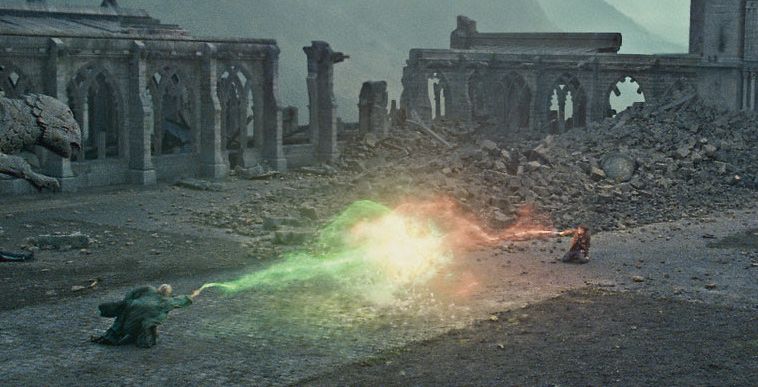
Wand battle magic as seen in Harry Potter films, Image: Warner Bros.
This effect could look similar to wand battles, as they appear in the Harry Potter films, where two beams of magic meet in the middle.
The display track facilitates movement in the z-plane towards or away from the user as demonstrated by arrows (46)… The ability of the multi-layer display system (16) to shift towards a certain user in the z-plane facilitates communication of battle information to the user (e.g. user recognition of progress, how well the user is performing the associated movements, and status of user in battle in a battle scenario)…
Another possible concept from the document would include a transparent OLED screen within the central metallic glass layer. This could display instructions or user score data, almost like a head’s up display in a video game.
This on-screen data might be useful in a single-player implementation, but a see-through screen layer could also be used to add additional energy effects visible to each of the players in a battle scenario.
The patent description contains multiple instances of how this effect could be achieved, including the use of real electricity and/or special effects.
The visible energy emission effect could be “plasma bolts,” or other “visible energy effects, such as light beams, electrical effects, lighting effects, media projection effects, augmented reality effects, pyrotechnics, vapor effects, or any combination thereof.”
The energy emitter, in an embodiment, may include a Tesla coil gun that, in operation, emits visible energy bolts or arcs, e.g., referred to as the plasma bolts, using a double-tuned resonant transformer to produce high voltages at low currents.
The energy beam would be absorbed by the metallic transparent layer between two users in a battle scenario, or in front of a target during a single-user scenario. This special multiple-layer plane could contain a layer for absorbing the energy, a layer for helping to direct where the energy hits the target, as well as a transparent screen, as described above.
Figure 5 illustrates a possible single-player scenario, where the user would cast magic onto a prop or within an interactive environment.
…the user may interact to emit energy towards the show prop. The show prop can include a robotic device, display screen, special effect system, or any combination thereof that produces a special effect audibly, haptically, visually, or otherwise.
The document says this energy beam concept could be used to “further immerse the guest within the particular attraction, ride, or interactive experience.”
Maybe we could see it used as a special effect within the new ride we believe is coming to Epic Universe, or maybe utilized within the theater show, or even some interactive experiences around the land.
What do you think? Is this the next evolution of the interactive wand controlled window effects currently seen in Hogsmeade and Diagon Alley, or would something like this only be utilized within a special show or on a ride?
Or have I been reading this all wrong, and it’s for an interactive Ghostbusters experience instead!? Leave a comment with your thoughts. And check out today’s video for more details on this patent.
That’s all for now, but if you’d like to bring a piece of the parks home, Souvenir Scents has candles and wax melts that smell like the Butterbeer, the ET ride, and even HHN houses. Save 15% off every order with my promo code PARKSTOP at SouvenirScents.com.
Subscribe to the news feed or enter your email address below to never miss an update. Patent Images: U.S. Patent and Trademark Office | Other Images as Captioned
Consider supporting us on Patreon for as little as $1/month. All patrons receive behind the scenes posts and exclusive podcasts. Learn More
This guided tour of London takes you to key filming locations around the city as well as real-life spots that inspired some of the best-loved places in the series including Diagon Alley, the Leaky Cauldron, and the Ministry of Magic.
Starts from £17 per person.
Tour for Muggles – London (Tripadvisor)
Fully Guided Tour of Warner Bros Studio Tour London – The Making of Harry Potter – London
Make the most of a personalised guided tour of Warner Bros Tour Studio London with a small group of up to eight people. You’ll get to hear behind-the-scenes stories, look at magical artifacts from the films and re-create the famous scene on Platform 9 3/4 beside the Hogwarts Express. The price includes train tickets from London to the Warner Bros Studio.
Starts from £155 per person.
Hogwarts Express and the Scenic Highlands Day Tour – Inverness
Enjoy some of Scotland’s most stunning scenery as you travel into the Highlands on this full-day guided tour from Inverness. Journey around Loch Ness and all the way to the west coast. You’ll see ancient ruins, a poignant war memorial, beautiful beaches and a hidden waterfall before boarding the classic Jacobite Steam Train, one of the world’s most scenic railways made famous by the Harry Potter movies.
Starts from £139 per person.
JK Rowling’s Harry Potter Walking Tour – Edinburgh
The city of Edinburgh features regularly in the ‘Harry Potter’ films and books, but unless you know where to look, it can be difficult to discover significant spots by yourself. Find out how the city inspired J. K. Rowling to write the books—and listen to trivia and gossip that you might normally miss—on a walking tour that offers an intimate glimpse into Scotland’s capital city.
Hogwarts Express and the Scenic Highlands Day Tour – Inverness (Tripadvisor)
See where Diagon Alley came to life, and where Lord Voldemort is buried, see the original Hogwarts school, as well as a virtual school assembly of its characters, and learn how Edinburgh’s own dark history of witches and wizards played a role in inspiring Rowling herself.
Get an inside look at the world of Harry Potter on this walking tour of Oxford. Accompany your guide inside the grand buildings of Oxford University, including New College and Divinity School—both used for Hogwarts in the films. Hear lesser-known stories about the filming, as well as context about
Oxford’s long history as a place of literary inspiration. A small group ensures an intimate experience and plenty of time for questions.
Oneida, N.Y. — The City of Oneida Parks and Recreation Department and Connected Community Schools will host a Harry Potter Movie and Activity night June 10 from 5:30-8:30 p.m. at the Kallet Civic Center, 159 Main St., Oneida.
The event is free and all ages are welcome. Families are welcome to enjoy a Harry Potter movie along with activities such as making wands and Hogwarts House bracelets.
Right now, if you buy Harry Potter gear from BoxLunch, you can save up to 50% off! So now is the time to buy that Hogwarts Classes Mini Backpack that has a fun print with Hogwarts classes on it.
Accio pen! How about a Wand Pen Set that lets you write with your own Harry Potter wand? You get a set of four pens designed to look like the wands of Hermione, Harry, Lord Voldemort, and the Elder Wand.
Okay, grab that apron and get ready to make some delicious wizard dishes. The Harry Potter Feasts Festivities Cookbook is on sale! This book includes Harry Potter-inspired recipes, crafts, and activities.
Need a place to stash all your favorite candies and treats? Then you need the Honeydukes Snack Jar that has the Honeydukes logo on it, along with artwork of various Honeydukes treats.
There are PLENTY of items you can get right now on sale, so be sure to head on over to BoxLunch to check them all out!
Heading to Universal Orlando soon? If you only have one day, here’s how you can do EVERYTHING in Harry Potter World in just that one day (and we’ve provided tips on how to make that happen).
A new online poster for the Harry Potter 20th Anniversary: Return To Hogwarts event on HBO Max was released today. The poster was revealed in a tweet from HBO Max, and it features many famous stars from the beloved series.
Daniel Radcliffe (Harry Potter), Rupert Grint (Ron Weasley), and Emma Watson (Hermione Granger) are front and center in the poster. Entertainment Tonightreports that this is the first time the trio has been together since the release of the eighth and final film in 2011. Also featured are James and Oliver Phelps (Fred and George Weasley), Tom Felton (Draco Malfoy), Evanna Lynch (Luna Lovegood), Alfred Enoch (Dean Thomas), Matthew Lewis (Neville Longbottom), and Bonnie Wright (Ginny Weasley).
Helena Bonham Carter, Robbie Coltrane, Ralph Fiennes, Jason Isaacs, Gary Oldman, and many others are set to appear for the Return To Hogwarts special. One notable absence from the special will be the creator of the Harry Potteruniverse herself, J.K. Rowling, who has likely been left out due to many controversial tweets that have upset the transgender community. Many members of the cast have maintained respect for Rowling, but they have denounced her controversial beliefs.
The first Harry Potterfilm was released in 2001, giving visual life to a series of bestselling books. The original film series ended in 2011, but the franchise continued with the Fantastic Beasts prequel series. The third film of that series, Fantastic Beasts: The Secrets of Dumbledore, will be released on April 15, 2022.
Return To Hogwarts is one of the many ways the 20th anniversary of the first Harry Potter film is being celebrated. We at The Nerd Stash have joined in the celebration with lists ranking the films, characters, and even a list comparing main characters to Christmas cookies.
Return To Hogwarts will stream on HBO Max on New Years Day. Are you Harry Potterfans looking forward to seeing the cast reunite after so long? Share your excitement in the comment section.
The first Harry Potter movie came out nearly 20 years ago and to celebrate the November anniversary, the Wizarding World will be releasing memorable moments from the first film for the rest of the year.
Each year on Sept. 1, the Wizarding World, the official digital hub for “Harry Potter” and “Fantastic Beasts” fans, celebrates the start of the magical school year with its annual “Back to Hogwarts” celebration. This year’s virtual journey, however, marks 20 years since “Harry Potter and the Sorcerer’s Stone” was released and started the epic eight-part movie series.
In celebration of 20 years of movie magic, the Wizarding World will highlight 20 epic moments from the film over the next four months. The moments will be released each week, along with games, quizzes and secrets from the crew. Kicking things off: Harry’s blizzard of acceptance letters and his first time at Platform Nine and Three-Quarters.
The Wizarding World will also be launching a “Harry Potter” quiz show later this year, to stream on HBO Max, Cartoon Network and TBS. Celebrities will be sorted into their very own Hogwarts house.
A live digital event hosted by superfan Yinka Bokinni kicked things off Wednesday, featuring an appearance by Tom Felton, who played the iconic Draco Malfoy.
Fall movie preview: The 10 most must-see movies, from ‘Dune’ to ‘Halloween Kills’
During the interview, Felton revealed his most memorable moment on the set.
“The set of The Great Hall was fantastic,” he said. “All of the cast’s reactions were genuine in that moment. We hadn’t seen it before, so it was a complete surprise.”
Catch one before summer ends:Catch a flick at 10 of the best drive-ins in the Northeastern United States
“Harry Potter and the Sorcerer’s Stone” recently passed the $1 billion mark at the global box office after China re-released the remastered film in 2020. It’s the second movie in the franchise to reach that status: “Harry Potter and the Deathly Hallows – Part 2,” the final chapter in the saga, earned $1.34 billion worldwide in 2011, according to Box Office Mojo.
On a July evening, Sadaf Jafar tries to call her cats in the hall of her tastefully decorated Lucknow home. Four Persian cats—Rani, Timur, Gabbu Singh and Bibbo, named after the character Jafar played in A Suitable Boy. Nonchalant, they wouldn’t come out of their cosy hiding. The hall has a tall cat tree with scratching posts. But the cats don’t scratch it, they scratch Sadaf and her two teenage children. “Cat moms,” the small family calls itself.
A teacher and single mother, Congress leader Jafar contested the recent assembly elections from Lucknow and was among the people who were jailed during the anti-CAA protests. Her daughter Kaunain Fatima has just completed Class 12th from La Martiniere, the city’s most prestigious school, and is now aiming for Delhi University. Kaunain loves Harry Potter, but not the “transphobic” JK Rowling. The girl, who has published poems in English, is associated with an organisation that has been fighting for the LGBTQ rights.
If there’s a family that effortlessly demolishes the stereotypes about the Muslims, it’s this. And if there’s a home that underlines the economic and cultural gap between the Ashrafs and the Pasmandas, it’s also this. For, at a little distance live a Pasmanda couple, Waqar Hawari and his wife Kahkasha, who speak for hours about their bitter experiences with the Ashrafs and even seem to find a poetic justice in Jafar’s electoral loss.
Related stories
Such rifts exist in other communities as well, but the BJP has sensed a space here to make inroads into the Muslim community. It has already shed the image of an upper caste party. According to a Lokniti-CSDS survey, of the total BJP’s Votes in 1996 LS elections, 49 percent came from upper castes, 33 percent from OBCs, 11 percent from SC and 7 percent from STs. In 2019, 30 percent of the party’s votes came from upper castes, 44 percent from OBCs, 16 percent from SCs and 10 percent from ST.
Having won over the OBC Hindus and thus weakened the Mandal parties, the BJP is now trying to reach out to the Muslims—perhaps the only community beyond the party’s electoral machine. Since the upper caste educated Muslims are the most vocal and articulate opponents of the BJP, it has trained its focus on the Pasmandas, a collective term for the OBC and the Dalit Muslims. The Pasmandas are astutely aware of it. “The BJP has seen that aligning with the Ashrafs doesn’t help as their community didn’t come to them. We Pasmandas want to talk only about our representation. We don’t want to raise any emotional or religious issues,” says Waqar Hawari, the Chief General Secretary of All Indian Pasmanda Mahaz.
The BJP’s project has begun from Uttar Pradesh where they inducted several Pasmanda leaders at key positions including Minority Commission Chairperson Ashfaq Saifi, Madarsa Board chairperson Iftikhar Ahmed Javed and Urdu Academy Chairperson Chaudhary Kaiful Wara. While the party didn’t give a single ticket to a Muslim candidate during the recent assembly elections, CM Yogi Adityanath has made Danish Ansari, a Pasmanda, Minority Welfare Minister. The representation of the Ashrafs is nearly zilch at key posts in the UP government.
BJP’s Minority Morcha chief Kunwar Basit Ali, though an Ashraf, has given 70 percent posts in his organisation to Pasmandas, who have also been the major beneficiaries of the government schemes.
“UP has 19.33 percent of Muslim population. As many as 39 percent beneficiaries of Pradhan Mantri Awas Yojana, 22 percent beneficiaries of toilet yojna, 37 percent beneficiaries of Ujjawala Yojna and 30 percent beneficiaries of Mudra Yojana are Muslims,” the Uttar Pradesh Chief Minister’s office told Outlook in a statement.
“Around 43 lakh homes were constructed under the Awas Yojna in the state in the last 5 years. Of these 20 lakh are for the Pasmandas only,” says Basit Ali. Even BJP’s opponents admit it. “Muslim could be 33 percent of the total beneficiaries of the housing scheme,” Waqar Hawari says. There are also government schemes like One District One Product (ODOP) that have benefitted more Muslims than Hindus, because of the sheer number of Muslim artisans.
The contestations
Several upper caste leaders term it eyewash. “What’s the big deal if you make a Muslim chairperson of the Urdu academy? If you want to give us representation, make a Muslim home minister. If the Pasmandas take this bait, nothing can help us,” says Sadaf Jafar, pointing out that the many shops of Muslims the government forcibly shut down were of the Pasmandas.
The BJP’s plan is obvious. “The whole Pasmanda initiative is a deliberate attempt to further fragment the already fragmented Muslim vote bank,” says Congress leader Yusuf Ahmad Ansari.
Sadaf Jafar and her daughter Kaunain at their Lucknow home. Outlook Photo/Ashutosh Bhardwaj
The divisions emerge from the long list of allegations the Pasmandas make—the Ashrafs caused the partition, Aligarh Muslim University was designed to exclude them and favour the Ashrafs, major community organizations like the All India Muslim Personal Law Board are dominated by the Ashrafs. And then they point out two infamous incidents on December 6—one was in 1992, the other in 2007 when some Syeds and Pathans assaulted low caste Ansaris and Mansuris over the right to pray and drove them out of their mosque in East Champaran district in Bihar. When the Pasmandas built a thatched mosque nearby, the upper caste Muslims damaged it.
Of the total 1288 faculties at the AMU in 2016, upper caste Muslims occupied 1138 or 88.35 percent posts, with OBC Muslims reduced to just 62 or 4.81 percent posts—even lesser than the 87 non-Muslim faculties.
The BJP is trying to exploit this sentiment, and upper caste Muslims are not unaware of it. “By raking up the partition and the AMU case, the Pasmandas are gifting a lethal argument to the BJP,” cautions a Syed leader in Lucknow.
While the Pasmandas are not aligned with the BJP, unlike the Ashrafs they don’t reject the BJP’s outreach. “2024 is very important for the BJP. As a professional party, it’d like to increase its voter base,” says Khalid Ansari, who teaches at Azim Premji university.
“The political sphere has some autonomy from the cultural and economic sphere. There’s a cultural project of the RSS. There’s a political project of the BJP, and there’s an economic project of the plutocrats like Adanis. They work together, but they also have some autonomy and there are course corrections as well,” he says.
If the academic Ansari is guarded, some Pasmanda leaders are upbeat. Hawari, who is as opposed to the hate campaign against Muslims as any of his community leader is, terms Narendra Modi’s call to reach out to weaker Muslims a “good move”. “The Ashrafs are worried for the first time. They are facing defeat. Most new posts in UP have gone to the Pasmandas. The BJP’s move can drastically improve our situation. It will scare the Ashrafs, and they will begin working for us,” he says.
But Hawari is also aware that the BJP’s scheme “can create a further divide in the Muslim community”. This, perhaps, is the BJP’s precise hope.
The party seems to have left the Pasmandas in a quandary. They can’t abandon their opposition to the BJP, but they can’t avoid welcoming the move either.
Challenges the BJP face
Among the Muslims appointed by the Yogi government is Tooraj Zaidi, the chairperson of the Fakhruddin Ali Ahmad Committee that looks after the promotion of Urdu, Arabic and Persian. The frail man quietly sips coffee at a Lucknow hotel and remembers the date he joined the BJP—November 11, 1993, “less than a year after the demolition of the Babri mosque”. “I was then among the few Muslim members in UP BJP. I brought 151 Shia families with me. When I joined, my effigies were burnt. My relatives became angry, boycotted me,” he says. A satisfaction now reflects in his voice, as his choice has finally paid off.
But he is aware that his party may not easily win the trust of a community it has considered its essential other for decades. Gau rakshaks and trolls don’t differentiate between the Ashrafs and the Pasmandas. “During elections you talk about 80 versus 20, of abbazan and mamazan. You insult them for wearing Hijab in Karnataka. First treat us with some dignity,” says Sadaf Jafar.
“A party that takes pride in not having a single Muslim representative is suddenly making an outreach. I don’t see anyone in Muslim community getting fooled by it,” says Congress’s Yusuf Ansari.
Basit Ali understands the crisis. He admits that while despite a large number of Muslim beneficiaries of various schemes, almost all of them poor, “only one lakh Pasmandas voted for the BJP in the recent elections”.
He wants his party “to also work on the dominant and powerful Ashrafs”. “The party should take them along. They will bring several other biradaris with them,” he says.
Some Muslim leaders in BJP also list a few communities that can be easily “won over”, including “converted Muslims” like Muslim Rajput, Muslim Jat and Muslim Gurjars, who are still closer to the Hindus in their practices and culture. They are politically powerful and hold influence over several weaker Muslims biradaris.
A sustained anti-Muslim campaign has enabled the BJP to consolidate its voters. It has to considerably tamper its stance to have a serious stab at the Pasmanda vote. Referring to the BJP’s Sneh Yatra, All India Pasmanda Muslim Mahaz president Ali Anwar underlines that Muslims want “samman (respect)” and not “sneh (affection)”, and asks Prime Minister Narendra Modi to rein in his party leaders who make objectionable remarks against Muslims.
Also, it’s not about some beneficiaries in housing schemes or posts at minority institutions, but about participation in governance and politics. While there is no reservation for the Dalit Muslims, a miniscule percentage of Muslims have been able to take the benefit of OBC reservation. A few years ago, Dalit Muslim Ejaz Ali had famously said: “Babri masjid le lo, Article 341 de do,” referring to Article 341 under which a community or caste can be classified as SC.
It will be a tall order for the BJP to secure the SC reservations for the Muslims, but if the political need to bring the Pasmandas to its fold forces the BJP to revise its stand, it may weaken the influential Ashrafs and may mark a new moment for Muslim politics.
Harry Potter: The Exhibition, a comprehensive museum exhibition, makes its world premiere at Philadelphia’s The Franklin Institute today, February 18.
The exhibit, which is slated to travel around the world, makes its debut in Philadelphia, on display now through September 18, 2022. Tickets with timed entry are required; adult tickets are $43, children are $39. Evening tickets for both children and adults are $30. Tickets also include access to the rest of The Franklin Institute.
Harry Potter: The Exhibition was created by Imagine Exhibitions in partnership with Warner Bros. Themed Entertainment to display the wonderful wizarding world, including the Fantastic Beasts series.
An 18,000 square-foot exhibit with 21 galleries, including Hogwarts Castle, Hagrid’s Hut, The Great Hall, the four Hogwarts Houses and more, guests can explore the interactive exhibit as if stepping into the school for the first time, choosing their Hogwarts house, wand and Patronus.
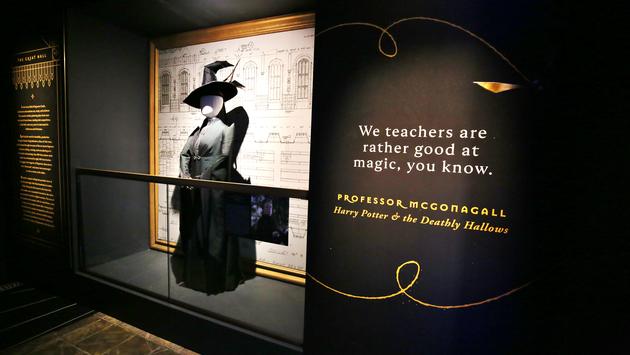
Interactions are personalized for each guest using RFID wristbands. The exhibit also includes artifacts from the movies and books, including an original first edition of Harry Potter and the Sorcerer’s Stone, iconic costumes and more. Guests can enjoy personalized moments with their chosen Hogwarts house professor, enjoy magical lessons and games and even interact with centaurs in the Forbidden Forest.
Minerva McGonagall’s original movie costume is displayed as part of Harry Potter: The Exhibition at the Franklin Institute. (photo via The Franklin Institute)
“Harry Potter: The Exhibition brings iconic moments that are beloved by fans across the world to life in an immersive and innovative way, providing an experience like none other, and we are thrilled that The Franklin Institute is the first to host this incredible exhibition,” said Larry Dubinski, president and CEO of The Franklin Institute.
Merchandise will also be available for purchase, ranging from wands, apparel and jewelry to butterbeer and chocolate frogs, as well as artwork from the movies.
For more information on the exhibition’s next locations or to purchase tickets, please click here.